
The rapid growth of online shopping has transformed the way businesses connect with customers. More entrepreneurs than ever are launching online stores to expand their reach, build stronger brands, and generate sustainable revenue. Among the many eCommerce platforms available today, Amazon and Shopify continue to stand out as two of the most popular options for selling products online.
Although both platforms help businesses sell online, they serve very different purposes. Amazon gives sellers access to one of the world’s largest online marketplaces with millions of active shoppers, while Shopify allows businesses to create and manage their own branded online stores. Choosing between the two depends on your goals, budget, and long-term business strategy.
If you’re unsure which platform is the right fit, this guide compares Amazon and Shopify across key areas to help you make an informed decision.
Amazon vs. Shopify: What’s the Main Difference?
At first glance, Amazon and Shopify may appear to offer similar services because both allow businesses to sell products online. However, their business models are fundamentally different.
Amazon operates as an online marketplace where customers visit specifically to browse and purchase products. Sellers list their products alongside competitors and benefit from Amazon’s existing traffic, trusted reputation, and built-in customer base.
Shopify, on the other hand, is an eCommerce platform that enables businesses to build their own independent online stores. Instead of selling within a marketplace, merchants create a branded shopping experience where they have complete control over their website, design, customer relationships, and marketing strategies.
This distinction is important because each platform serves different business needs. Amazon is ideal for sellers looking to gain immediate exposure to shoppers, while Shopify is better suited for businesses focused on building a long-term brand with greater ownership and flexibility.
Let’s compare some of the most important differences.
Fulfillment and Shipping
Order fulfillment plays a major role in customer satisfaction and business growth. Fast delivery, secure packaging, and reliable customer service all contribute to positive shopping experiences.
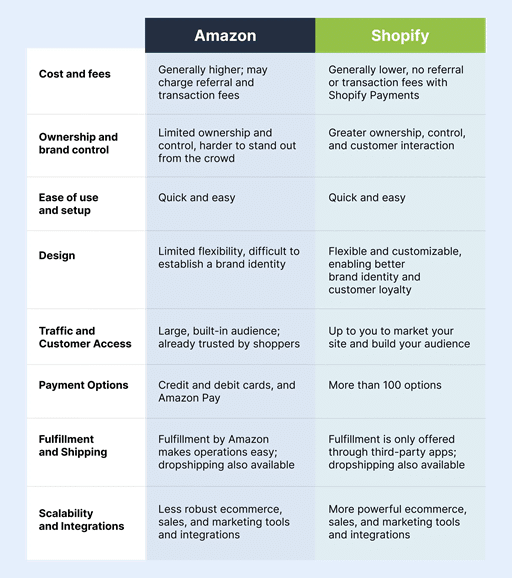
One of Amazon’s biggest advantages is Fulfillment by Amazon (FBA). Through FBA, sellers send inventory to Amazon’s fulfillment centers, and Amazon takes care of storage, picking, packing, shipping, returns, and much of the customer support. This allows businesses to scale more efficiently without managing logistics themselves. Products fulfilled through FBA can also qualify for Prime shipping, giving customers access to fast delivery that often encourages more purchases.
Shopify also offers fulfillment solutions through its ecosystem of shipping partners and third-party logistics providers. Merchants can integrate fulfillment services directly into their stores, making inventory and order management more streamlined. While these solutions have improved significantly, Amazon’s fulfillment network remains one of the most extensive and efficient in the eCommerce industry, particularly for businesses that prioritize speed and nationwide distribution.
For sellers who want a hands-off fulfillment process, Amazon currently provides a more mature logistics infrastructure, whereas Shopify offers greater flexibility by allowing merchants to choose fulfillment partners that best fit their business model.
Conversion Rate Optimization
Generating traffic is only part of the equation—converting visitors into paying customers is what ultimately drives revenue.
Amazon has built its marketplace around maximizing conversions. Shoppers typically visit Amazon with the intention of making a purchase, resulting in higher buying intent compared to many standalone online stores. If your product listings are properly optimized with relevant keywords, compelling images, competitive pricing, and positive customer reviews, your chances of converting visitors into customers increase significantly.
With Shopify, businesses have complete control over the customer experience, but attracting and converting visitors requires more effort. Store owners need to invest in SEO, content marketing, paid advertising, email campaigns, and social media to generate qualified traffic. They must also optimize their website’s design, navigation, product pages, and checkout process to improve conversion rates.
While Shopify offers greater customization and branding opportunities, achieving high conversion rates often takes more time and continuous optimization. Amazon, by comparison, benefits from an established marketplace where customers are already prepared to buy, making it easier for many sellers to generate sales quickly.
Amazon vs. Shopify Pricing: Which Platform Is More Cost-Effective?
Understanding the pricing structure of each platform is essential before deciding where to sell. While both Amazon and Shopify require an investment, their fee structures are very different.
Amazon offers two primary selling plans:
Individual Selling Plan
The Individual plan is designed for businesses that sell fewer than 40 products each month. Instead of a monthly subscription, sellers pay a fee for every item sold, making it a practical option for beginners or those testing the marketplace before scaling.
Professional Selling Plan
For businesses expecting higher sales volumes, the Professional plan includes a monthly subscription fee and provides access to advanced selling tools, advertising features, detailed reports, and bulk listing capabilities. Sellers using Fulfillment by Amazon (FBA) should also account for additional fulfillment, storage, and referral fees, which vary based on product size, weight, and category.
Shopify Pricing Plans
Shopify offers multiple subscription plans designed to support businesses at different stages of growth.
Basic Shopify
The Basic plan is well suited for new businesses launching their first online store. It includes essential eCommerce features such as a fully hosted website, secure checkout, product management, discount codes, basic reporting, and customer support. Businesses that use payment gateways other than Shopify Payments may also incur additional transaction fees.
Shopify
The standard Shopify plan is ideal for growing businesses that require additional reporting tools, more staff accounts, gift card functionality, and improved shipping discounts. It offers greater flexibility for businesses managing larger inventories and increasing sales volumes.
Advanced Shopify
The Advanced plan is built for established businesses with higher sales volumes. It includes advanced reporting, custom report generation, third-party shipping rate calculations, and lower transaction fees for merchants not using Shopify Payments.
In addition to these plans, Shopify also offers enterprise-level solutions for large businesses and starter options for entrepreneurs looking to sell through social media or existing websites.
Overall, Shopify provides predictable monthly pricing and the flexibility to choose features that align with your business needs. Amazon’s costs, on the other hand, vary depending on sales volume, fulfillment method, storage requirements, and product category. Before committing to either platform, it’s important to estimate your total selling costs and expected profit margins.
Amazon vs. Shopify: Which Platform Is Easier to Use?
Ease of use is another important consideration, especially for first-time online sellers.
Amazon offers a relatively straightforward setup process. After creating a seller account and listing your products according to Amazon’s requirements, you can begin selling almost immediately. If you use FBA, Amazon also handles storage, shipping, returns, and much of the customer service, allowing you to focus primarily on sourcing products and growing sales.
Shopify requires more initial setup because you’re building your own online store rather than joining an existing marketplace. You’ll need to choose a theme, customize your website, configure payment methods, organize product collections, and optimize your store for customer experience. While Shopify’s interface is beginner-friendly, creating a polished, high-converting storefront typically requires additional time and effort.
The better choice depends on your business objectives. If you want to start selling quickly with minimal setup, Amazon offers the faster path. If your goal is to create a unique online brand with complete design and marketing control, Shopify provides far greater flexibility despite the longer setup process.
Shopify: Advantages and Disadvantages
Like any eCommerce platform, Shopify has strengths and limitations. Understanding both can help determine whether it’s the right fit for your business.
Advantages of Shopify
Fully Customizable Online Store
One of Shopify’s greatest strengths is the ability to create a professional, branded storefront. Businesses can choose from a wide range of themes, customize layouts, and deliver a shopping experience that reflects their brand identity.
User-Friendly Platform
Shopify simplifies website management by combining hosting, security, software updates, and store management into one platform. Its intuitive dashboard makes it easier for merchants to manage products, inventory, and customer orders without extensive technical knowledge.
Reliable Performance and Security
As a hosted solution, Shopify takes care of server maintenance, security updates, backups, and PCI compliance. This allows merchants to focus on growing their business rather than managing technical infrastructure.
Extensive App Integrations
Shopify’s App Store includes thousands of integrations that allow businesses to expand functionality. Whether you need email marketing, accounting software, inventory management, customer loyalty programs, or advanced analytics, Shopify offers integrations for almost every business requirement.
Mobile-Optimized Shopping Experience
Modern consumers increasingly shop using smartphones and tablets. Shopify themes are designed to be mobile responsive, ensuring customers enjoy a seamless shopping experience across all devices.
Excellent Customer Support
Shopify provides round-the-clock customer support through multiple channels, including live chat, email, and phone support. This gives merchants access to assistance whenever technical or operational issues arise.
Disadvantages of Shopify
While Shopify offers a powerful platform for building an online store, there are a few limitations that businesses should consider before getting started.
Monthly Costs Can Add Up
Although Shopify offers flexible pricing plans, the overall cost of running a store can increase over time. In addition to the monthly subscription, merchants may pay payment processing fees, transaction fees (if using a third-party payment gateway), premium theme costs, and charges for paid apps or advanced features. As your business grows, these expenses can become a significant part of your operating budget.
Learning Curve for Beginners
Shopify is designed to be user-friendly, but new users may still need time to become familiar with the platform. Understanding store settings, themes, product organization, apps, SEO settings, and customization options requires some learning, particularly for those with little eCommerce experience.
Store Setup Takes Time
Launching a Shopify store involves more than simply uploading products. Merchants need to design their storefront, configure payment and shipping settings, organize collections, optimize product pages, and create a seamless customer experience. While Shopify provides templates to simplify the process, building a polished online store still requires planning and effort.
Selling on Amazon: Pros and Cons
Amazon remains one of the largest online marketplaces in the world, making it an attractive option for businesses of all sizes. However, like any selling platform, it has both advantages and challenges.
Advantages of Selling on Amazon
Instant Access to Millions of Shoppers
One of Amazon’s biggest strengths is its enormous customer base. Instead of spending months building website traffic, sellers can immediately showcase their products to shoppers who are already searching with the intent to buy. This built-in audience can help businesses generate sales much faster than launching a standalone online store.
Quick and Simple Setup
Getting started on Amazon is relatively straightforward. After creating a seller account and listing your products according to Amazon’s guidelines, you can begin selling without building a website or managing complex technical settings. This makes Amazon especially appealing for first-time sellers.
Strong Customer Trust
Consumers recognize Amazon as one of the most trusted names in eCommerce. Many shoppers feel more comfortable purchasing from Amazon than from unfamiliar online stores, which often leads to higher conversion rates for sellers.
Fulfillment by Amazon (FBA)
Fulfillment by Amazon simplifies logistics by handling storage, packing, shipping, customer service, and returns on behalf of sellers. Products fulfilled through FBA are also eligible for Prime shipping, making them more attractive to millions of Prime members who expect fast and reliable delivery.
Active Seller Community
Amazon offers a large community of sellers who regularly share advice, experiences, and best practices through forums and discussion groups. Whether you’re troubleshooting an issue or learning new selling strategies, the seller community can be a valuable resource.
Strong Search Visibility
Optimizing your product listings for Amazon’s search algorithm can significantly improve product visibility. Well-optimized listings with relevant keywords, compelling titles, informative descriptions, and quality images have a better chance of appearing in search results and attracting more customers. In many cases, Amazon product pages may also appear in Google search results, creating additional opportunities for visibility.
Disadvantages of Selling on Amazon
Limited Access to Customer Data
One of the biggest drawbacks of selling on Amazon is the limited customer information available to sellers. Since Amazon owns the customer relationship, merchants have very little access to buyer contact details, making it difficult to build email lists, develop loyalty programs, or market directly to previous customers.
Intense Competition
Amazon is an extremely competitive marketplace. Sellers often compete with thousands of other businesses offering similar products, including well-established brands and Amazon’s own private-label products. Price competition can be particularly challenging, making it difficult for smaller businesses to maintain healthy profit margins.
Limited Branding Opportunities
Although Amazon has introduced features such as Brand Stores and enhanced product content, sellers still have relatively little control over the overall shopping experience. Product pages follow standardized layouts, leaving limited room for customization. Businesses focused on building a distinctive brand identity may find Shopify offers far greater creative freedom and long-term branding opportunities.
Amazon vs. Shopify: Which Platform Should You Choose?
Choosing between Amazon and Shopify doesn’t have to be an either-or decision. In fact, many successful eCommerce businesses use both platforms to maximize their reach and revenue.
Amazon offers immediate access to millions of active shoppers, making it an excellent choice for businesses that want to generate sales quickly. Shopify, on the other hand, provides complete control over your online store, branding, and customer relationships, making it ideal for building a long-term business.
For new sellers, Amazon often provides the fastest path to market because you can leverage its established customer base and trusted reputation. As your business grows, launching a Shopify store allows you to strengthen your brand, own your customer experience, and diversify your sales channels.
Instead of relying entirely on one platform, many businesses achieve the best results by combining the strengths of both.
When Should You Sell on Amazon?
Amazon may be the better option if you:
- Are launching a new business without an existing customer base.
- Want to start selling with minimal setup and technical knowledge.
- Prefer a marketplace that already attracts millions of ready-to-buy customers.
- Want to simplify logistics by using Fulfillment by Amazon (FBA).
- Don’t mind competing with other sellers in exchange for greater marketplace exposure.
When Should You Choose Shopify?
Shopify is a strong choice if you:
- Want complete control over your website and brand identity.
- Plan to build long-term customer relationships.
- Are willing to invest time in marketing your own online store.
- Prefer customizing your storefront and shopping experience.
- Already have an audience or are prepared to generate traffic through SEO, social media, email marketing, or paid advertising.
Can You Use Amazon and Shopify Together?
Absolutely. Many businesses choose to integrate Amazon with Shopify to enjoy the benefits of both platforms.
By selling on Amazon, you can tap into a massive marketplace filled with high-intent shoppers. At the same time, Shopify enables you to create a professional branded website where you control the customer experience and build long-term loyalty.
Managing both channels together also helps diversify your revenue. Rather than depending on a single platform, you can reach customers wherever they prefer to shop while maintaining greater flexibility as your business grows.
For many brands, a multi-channel selling strategy offers the best balance between immediate sales and sustainable business growth.
Final Thoughts
Both Amazon and Shopify are powerful eCommerce platforms, but the right choice depends on your business goals.
If your priority is reaching customers quickly and generating sales with minimal setup, Amazon offers a significant advantage through its established marketplace and fulfillment network.
If you’re focused on creating a recognizable brand, owning your customer relationships, and building a customized online shopping experience, Shopify provides the flexibility and control you need.
For many businesses, the most effective strategy isn’t choosing one platform over the other—it’s using both together. Amazon can help drive immediate sales and brand visibility, while Shopify serves as the foundation for long-term brand growth and customer retention.
By understanding the strengths of each platform and aligning them with your business objectives, you can build a scalable eCommerce strategy that supports both short-term success and long-term growth.