
If Amazon were a baseball field, every seller would be swinging hard to beat the competition. Today, cross-selling and upselling have become two of the most powerful methods to increase visibility and drive more conversions on the platform.
New sellers often struggle to get noticed because of massive competition, and this slows down growth. Aside from boosting brand recognition, these techniques can significantly increase profit margins.
By applying cross-selling and upselling strategically, you can boost both your Average Order Value (AOV) and Customer Lifetime Value (CLV), while giving customers personalized solutions that make their shopping experience smoother and more satisfying. Sounds like a win-win, right? Let’s explore the most effective ways to use these strategies successfully on Amazon.
Cross-Selling and Upselling on Amazon — What Do They Add to Your Business?
At a basic level:
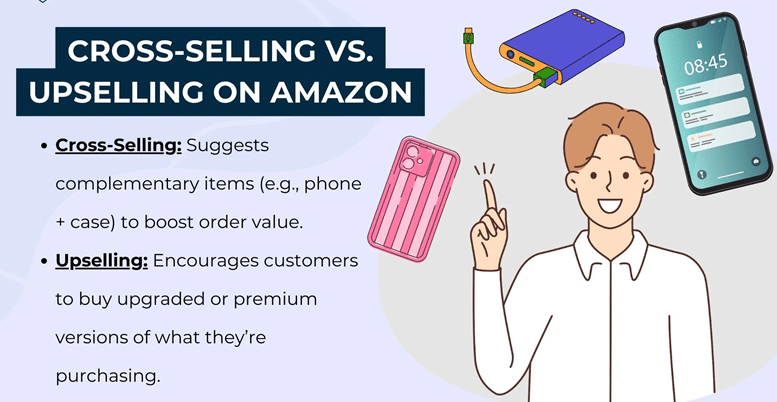
- Upselling encourages shoppers to buy a higher-end or upgraded version of the item they’re already considering.
- Cross-selling promotes additional products that complement the main item in a customer’s cart.
In simpler terms, upselling increases the value of a single purchase, while cross-selling increases the number of items bought together.
How to Recognize Cross-Selling on Amazon
A common example is when someone clicks on a digital camera. On the product page, Amazon displays suggestions like memory cards, lens protectors, or spare batteries under labels such as “Frequently Bought Together” or “Customers Also Bought.” These complimentary items are classic cross-selling products.
How to Recognize Upselling on Amazon
If a shopper views a laptop, Amazon may show the same model but with additional features—like more RAM or upgraded storage. This subtle nudge toward a premium option is an example of upselling, giving customers a better version of what they already want.
What Makes Cross-Selling and Upselling Conceptually Different?
| Points | Upselling | Cross-selling |
| Aim | Boosts AOV by increasing the value of the main purchase | Boosts AOV by increasing total items purchased |
| Experience | Focuses on enhancing performance of the primary product | Enhances overall experience with complementary items |
| User Intent | Customer already wants the main product | Customer wasn’t planning to buy extras but finds suggestions useful |
Both aim to increase revenue, but they do so by targeting different customer motivations.
Benefits of Implementing Cross-Selling and Upselling on Amazon
Upselling Benefits
- Promotes premium products to high-intent buyers
- Increases repeat purchase likelihood
- Generates more revenue per order
Cross-Selling Benefits
- Highlights useful additional items customers may overlook
- Reduces search time by presenting logical bundles
- Helps improve customer satisfaction and retention
Hybrid Approach: Using Both Cross-Selling & Upselling
Combined, these methods help sellers grow AOV and ROI. Over time, they lower customer acquisition costs and increase CLV since existing customers continue to buy more frequently and at higher values.
How to Implement Effective Cross-Selling & Upselling Strategies on Amazon
Whether you run a small store or a large brand, these tactics help you outperform competitors. Here’s where to begin:
Understand Your Customer Base
Start by learning what your customers want and how they behave. This is the foundation of a strong cross-selling and upselling strategy.
Leverage Amazon Data
Use Business Reports and other analytics inside Seller Central to understand purchase behavior, browsing patterns, and demographics. These insights help refine your marketing and product positioning.
Create Detailed Buyer Personas
Research shows that brands using defined buyer personas improve their targeting significantly. The data you gather can optimize your listings, keyword strategy, and marketing efforts while strengthening your upselling and cross-selling tactics.
Track Customer Engagement Carefully
Amazon metrics such as click-through rate, page views, and purchase frequency reveal how shoppers interact with your listings. This helps you time your upsell or cross-sell efforts more effectively.
Identify Customer Pain Points
By analyzing customer reviews and feedback, you can discover product limitations or desires. These insights help you create upgraded versions to upsell or develop accessories to cross-sell.
For example, if customers complain about short battery life, you may offer a higher-capacity model (upsell) or launch a compatible power bank (cross-sell).
Use Personalized Recommendations
You can add relevant keywords and descriptions aligned with shopper search behavior. With Amazon product-targeting ads, brands can showcase premium versions or complementary products directly to interested buyers.
For instance, a brand selling retinol serum can target customers with an eye cream to increase AOV through cross-selling.
Optimize Product Listings
Strong product listings—with high-quality images, compelling titles, and strategic keywords—play a major role in boosting visibility and increasing conversions.
Example:
A new leather brand, Mirage, improved its product photos, rewritten features, and strengthened keyword placement. These updates boosted visibility, supporting both upselling and cross-selling strategies.
Monitor and Adjust Strategies
Using Seller Central analytics, sellers can measure conversions, CTR, and customer behavior. This helps refine offers, recommendations, or product bundles for better performance.
Example:
MCB Electronics tracks that smart speakers and smart bulbs are frequently purchased together. Using this insight, they improve product pairing strategies to increase AOV.
Advanced Strategies for More Effective Upselling & Cross-Selling
Use Strategic Timing for Offers
Seasonal promotions—such as holiday sales or major events—create the perfect opportunity for upsell or cross-sell offers. Customers are more willing to purchase additional gifts during festive seasons.
Bundle deals during events like Christmas or New Year often outperform regular promotions.
Dynamic Pricing
Adjusting prices based on demand helps maximize sales during high-traffic periods.
Example:
A clothing brand discounts denim products during the Fourth of July, increasing traffic and revenue without harming the brand.
A/B Testing for Better Optimization
A/B testing different promotional approaches helps you understand which strategy resonates most with your audience.
Consider testing:
- Bundles
- Coupons
- Discounts
- Free samples
Tracking key metrics such as conversion rate and AOV ensures you stay data-driven and adaptive.
Offer Bundle Deals
Product bundles give buyers everything they need in one package—saving them time and boosting your AOV. For example, a camera bundle with lenses and memory cards encourages customers to buy more at a better perceived value.
Final Thoughts
To succeed on Amazon, sellers must stay aligned with customer expectations and aim for consistent improvement. While Amazon provides plenty of data through Seller Central, taking your analysis deeper allows you to perfect your strategy.
Although market trends may shift, consistent cross-selling and upselling efforts strengthen product discoverability and maximize revenue. Make the most of available Amazon tools to enhance performance and increase your AOV.