
As an Amazon vendor, it can be confusing to see why some products receive steady purchase orders while others slowly fade away. One major reason behind this difference is Amazon Net PPM, also known as Amazon Net Pure Profit Margin—a metric many vendors overlook, despite how critical it is.
Amazon relies on Net PPM to measure how profitable your products truly are after accounting for costs, discounts, and vendor agreements. It’s not just a definition—it’s a formula-driven evaluation that directly influences replenishment decisions. If your Amazon Net PPM drops too low, Amazon may stop ordering your product altogether, triggering what vendors commonly call CRaP-out (Can’t Realize a Profit).
While the term may sound amusing, the consequences are anything but. This is why the Amazon Net PPM report plays a vital role in performance reviews and vendor discussions.
The positive news is that Amazon Net PPM is not fixed. Vendors can actively influence it. By understanding how Amazon calculates Net PPM and taking smart actions—such as optimizing COGS, refining pricing, renegotiating trade terms, and managing promotions more strategically—you can improve profitability and remain in Amazon’s favor.
What Is Amazon Net PPM?
Amazon Net PPM, short for Net Pure Profit Margin, is the primary profitability metric Amazon uses to evaluate vendor performance at both the ASIN and account level. It is also commonly referred to as Procurement Margin.
When Amazon identifies a product with weak profitability, it is flagged as low margin within Vendor Central analytics. If Net PPM falls below internal category thresholds—often around 25%—Amazon may reduce order volume or push vendors to improve cost structures or trade terms.
In simple terms, Amazon Net PPM represents the percentage of profit Amazon earns from selling a vendor’s product. For vendors, understanding and managing this metric is essential to maintaining a strong working relationship with Amazon and securing favorable negotiations.
Now that we’ve clarified the Amazon Net PPM meaning, let’s explore how it’s calculated.
How to Calculate and Analyze Amazon Net PPM
Amazon Net PPM shows how much profit Amazon retains after accounting for product costs, vendor incentives, and customer discounts.
Key Inputs Required for Amazon Net PPM Calculation
Before calculating Net PPM, vendors need access to the following data points:
Average Selling Price (ASP) / Shipped Revenue
This refers to the total revenue Amazon generates from selling the product.
Cost Price / Shipped COGS
This is the price Amazon pays the vendor for the product.
Vendor Terms (Contra-COGS)
These are incentives or credits vendors provide to Amazon that reduce the effective cost. Examples include co-op marketing funds, trade investments, freight allowances, or volume-based accruals.
For instance, if a vendor offers Amazon a per-unit marketing credit or a quarterly rebate based on sales volume, these contributions increase Amazon’s margin without changing invoice pricing.
Sales Discounts
These include coupons, Lightning Deals, Best Deals, Prime Day promotions, Subscribe & Save discounts, and other price reductions offered to customers. These discounts reduce Amazon’s margin and are factored into Net PPM.
Amazon Net PPM Formula (Single ASIN)
Amazon Net PPM
= (ASP – Cost Price + Vendor Terms – Sales Discounts) ÷ ASP × 100
Example Calculation
- Average Selling Price: $49.99
- Cost Price: $30.00
- Vendor Terms: $2.00
- Sales Discounts: $1.50
Calculation:
(49.99 – 30.00 + 2.00 – 1.50) ÷ 49.99 × 100
= 40.98%
This means Amazon earns a 40.98% Net PPM on this ASIN.
Amazon Net PPM Formula (Vendor Account Level)
At the account level, the formula remains the same but uses shipped revenue and shipped COGS instead of per-ASIN values.
Note: Amazon Net PPM does not include advertising spend, chargebacks, or payment terms, as these are reflected later in Amazon’s internal P&L.
Why Amazon Net PPM Matters for Vendors
Amazon Net PPM is one of the most influential metrics affecting a vendor’s success. Here’s why it matters.
1. Net PPM Drives Vendor Negotiations
Amazon closely reviews Net PPM during quarterly and annual business reviews. Vendors with strong margins—typically 40% for hardlines and 30% for consumables—are more likely to receive favorable terms.
Low PPM often leads Amazon Vendor Managers to request cost reductions, revised trade terms, or pricing adjustments. A healthy Net PPM strengthens your position in category-level discussions and helps ensure your SKUs remain prioritized.
2. Preventing CRaP-Out
Products with consistently low profitability may be flagged as CRaP, leading to serious consequences such as:
- Reduced or removed A+ content
- Loss of promotional or advertising eligibility
- Fewer or no new purchase orders
In severe cases, Amazon completely stops ordering the product.
If you suspect a SKU is being CRaP’d:
- Review cost structure and vendor terms
- Speak directly with your Vendor Manager
- Reduce packaging or shipping costs
- Consider moving the SKU to Seller Central (3P model)
3. Supporting Smarter Vendor Decisions
Net PPM insights help vendors identify underperforming products, adjust pricing, renegotiate terms, and refine promotional strategies.
Tracking Net PPM over time allows vendors to understand the real impact of discounts and avoid margin erosion caused by excessive promotions.
How Amazon’s Profitability Impacts Your Business
Amazon’s profitability directly determines whether your products are stocked, promoted, or discontinued.
Amazon as a B2B Partner
Amazon operates as a wholesale buyer. If a product fails to generate sufficient profit, Amazon has little incentive to continue carrying it. Net PPM reveals whether a SKU is worth keeping in Amazon’s catalog.
Operational Consequences
- Strong margins = stable POs and visibility
- Declining margins = stricter terms or reduced orders
While Net PPM doesn’t include operational costs, vendors must still balance it with logistics efficiency, packaging optimization, and pricing sustainability.
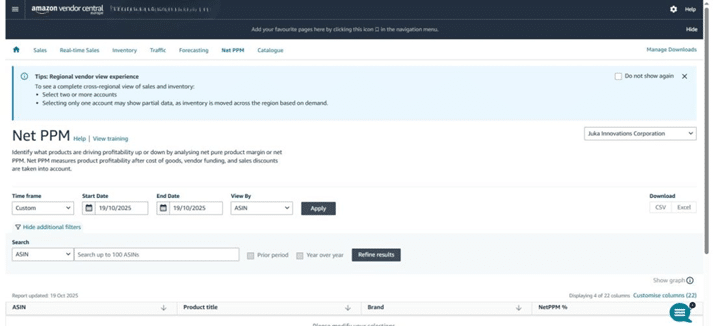
Where to Find Amazon PPM in Vendor Central
To access Net PPM data:
- Log in to Vendor Central
- Navigate to Reports
- Select Retail Analytics
- Click on Net PPM from the top menu
- Choose your date range and export format
- Download the report
Note: Vendor Central Net PPM may differ slightly from figures shared by your Vendor Manager.
What Is a Good PPM?
Amazon’s Net PPM benchmarks vary by category:
- Hardlines: ~40% or higher
- Consumables: ~30% or higher
- Media & Gaming: ~20–25%
Meeting or exceeding these thresholds improves Amazon’s willingness to invest in your products.
Proven Strategies to Improve PPM
1. Reduce Cost of Goods Sold (COGS)
Lowering COGS directly improves Net PPM. Vendors can renegotiate supplier pricing, optimize freight routes, or use regional fulfillment centers to reduce costs.
Even a $1 reduction per unit can significantly increase profitability.
2. Renegotiate Vendor Terms
Vendor terms contribute positively to Amazon’s margin. Reviewing co-op funds, accruals, and promotional investments ensures they align with profitability goals.
Strategic renegotiation can lift low-performing SKUs above Net PPM thresholds.
3. Improve Pricing & Discount Strategy
- Monitor competitors to stay competitive without underpricing.
- Adjust prices carefully to increase per-unit margin without hurting demand.
- Avoid excessive discounts that erode profitability.
- Use strategic promotions on high-margin SKUs to boost volume safely.
4. Optimize Your Product Portfolio
Regularly review SKUs and focus on high-margin products. Discontinue or rework items that consistently fall below acceptable Net PPM levels.
Shifting focus to top-performing products can significantly improve overall account health.
5. Improve Operational Efficiency
High return rates, bulky packaging, or inefficient logistics can indirectly raise CRaP-out risk. Bundles and multipacks can increase order value and margins.
6. Track Net PPM Consistently
Monitor Net PPM weekly or monthly to catch negative trends early. Ensure new products launch with optimized pricing and balanced trade terms from day one.
Final Thoughts
PPM is not just another metric—it’s a safeguard for your long-term success as a vendor. Maintaining a strong Net PPM keeps your products visible, ordered, and prioritized while strengthening your negotiation power.
By understanding how Amazon evaluates profitability and taking data-driven action, vendors can prevent CRaP-out, optimize product strategy, and build a sustainable partnership with Amazon.