Are you putting significant time and effort into optimizing your Amazon advertising campaigns but still not seeing meaningful growth in sales? It’s frustrating to adjust bids, refine keywords, and add negatives—only to watch performance stay flat, but now when implementing ASIN matrix.
The reality is that not every campaign should be managed the same way.
If your sales feel stuck despite continuous optimization, it may be time to rethink your strategy. A more structured and data-driven approach can make all the difference.
That’s where the Amazon ASIN Matrix comes in.
The ASIN Matrix provides a strategic framework that helps sellers evaluate products based on sales performance and product lifecycle stage. Instead of treating every ASIN equally, this method helps you prioritize what truly deserves attention and budget.
If you’re ready to break the cycle of stagnant PPC results, implementing the Amazon ASIN Matrix can transform how you allocate ad spend and scale performance. By focusing on your top-performing ASINs and managing underperformers strategically, you can unlock stronger and more consistent growth.
What Is an ASIN Matrix?
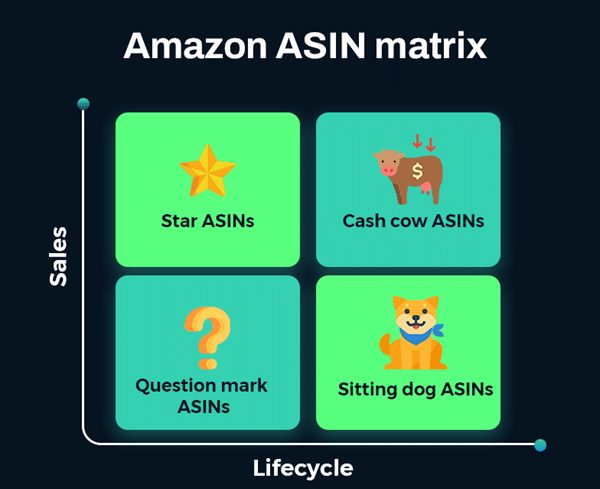
The ASIN Matrix is a portfolio management system that helps brands categorize their products based on profitability and performance. It enables sellers to prioritize ASINs according to their lifecycle stage and revenue potential.
The matrix consists of four quadrants:
- Star ASINs
- Cash Cow ASINs
- Question Mark ASINs
- Sitting Dog ASINs
These categories are determined by comparing average sales performance with product lifecycle stage. Each group behaves differently, which means each requires a tailored advertising and optimization approach.
When you classify your products into these four groups, it becomes much easier to determine where to invest, where to optimize, and where to reduce spending.
Below is a breakdown of each ASIN type and how you can improve performance using PPC strategies.
Star ASINs
Star ASINs are newly launched or relatively young products generating above-average sales. These items show strong growth momentum and high marketplace potential.
Because they are already performing well, they present a major opportunity for scaling.
Advertising Strategy for Star ASINs
With Star ASINs, your objective should be rapid expansion and high visibility.
Focus on reaching highly relevant audiences through:
- Keyword targeting
- ASIN targeting
- Category targeting
Precise targeting ensures your ads are shown to shoppers most likely to convert. Since these products already demonstrate strong demand, increased visibility can significantly accelerate their growth.
Launching Sponsored Products campaigns with premium placements (such as top-of-search placements) is highly recommended. Ads placed above the fold capture immediate attention and increase click-through rates.
To maximize effectiveness, refine your creatives and listings to ensure they are compelling, conversion-focused, and aligned with buyer intent. Strong placements combined with optimized creatives can boost awareness, traffic, and sales velocity.
Cash Cow ASINs
Cash Cow ASINs are long-standing products with consistently strong sales. These are typically among your most profitable ASINs and deliver stable returns over time.
Because they already have established performance and customer trust, they require a defensive yet scalable strategy.
Before grouping these ASINs into a campaign, ensure they share similar customer bases and keyword themes. This prevents inefficient budget distribution and improves optimization efficiency.
Cash Cow ASINs often have substantial reviews and credibility. You can expand their reach by targeting competitor detail pages and broader generic keywords.
For example, if you sell photo frames and they are commonly purchased as gifts, targeting related keywords like “housewarming gifts” can help you capture additional demand beyond core keywords.
Advertising Strategy for Cash Cow ASINs
To scale Cash Cow ASINs effectively:
- Target similar categories and competitor detail pages
- Capture traffic from shoppers already interested in comparable products
- Use broad but relevant keywords to increase exposure
Conduct detailed keyword research to identify high-intent, proven search terms within your niche. Incorporating these keywords into your campaigns maintains steady traffic and conversions.
Cash Cows should generate consistent revenue while supporting broader portfolio growth.
Question Mark ASINs
Question Mark ASINs are relatively new products with below-average sales. While performance is currently weak, these products still hold potential.
Instead of cutting them immediately, strategic promotion and optimization can help them gain traction.
If you want to increase their performance, consider leveraging promotional strategies such as:
- Coupons
- Limited-time discounts
- Deal campaigns
Advertising Strategy for Question Mark ASINs
One of the best approaches for Question Mark ASINs is combining advertising with promotions. Offering discounts or special deals increases perceived value and encourages trial purchases.
Highlighting these offers within your ad campaigns helps create urgency and drives conversions.
Another effective tactic involves manual product targeting. Identify complementary ASINs within your catalog that work well alongside the Question Mark product. Then create campaigns that cross-promote these related products.
This approach not only supports the weaker ASIN but can also increase overall average order value.
Sitting Dog ASINs
Sitting Dog ASINs are older products with below-average sales. They have been on Amazon for some time but never gained strong traction.
These products require careful evaluation and selective optimization.
Advertising Strategy for Sitting Dog ASINs
For Sitting Dog ASINs:
- Focus only on your highest-performing, proven keywords
- Build tightly segmented campaigns
- Avoid broad spending
Use Sponsored Products product targeting to reach shoppers browsing related ASINs.
When targeting competitors, consider focusing on products with:
- Higher price points
- Lower ratings
- Weaker reviews
Additionally, niche keyword targeting can help reposition these ASINs toward smaller, more specific audiences where competition may be lower.
Seasonal campaigns during major events like Prime Day, Black Friday, Halloween, or other holidays should be created separately. Your Star and Cash Cow ASINs should be the primary drivers during these high-traffic periods to maximize revenue.
With consistent monitoring and structured optimization, Question Mark and Sitting Dog ASINs can eventually transition into Cash Cows.
Key Considerations When Using the Amazon ASIN Matrix
The ASIN Matrix is straightforward and easy to implement. It doesn’t require advanced analytics or complex financial modeling. By visually categorizing your products, you immediately gain insight into your portfolio’s strengths and weaknesses.
This framework highlights underperforming areas and helps you redirect resources toward higher-value opportunities. In some cases, removing weak ASINs can free up budget and operational capacity for growth products.
Depending on your strategy and risk tolerance, you may choose to aggressively scale your Star ASINs or maximize profitability from established Cash Cows.
However, the matrix does have limitations. It simplifies product performance into two main variables—sales and lifecycle stage. The Amazon marketplace is dynamic, with increasing competition and rapidly changing trends.
To remain competitive, sellers should also analyze external competition, category dynamics, and broader market conditions. The ASIN Matrix provides structure—but strategic adaptability remains essential.
Conclusion
PPC success on Amazon requires ongoing management and structured decision-making. Campaigns cannot simply be launched and left unattended.
By implementing the Amazon ASIN Matrix, you gain a clear framework for allocating budgets, prioritizing products, and scaling strategically.
When applied consistently, this approach can significantly improve your PPC efficiency and overall Amazon revenue growth.