Amazon Marketing Services is something every online seller should pay attention to—especially if you are selling on the world’s largest e-commerce marketplace, Amazon. Many shoppers check Amazon for pricing, reviews, and availability before making a buying decision. To reach these ready-to-purchase consumers, brands and sellers often partner with Amazon to list and promote their products effectively.
With the launch and evolution of Amazon Marketing Services (AMS), the advertising landscape within Amazon has shifted significantly, giving sellers powerful tools to drive visibility and sales directly on the platform.
What is Amazon Marketing Services (AMS)?
Amazon Marketing Services (AMS) is an advertising platform that allows sellers to reach millions of Amazon shoppers while they are actively researching and buying products. While the overall audience may be smaller than large networks like Google, the key difference is buyer intent—Amazon users are typically already in shopping mode. Ads can appear in search results as well as on individual product detail pages.
AMS operates as a pay-per-click (PPC) advertising system where sellers promote products based on keywords, competing ASINs, and shopper interests. Advertisers only pay when a user clicks on their ad, making it a performance-driven marketing approach.
Services Offered Under AMS
The core advertising options under AMS include:
- Amazon Pages
- Product Display Ads
- Headline Search Ads
- Sponsored Products Ads
Each campaign type offers a different way to increase product exposure and brand visibility.
Eligibility for Amazon Marketing Services
To access AMS, sellers typically need one of the following account types:
- A Vendor Central account
- Authorization to represent a vendor
- A Vendor Express account
- An Advantage Central account
- A Kindle Direct Publishing (KDP) account
Vendor Express has traditionally been one of the simpler entry routes. However, Headline Search Ads—previously limited to vendors—are now available to third-party sellers through Seller Central.
The traditional steps to join Vendor Express include:
- Creating a Vendor Express account
- Submitting products for approval
- Accepting a purchase order from Amazon
- Registering for AMS
Types of Amazon Marketing Services Ads
There are three primary ad formats available under AMS: Sponsored Products, Headline Search Ads, and Product Display Ads.
1. Sponsored Products Ads
Sponsored Products ads allow sellers to promote specific listings directly in Amazon search results and on product pages. These ads are triggered by keywords selected by the seller, giving greater control over how products are discovered.
This model follows a cost-per-click (CPC) structure. You only pay when a shopper clicks your ad and visits the product page where your offer is listed.
Sponsored Products Cost Structure
Sponsored Products operate through an auction-based bidding system. Sellers set the maximum amount they are willing to pay per click. Competitive bids improve the chances of securing ad placements when shoppers search for targeted keywords.
Each campaign requires a daily budget. This amount represents the average you are willing to spend per day over a calendar month. While daily spending may fluctuate, Amazon ensures your average monthly spend does not exceed your set budget.
Creating Sponsored Products Campaigns
To launch a campaign, sellers select products from their existing listings, assign relevant keywords, and set CPC bids. Campaigns are organized within the Campaign Manager under the Advertising tab in Seller Central, allowing structured performance tracking and optimization.
2. Headline Search Ads
Headline Search Ads—now widely known as Sponsored Brands—allow advertisers to display banner-style ads at the top of search results. These ads enhance brand visibility and can significantly increase traffic.
Keyword targeting plays a crucial role in this format. Ads are shown when shoppers search for terms that match your chosen keywords.
When you win the bidding auction, your ad appears prominently at the top of the first page of search results, driving high visibility. Creating this campaign involves logging into your advertising dashboard, selecting the appropriate ad type, and configuring your keywords and budget.
Headline Search Ads are available to approved advertising accounts and must comply with Amazon’s advertising policies. Amazon automatically generates most creative elements for these ads, but advertisers must provide a custom headline and image before submission for review. There are content restrictions for headlines. Amazon maintains strict guidelines to protect customer experience and brand integrity.
Keyword matching typically includes Phrase Match and Exact Match. Exact Match limits impressions to precise search terms, while Phrase Match allows additional terms before or after the target keyword.
Like Sponsored Products, Headline Search Ads operate under an auction-based CPC model. The minimum CPC is low, but competitiveness influences impression share.
3. Product Display Ads
Product Display Ads appear on product detail pages, often on the right-hand side below the Buy Box. These ads emphasize the brand while still promoting specific products.
There are two primary targeting options: Product Targeting and Interest Targeting.
Product Targeting enables sellers to select specific ASINs or related listings where their ads will appear. This approach is useful for targeting competitor pages.
Campaign setup includes naming the campaign, setting CPC bids, determining a daily or lifetime budget, and choosing campaign duration.
Interest Targeting allows sellers to reach shoppers based on broader category preferences rather than specific products.
After running for a short time, campaigns begin generating performance metrics such as impressions, clicks, click-through rate (CTR), sales, spend, average CPC, and Advertising Cost of Sales (ACoS).
These ads can appear across multiple placements including search result sidebars, product detail pages, customer review sections, offer listing pages, and even in Amazon marketing emails. They run on desktop, mobile web, and the app.
If a product goes out of stock, ads are automatically paused until inventory is replenished within the campaign window.
Product Display Ads also follow a CPC auction model, with a very low minimum CPC.
Challenges of Using AMS
AMS does not deliver instant results for every product. Success requires strategy, patience, and continuous optimization. Common challenges include competing for impressions, managing bids effectively, improving conversion rates, and maintaining a positive ROI.
Common Mistakes Sellers Make
Some sellers rely too heavily on Amazon’s suggested bids, increase bids too quickly, or fail to run controlled experiments. Others stop campaigns prematurely without analyzing sufficient data. Instead of terminating underperforming ads immediately, consider lowering bids and accepting a lower impression rate that still maintains profitability.
What AMS Is — and Isn’t
AMS is a powerful advertising tool—but it is not a guaranteed success formula. Performance varies depending on product demand, pricing, competition, and listing optimization. It is not a magical solution for products that are already struggling organically. Nor does it guarantee a positive return on investment.
How to Optimize Your AMS Campaigns
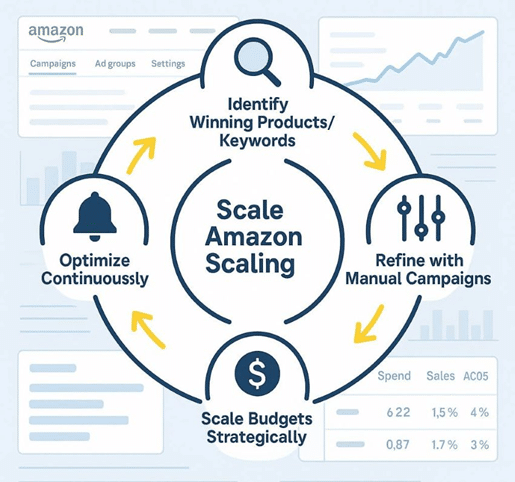
Start with patience. Begin with lower bids and allow campaigns time to collect meaningful data before making adjustments.
Wait several days—preferably a week—before increasing bids, and when you do, increase gradually in small increments.
Run multiple campaigns for the same product. Use one with tight targeting and another with broader experimental targeting to explore new audiences. Remember that bid size is not the only factor influencing impressions. Strong targeting, appealing product images, optimized titles, and persuasive descriptions all improve performance.
High click-through rates can improve ad visibility even at lower bids, as Amazon favors ads that perform well.
Learning from Campaign Data
Even if a campaign does not generate profit, the data collected is valuable. It reveals your true conversion rate and highlights areas for listing improvement.
If conversion rates are low, consider optimizing your images, copy, pricing, or overall product-market fit. Short-term losses can still deliver branding value and future customer acquisition opportunities.
Final Thoughts
Amazon Marketing Services is a relatively low-risk advertising channel when managed carefully. By starting with conservative bids, monitoring performance closely, and optimizing consistently, third-party sellers can use AMS to scale sustainably.
Success does not happen overnight—but with strategy, testing, and patience, AMS can become a powerful growth driver for your Amazon business.