
What are the two most important metrics in your Amazon business? Most would say revenue and profit margins—and they’re right.
However, there’s a catch.
Your sales might be increasing steadily, and your brand may appear to be thriving, but that doesn’t automatically mean your business is profitable.
Revenue alone can be misleading. Even if you’re experiencing month-over-month growth, profitability isn’t guaranteed. In fact, many e-commerce businesses continue to struggle with maintaining healthy margins despite generating high sales volumes.
Let’s be honest—profit margins in e-commerce aren’t getting easier. Competition, especially from overseas sellers, has made it tougher than ever. Many Amazon businesses reach 7- or even 8-figure revenues while still operating on very thin profits.
The upside? With the right strategy and a strong business model, you can still build a highly profitable Amazon business. This guide breaks down what truly impacts your margins and how to improve them.
What Is a Good Profit Margin?
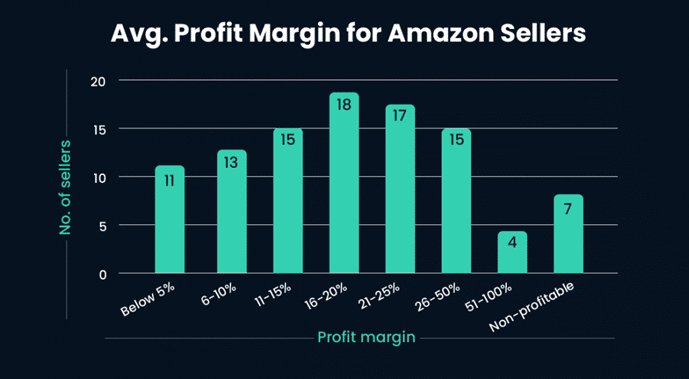
For most Amazon sellers, profit margins typically fall between 15% and 20%, depending on the product category.
A margin above 20% is considered excellent, while anything around 5% or lower is usually not sustainable in the long run.
How to Calculate Profit Margins on Amazon
Let’s start with gross profit margin.
Gross profit refers to the amount left after subtracting the cost of goods sold (COGS) from your net sales.
Formula:
Gross Profit = Net Sales – COGS
Gross Profit Margin (%) = (Net Sales – COGS ÷ Net Sales) × 100
Net sales include your total revenue after accounting for refunds, discounts, and returns.
But that’s not the only metric you should track.
Net profit margin gives a more complete picture, as it includes all expenses such as taxes, operational costs, and other overheads.
Formula:
Net Profit = Net Sales – COGS – Operating Expenses
Net Profit Margin (%) = (Net Sales – Total Expenses ÷ Net Sales) × 100
Simple Example
Let’s break it down in simple terms.
If you sell a product for $15, with direct costs of $5 and additional expenses of $7:
- Gross Profit Margin = (15 – 5 ÷ 15) × 100 = 67%
- Net Profit Margin = (15 – 5 – 7 ÷ 15) × 100 = 20%
This shows how quickly additional costs can impact your final profit.
Why Profit Margin Matters
Profit margin is one of the most important indicators of your business health.
Gross margin reflects how strong your product and pricing model is, while net margin shows how efficiently you’re running your operations.
These metrics also help you make smarter decisions around pricing, advertising, and discounts—without hurting your bottom line.
How to Improve Profit Margins on Amazon
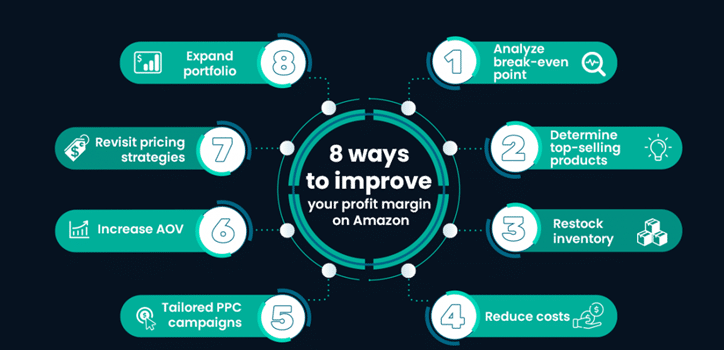
Every business is different, but certain factors consistently influence profitability. If your margins are low, these are the areas you should focus on.
1. Calculate Your Break-Even Point
Your break-even point tells you how much you need to sell to cover your costs before making a profit.
Formula:
Break-even = Overhead Costs ÷ (1 – (COGS ÷ Total Sales))
Understanding this helps you set realistic sales targets and refine your strategy.
2. Identify High and Low-Performing Products
Not all products contribute equally to your profits.
Analyze which items generate the highest margins and which ones cost more than they earn. Once identified, focus on scaling profitable products and consider removing underperformers.
3. Maintain Inventory Levels
Running out of stock can significantly hurt your profitability.
When your best-selling products go out of stock, you lose ranking, visibility, and momentum. Restarting that growth cycle can be costly and time-consuming.
Accurate demand forecasting and efficient supply chain management are essential to avoid this.
4. Expand Your Product Line
Adding complementary products can increase your revenue and improve margins.
For example, if you sell t-shirts, introducing related items like shorts or joggers can help boost overall sales and create bundling opportunities.
5. Reduce Direct Costs
Lowering your expenses directly improves your margins.
Some practical ways include:
- Negotiating better rates with suppliers
- Ordering in bulk for discounts
- Exploring cost-effective shipping solutions
- Managing cash flow with flexible payment terms
6. Understand Amazon Fees
Amazon fees play a major role in your profitability.
Over the years, fulfillment costs have steadily increased. While certain surcharges introduced earlier were removed, they’ve effectively been absorbed into standard fee structures.
By 2026, fulfillment fees continue to rise incrementally, making it essential to factor them into your pricing.
Key costs to consider:
- Seller subscription fees
- Storage fees
- Referral fees
- Fulfillment charges
- Long-term storage penalties
For private label sellers and resellers, these expenses can significantly reduce margins.
7. Optimize Advertising Campaigns
Advertising is crucial for visibility—but it must be strategic.
Simply cutting ad spend isn’t the solution to low margins. Instead, focus on optimizing campaigns to improve return on investment.
Key actions:
- Prioritize high-margin products
- Align listings with search intent
- Adjust bids and budgets strategically
- Monitor total advertising cost of sales (tACOS)
- Use time-based ad scheduling for efficiency
8. Reduce Overhead Costs
Operational inefficiencies can eat into your profits.
Regularly review your expenses and identify areas where you can cut costs or automate repetitive tasks. Streamlining operations leads to better consistency and higher margins.
9. Increase Average Order Value (AOV)
A higher AOV improves profitability without significantly increasing costs.
Strategies to boost AOV:
- Bundle related products
- Offer incentives like free shipping on minimum orders
- Promote higher-margin items
10. Revisit Your Pricing Strategy
Pricing has a direct impact on your margins.
Whether you use competitive pricing or value-based pricing, your goal should be to find the sweet spot between customer appeal and profitability.
A strong brand presence can also justify higher pricing.
Long-Term Strategies for Sustainable Profitability
Improving margins isn’t just about short-term fixes—it requires long-term thinking.
Consider focusing on:
- Expanding to multiple sales channels
- Strengthening customer service
- Building a direct-to-consumer (D2C) presence
- Growing brand loyalty
- Continuously expanding your product range
If you plan to sell your business in the future, consistent profitability will significantly increase its value.
Customer Acquisition Cost (CAC)
CAC measures how much it costs to acquire a new customer.
Formula:
CAC = Total Marketing & Sales Costs ÷ Number of Customers Acquired
Lowering your CAC improves profitability and indicates efficient marketing and strong brand positioning.
Monitor and Optimize Continuously
Tracking your data is essential for long-term success.
From inventory levels to return rates, every metric provides insights into your business performance. Regular analysis helps you identify opportunities to improve margins and stay competitive.
Final Thoughts
Profit margins are the foundation of a successful Amazon business.
With the right strategies—ranging from cost control to smart pricing and optimized advertising—you can build a sustainable and profitable operation.
Consistency, data-driven decisions, and long-term planning are what truly move the needle.