
The Amazon NARF program (North American Remote Fulfillment) is transforming how U.S. sellers expand into international markets.
Rather than managing multiple warehouses, splitting inventory across countries, or dealing with fragmented operations, sellers can now tap into Canadian and Mexican markets using a single U.S.-based FBA inventory. This eliminates the need for heavy upfront investment in international stock.
Previously, entering marketplaces like Amazon.ca or Amazon.com.mx required sellers to take on significant risks. These included shipping inventory abroad, handling local compliance, adjusting pricing strategies, and hoping demand would justify the effort.
While traditional FBA expansion still works well for established brands, it often creates unnecessary complexity for sellers who simply want to test international markets.
The Amazon NARF program changes this by enabling a demand-first approach. Sellers can test new markets, gather insights, and scale gradually before committing resources.
This guide is built for U.S. sellers who want deeper insights. It explains how NARF operates behind the scenes, how costs and fulfillment impact profitability, which products perform best, and where sellers typically lose margins or visibility.
Most importantly, it shows how to use NARF as a strategic testing layer to determine when remote fulfillment makes sense and when local expansion becomes the better option.
As Amazon continues to push toward unified selling systems and cross-border commerce, sellers who actively leverage NARF—not just enable it—will gain a clear advantage in international growth.
What Is the Amazon NARF Program?
At its core, the Amazon NARF program separates marketplace reach from inventory location—but only within North America.
For example, if your inventory is stored in a U.S. fulfillment center, a customer in Canada or Mexico can purchase your product through their local Amazon marketplace. Amazon then ships that unit directly from the U.S. across the border.
You don’t need to send inventory internationally, manage separate warehouses, or maintain multiple stock pools. The sale still comes from your U.S. inventory, simply accessed through a different storefront.
Instead of requiring sellers to place inventory in Canada or Mexico, NARF allows eligible U.S. FBA inventory to fulfill cross-border orders on demand.
A key aspect of this model is that inventory only moves when a customer places an order. There are no pre-shipped stock transfers, no local warehousing, and no need for country-specific demand forecasting.
Amazon enables this through a unified SKU system. When enrolled, your U.S. listings are linked to corresponding listings in Canada and Mexico, all drawing from the same inventory pool.
In practice, this means:
- One inventory pool serves three marketplaces
- Stock is deducted from U.S. inventory regardless of order origin
- U.S. stockouts instantly impact Canada and Mexico listings
This setup prioritizes product availability over delivery speed. While shipping times may be longer, Amazon compensates by improving selection in less saturated markets.
It’s also important to clarify what NARF is not.
It is often confused with FBA Export, but the two serve different purposes. FBA Export focuses on shipping U.S. inventory globally to countries without full Amazon marketplaces. NARF, however, operates within established marketplaces like Canada and Mexico.
Unlike traditional expansion, NARF does not require upfront inventory commitment. Instead, it allows sellers to validate demand, pricing, and conversion before scaling.
In this sense, NARF is less about logistics and more about strategic flexibility. It enables sellers to explore new markets without long-term commitment.
The Business Case for U.S. Sellers
The Amazon NARF program doesn’t generate new demand—it reveals existing demand that sellers couldn’t access before due to operational barriers.
To evaluate whether NARF is a good fit, sellers must look beyond simple marketplace comparisons and instead analyze demand behavior, competition levels, and pricing dynamics.
A. Market Demand Dynamics
Amazon Canada and Mexico are not just smaller versions of the U.S. marketplace—they function differently.
In Canada, demand is often driven by gaps in product selection. Many long-tail or niche products that are highly competitive in the U.S. face far less competition here.
As a result, products that struggle in the U.S. can sometimes perform better simply because fewer sellers are offering them.
Mexico shows a different trend. Here, availability plays a major role in purchasing decisions. In many categories, U.S. products are the only viable option.
Although price sensitivity is higher, demand can increase sharply once pricing falls within an acceptable range.
A key takeaway is that NARF works best for products that already perform well in the U.S. Poor-performing SKUs rarely improve cross-border, while proven products often gain additional traction.
B. Revenue Potential
Many estimates suggest a 20–30% revenue increase with NARF, but this oversimplifies reality.
In practice, revenue gains are uneven and often concentrated in a small number of SKUs—typically those with stable demand, predictable sales, and low seasonality.
These products often benefit from demand balancing. When U.S. sales slow down, Canadian and Mexican sales may increase, helping stabilize overall revenue.
Category trends also follow logical patterns:
- Electronics accessories perform well due to universal compatibility
- Health and beauty products succeed when compliant with local regulations
- Practical home goods outperform decorative items
While fulfillment costs are higher, advertising costs are often lower. This balance can maintain or even improve overall profitability.
C. Competitiveness & Pricing Dynamics
Lower competition in Canada and Mexico isn’t just about fewer sellers—it creates a more stable selling environment.
Rankings change more slowly, Buy Box ownership is more consistent, and listings don’t fluctuate as aggressively.
This allows sellers to adopt more intentional pricing strategies instead of constantly reacting to competitors.
Advertising also becomes more efficient. With less competition, keyword targeting is cleaner, and campaigns require less budget to perform effectively.
Additionally, cross-border buyers often accept higher prices for U.S. products. Sellers who price strategically instead of simply converting currency can increase margins without hurting conversions.
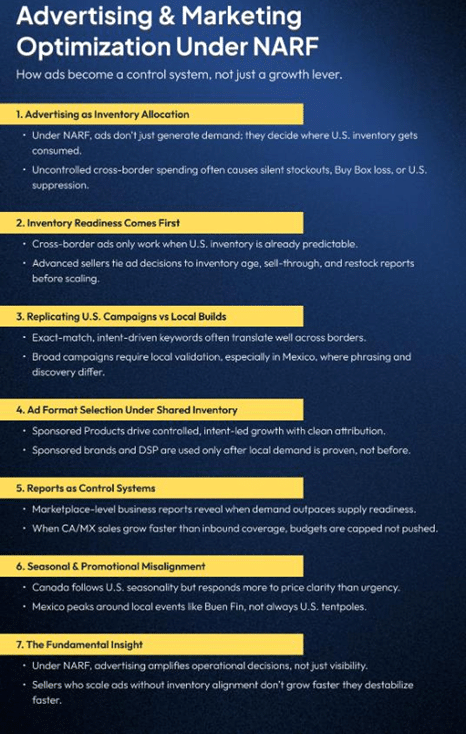
Advertising & Marketing Optimization Under NARF
Advertising as Inventory Control
Under NARF, advertising doesn’t just drive demand—it directly impacts inventory distribution.
Since all orders pull from the same U.S. inventory, increased advertising in Canada or Mexico can reduce stock availability for U.S. customers.
Inventory Readiness First
Before scaling ads internationally, sellers must ensure their inventory levels are stable.
If inventory is tight, even small increases in cross-border demand can lead to stockouts and disrupt operations.
Experienced sellers align advertising decisions with inventory data to maintain balance.
Campaign Strategy: Copy or Localize?
Exact-match campaigns based on functional keywords often perform well across all markets.
However, broader campaigns may require localization—especially in Mexico, where language differences influence search behavior.
Successful sellers use early data to refine campaigns before scaling budgets.
Choosing the Right Ad Formats
Sponsored Products remain the most effective format due to strong purchase intent.
Other formats, such as Sponsored Brands, should only be used once demand is proven.
More advanced strategies, like audience targeting, are best used for testing rather than scaling early.
Using Data as a Control System
Monitoring performance across marketplaces is essential.
If cross-border demand grows faster than inventory supply, sellers must adjust by reducing ad spend or optimizing pricing.
Seasonality Considerations
Canada generally follows U.S. seasonal trends, while Mexico has unique events like Buen Fin.
Blindly applying U.S. promotional strategies can lead to misleading results and poor decisions.
Risks, Compliance & Customer Experience Pitfalls
A. Compliance Risks
One of the biggest risks in NARF is compliance.
Products approved in the U.S. are not automatically approved in Canada or Mexico.
For example, Canada has strict regulations for health and wellness products, including labeling and ingredient requirements.
Mexico also enforces regulatory standards, often leading to sudden listing removals if products fail compliance checks.
Although Amazon handles import logistics, sellers are still responsible for understanding costs, taxes, and pricing impacts.
B. Customer Experience Challenges
NARF introduces longer delivery times, which can affect customer satisfaction.
Canadian customers, in particular, expect fast delivery and may leave negative feedback if expectations aren’t met.
Common issues include:
- Delayed shipping
- Unexpected fees
- Damaged packaging
To mitigate this, sellers should carefully select which products to enroll and monitor customer feedback closely.
Alternatives & When Not to Use NARF
NARF is not always the best option.
NARF vs Local FBA
Local FBA offers faster delivery and stronger market positioning but requires higher investment.
NARF, on the other hand, offers flexibility and lower risk but comes with limitations.
When NARF Becomes a Limitation
As sales grow, longer delivery times and higher costs can reduce competitiveness.
At this stage, local FBA may become the better choice.
When NARF Hurts U.S. Performance
Since all sales draw from the same inventory, increased international demand can negatively impact U.S. operations.
Poor inventory or pricing decisions can create instability across all marketplaces.
When Traditional Expansion Is Better
Products that rely on fast delivery, strong branding, or repeat purchases often perform better with local fulfillment.
If compliance requirements are already met, transitioning to local FBA becomes even more beneficial.
Final Thoughts
The Amazon NARF program is not a shortcut to global expansion—it’s a tool for understanding market demand.
When used strategically, it helps sellers identify which products perform well internationally and where to invest further.
However, treating NARF as a passive feature can lead to inventory issues, compliance risks, and reduced profitability.
The key is to use it as a testing phase. Let it guide decisions on pricing, inventory placement, and expansion strategy.
When managed correctly, NARF allows sellers to grow internationally while maintaining control over their core business.