Sponsored TV Amazon ads are not designed to solve a visibility issue alone. Most Amazon sellers already generate substantial impressions through Sponsored Products campaigns. The real challenge begins when that traffic reaches the product listing but fails to convert consistently.
In highly competitive niches, Sponsored Products campaigns often reach a plateau. Sellers continue adding keywords, increasing bids, and optimizing targeting, but growth eventually slows down. At that point, the limitation is no longer campaign management skills. Instead, it becomes a matter of influencing shoppers before they ever begin searching.
This is where Sponsored TV Amazon ads become valuable. They help shape customer perception early in the buying journey while keeping the shopper inside Amazon’s ecosystem.
The biggest advantage of Sponsored TV is not immediate attribution-based sales. Instead, the impact appears later through increased branded searches, stronger click-through rates on branded keywords, and improved account-wide conversion patterns.
This guide explores how Sponsored TV Amazon ads actually function in real campaign environments, how performance should be evaluated, and where the format truly delivers value for sellers.
What Are Amazon Sponsored TV Ads?
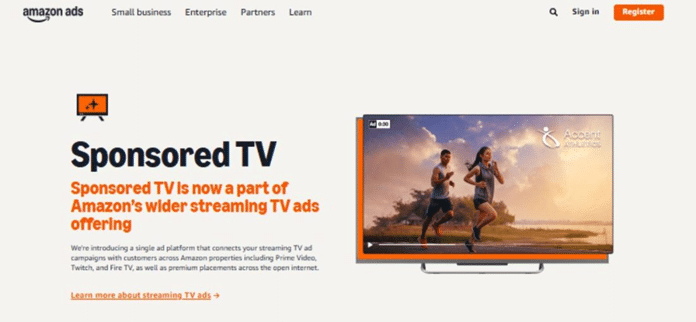
At their core, Sponsored TV Amazon ads are self-service streaming advertisements displayed across Prime Video, Fire TV, Twitch, and other connected TV placements. Sellers can launch campaigns directly through Amazon Ads Console without needing DSP contracts or agency management.
However, the important distinction is that Sponsored TV does not behave like Sponsored Products campaigns.
These campaigns are not designed for clean last-click attribution, nor are they a quick solution for listings already struggling to convert. Instead, they influence shoppers earlier in the decision-making process.
Today’s buying journey rarely starts entirely on Amazon. A large percentage of customers begin product research through search engines, review blogs, YouTube videos, and comparison content before ever reaching Amazon listings.
Sponsored TV Amazon ads help brands regain influence during this mid-funnel stage while still directing attention back toward Amazon.
When executed correctly, Sponsored TV campaigns improve the efficiency of existing Sponsored Products and Sponsored Brands campaigns rather than replacing them.
How Sponsored TV Impacts Overall Amazon Ad Performance
Sponsored TV impressions contribute to broader behavioral signals across Amazon’s advertising ecosystem.
When shoppers later search for a brand or interact with Sponsored Products ads, earlier exposure through Sponsored TV can influence conversion behavior. Because of this, experienced advertisers evaluate performance beyond direct attributed revenue.
Instead of focusing only on immediate sales, advanced sellers track:
- Growth in branded search volume
- Improved branded conversion rates
- Better click-through rates on exact-match campaigns
- Higher overall account efficiency
The strongest impact often appears indirectly through improved lower-funnel campaign performance.
Budget Structuring for Sponsored TV Campaigns
Budget allocation plays a far bigger role in Sponsored TV than in traditional search advertising.
Small tests with extremely limited budgets often fail to generate enough impressions to produce meaningful data. Because Sponsored TV relies heavily on exposure and behavioral lift, campaigns require sufficient reach before trends become visible.
The best approach is controlled experimentation with clearly defined objectives.
Rather than measuring only return on ad spend, sellers should focus on metrics such as:
- Increased branded search activity
- Store visit growth
- Improved click-through rates
- Conversion lift across existing campaigns
This creates a more accurate understanding of Sponsored TV performance.
Competing Against Established Brands
In competitive Amazon categories, sellers are not simply competing for keywords. They are competing for trust and perceived credibility.
Sponsored TV Amazon ads allow smaller and mid-sized brands to appear alongside major advertisers on premium streaming platforms. This visibility can improve shopper perception even before the customer reaches Amazon search results.
The result is often stronger engagement later during product discovery because customers already recognize the brand.
Creating Effective Creative Without Overspending
Many sellers assume Sponsored TV requires expensive, cinematic video production. In reality, high production quality is less important than clear communication.
Simple product-focused videos frequently outperform highly polished brand storytelling when they demonstrate:
- What the product does
- How it works
- Why it is different
Strong messaging and visual clarity usually matter more than expensive editing or production value.
A straightforward demonstration with a compelling value proposition can deliver excellent results even on smaller budgets.
Importance of Retail Readiness Before Scaling
Before increasing Sponsored TV spend, sellers must evaluate whether their listings are prepared to convert additional traffic.
Sponsored TV amplifies visibility, but it cannot fix weak retail fundamentals.
Before scaling campaigns, sellers should ensure:
- Product images are high quality
- Reviews are strong and trustworthy
- Pricing remains competitive
- Product positioning is accurate
- Listing copy is optimized for conversion
If these elements are weak, Sponsored TV may simply increase traffic without improving sales performance.
Audience Targeting Strategy
A conservative audience-entry strategy usually performs best in the beginning.
Rather than launching broad campaigns immediately, sellers should first target highly relevant audiences such as:
- Shoppers viewing similar products
- Competitor audiences
- In-market category buyers
Once campaigns stabilize and data becomes clearer, audience reach can gradually expand outward into broader segments.
Advanced advertisers often structure campaigns in layers, beginning with high-intent shoppers before scaling toward awareness-focused audiences.
Aligning Brand Awareness With Performance Goals
Many sellers separate awareness campaigns from performance campaigns entirely. This creates disconnects in measurement and optimization.
Sponsored TV Amazon ads work best when awareness and conversion strategies are structurally connected.
The format sits between upper-funnel visibility and lower-funnel performance. Its role is to strengthen future conversion behavior rather than replace direct-response advertising.
When awareness campaigns are integrated properly with Sponsored Products and Sponsored Brands strategies, overall account performance often improves significantly.
How to Create a Sponsored TV Amazon Ads Campaign
1. Access Sponsored TV Inside Amazon Ads Console
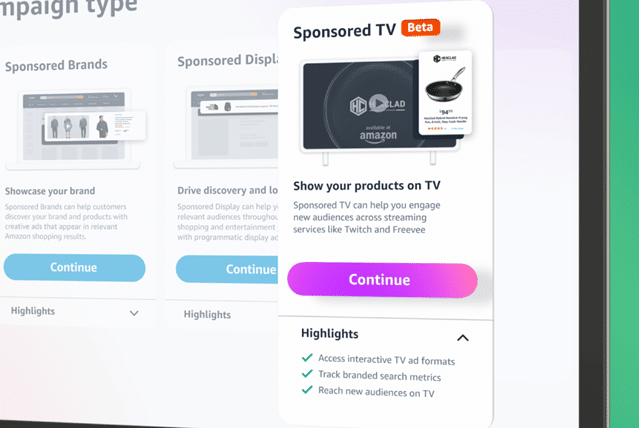
Begin by logging into Amazon Ads Console and selecting “Create Campaign.” From there, choose Sponsored TV as the campaign type.
Sponsored TV operates within the same advertising environment as Sponsored Products and Sponsored Brands, making it accessible without DSP agreements or large minimum spends.
2. Define a Clear Campaign Objective
Before launching, establish the primary goal of the campaign.
Common objectives include:
- Increasing branded search traffic
- Supporting new product launches
- Improving existing campaign conversion rates
- Building stronger brand recognition
Sponsored TV works best when aligned with measurable business outcomes.
3. Start With a Controlled Budget
Avoid scaling aggressively in the beginning.
Instead, launch with a manageable daily budget that allows you to observe:
- Search lift
- Click-through rate changes
- Store engagement
- Conversion improvements
This creates a more reliable foundation before increasing spend.
4. Choose Relevant Audiences
Start by targeting audiences already demonstrating shopping intent.
Effective starting audiences often include:
- Similar product viewers
- Competitor product audiences
- Category shoppers
This increases the likelihood of meaningful engagement early in the campaign lifecycle.
5. Upload a Product-Focused Video
Your creative should prioritize clarity over storytelling.
The video should immediately communicate:
- What the product is
- How it solves a problem
- Why shoppers should care
Product demonstration videos typically outperform abstract branding campaigns because they create stronger buying intent.
6. Confirm Listing Readiness
Before launching campaigns, ensure your product detail page is fully optimized.
Important areas include:
- Product photography
- Review quality
- Listing copy
- Pricing consistency
- Brand positioning
Strong listings maximize the value of incoming Sponsored TV traffic.
7. Measure Downstream Performance Signals
Sponsored TV should not be judged solely on direct attributed sales.
Instead, monitor downstream performance indicators such as:
- Branded search growth
- Higher conversion rates
- Better click-through rates
- Improved Sponsored Products efficiency
These signals provide a more accurate picture of campaign impact.
Common Sponsored TV Amazon Ads Mistakes
Mistake 1: High Impressions With No Real Performance Lift
One of the most common issues is generating massive impression volume without seeing meaningful growth in product page visits or conversions.
This usually happens because the creative does not align with the landing destination.
For example:
- Lifestyle-focused ads may fail when driving directly to a single product page
- Product-specific creatives may struggle when sending users to a broad Store page
The solution is matching the ad experience to the intended user action.
Mistake 2: Spending Budget Too Quickly
Some campaigns exhaust their budget too early due to aggressive bidding and poor pacing controls.
Unlike search ads, streaming inventory requires balanced exposure over time.
Sellers can improve delivery efficiency by implementing:
- Frequency caps
- Dayparting strategies
- More controlled bidding
This prevents early audience saturation and creates steadier campaign performance.
Mistake 3: Misinterpreting Attribution Data
Sponsored TV operates in a more complex attribution environment compared to Sponsored Products.
Metrics inside Amazon Ads Console may not perfectly align with downstream Store Insights or sales reporting.
This does not necessarily indicate campaign failure.
Experienced advertisers focus more on trend-based lift and behavioral changes rather than expecting perfect attribution consistency.
Advanced Sponsored TV Amazon Ads Strategies
Strategy 1: Optimize Frequency Management
Frequency control is critical in streaming advertising.
Excessive exposure can lead to ad fatigue, while overly restrictive frequency caps may reduce overall reach too aggressively.
Successful advertisers often create layered frequency structures based on audience type.
For example:
- Broad awareness audiences may tolerate higher frequency
- Retargeting audiences usually require stricter limits
Balancing exposure helps maintain both efficiency and audience quality.
Strategy 2: Retarget Sponsored TV Viewers
One of the most effective advanced tactics is turning Sponsored TV viewers into retargeting audiences.
Using Amazon Marketing Cloud audience insights, sellers can identify viewers who engaged but did not purchase.
These audiences can later be targeted through Sponsored Products or Sponsored Brands campaigns, improving lower-funnel efficiency.
This creates a connected advertising ecosystem where upper-funnel awareness strengthens downstream conversions.
Strategy 3: Know When to Transition to DSP
Sponsored TV works well for self-service experimentation and moderate-scale awareness campaigns.
However, larger advertisers may eventually outgrow its limitations.
Amazon DSP becomes more valuable when sellers require:
- Advanced audience granularity
- Multi-touch attribution
- Large-scale national campaigns
- Placement-level optimization
- Custom data integrations
The transition usually becomes necessary when campaign goals shift toward enterprise-level scaling and advanced reporting.
Final Thoughts
Sponsored TV Amazon ads have evolved into a powerful tool for influencing shopper behavior across Amazon’s streaming ecosystem.
Success with the format depends on structured testing, strong creative alignment, strategic audience targeting, and accurate performance evaluation.
Brands that treat Sponsored TV as a long-term demand-generation strategy often experience measurable improvements in:
- Branded search volume
- Product page engagement
- Sponsored Products efficiency
- Overall account conversions
The key is disciplined execution.
Rather than chasing immediate attributed sales, sellers should focus on how Sponsored TV shapes future buying behavior and strengthens lower-funnel campaigns over time.
When approached strategically, Sponsored TV becomes more than an awareness tool. It becomes a scalable system for building brand recognition, improving conversion quality, and driving long-term Amazon growth.