Counterfeiting is one of the biggest fears for any brand owner. It refers to unauthorized sellers offering low-quality replicas of original products, which damages brand credibility and directly eats into legitimate profits.
The issue of counterfeit goods has existed for decades, and Amazon treats it as a serious concern. Fake products cost Amazon billions of dollars annually in lost revenue and customer trust, making brand protection a top priority for the platform.
In several cases, counterfeit products have entered Amazon’s marketplace due to the first-sale doctrine. This policy allows third-party sellers to legally resell branded products as long as the items remain unchanged, creating loopholes that counterfeiters often exploit.
Selling fake or substandard products not only frustrates customers but also harms the reputation of both Amazon and genuine brands. To address this growing challenge and ensure customers receive authentic products, Amazon introduced the Amazon Transparency Program.
What Is the Amazon Transparency Program?
The Amazon Transparency Program is a product serialization and authentication system designed to verify the legitimacy of products before they are shipped to customers.
Launched in 2017, the program aims to identify and block counterfeit products from reaching buyers. Amazon initially tested Transparency on its own product lines before gradually expanding it to third-party sellers after successful results.
Today, the Amazon Transparency Program is available in multiple countries, including the United States, Canada, Germany, France, Italy, Spain, the United Kingdom, India, and Australia. Amazon plans to extend the program to additional marketplaces in the future.
This program primarily benefits brand owners and authorized third-party sellers. If an unauthorized seller attempts to list counterfeit versions of a Transparency-enabled product, those items are automatically blocked and never reach customers.
How Does the Amazon Transparency Program Work?
Amazon Transparency operates through a secure and detailed product labeling system designed to eliminate counterfeit risks at every stage of fulfillment.
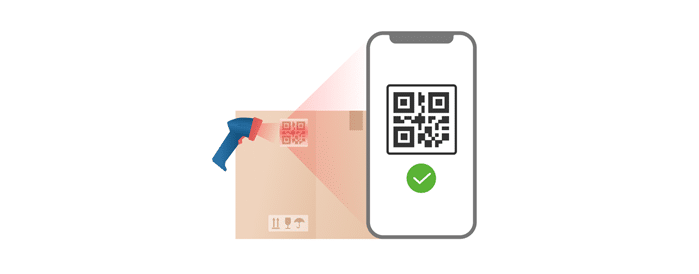
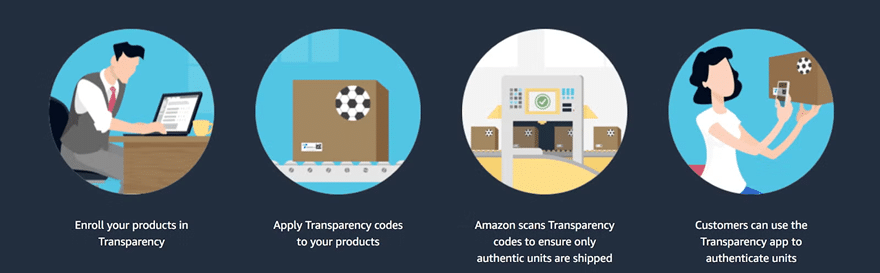
When a brand enrolls in the program, Amazon generates unique Transparency codes for each individual unit. These T-shaped 2D barcodes are applied directly to product packaging. Unlike standard UPC or GTIN codes, each Transparency code is unique to a single item.
Before any product is shipped, Amazon scans the Transparency code to confirm authenticity. Products without a valid code or those that fail verification are flagged and treated as potential counterfeits.
Amazon also offers a Transparency mobile app that allows customers to verify products themselves. By scanning the code, shoppers instantly see whether the item is authentic, helping build trust and confidence.
Brands can further enhance the customer experience by sharing unit-level details such as manufacturing date, origin, and product-specific information through the Transparency app.
Amazon maintains a centralized database that tracks all Transparency codes, ensuring they cannot be reused or manipulated by dishonest sellers. This system allows for reliable verification at any time.
How Does Amazon Transparency Work for FBM Sellers?
Amazon sellers can fulfill orders through Fulfillment by Amazon (FBA) or Fulfillment by Merchant (FBM). With FBA, Amazon handles storage, packing, and shipping, while FBM sellers manage fulfillment themselves.
For FBM sellers enrolled in the Transparency Program, Amazon requires a unique Transparency code for every protected unit sold. This ensures that only verified, authentic products are delivered to customers.
While Amazon generates the Transparency codes, FBM sellers must submit and apply these codes correctly to each unit before shipping. Every item shipped under FBM must have its own unique Transparency label attached to the packaging.
How Much Does the Amazon Transparency Program Cost?
Amazon does not publicly disclose exact pricing for the Transparency Program. However, most brands can expect to pay between $0.01 and $0.05 per Transparency code, depending on volume.
For example, authenticating 1,000 units may cost up to $50, making it a cost-effective solution for protecting high-value products.
This program is especially recommended for premium, luxury, or high-priced items that are more vulnerable to counterfeiting. Brands can gradually expand coverage to additional products based on budget and demand.
Labeling costs are another factor to consider. Transparency codes can be applied using stickers or printed directly on packaging. While manufacturers can apply them during production, this option may be more expensive.
Pro Tip: Many brands reduce costs by printing and applying Transparency labels in-house during the packaging process.
How to Enroll in the Amazon Transparency Program
To join the Amazon Transparency Program, sellers must meet specific eligibility requirements set by Amazon.
You must be the rightful brand owner and provide proof of ownership. Your products must display a valid Global Trade Item Number (GTIN), such as a UPC or EAN, and you must be capable of applying unique Transparency codes to every unit produced.
After submitting the enrollment form and requesting more information, Amazon reviews your application. Once approved, you can choose which products to protect using Transparency codes.
It’s best to start with your most expensive or frequently counterfeited products rather than enrolling your entire catalog at once.
Benefits of the Amazon Transparency Program
Increase Profitability
Counterfeit products directly compete with legitimate brands by stealing sales and offering inferior alternatives. Transparency prevents unauthorized sellers from listing your products because they cannot access valid codes.
When counterfeit listings are removed, customers have only one option—the authentic product—helping you recover lost sales and protect revenue.
Reduce Damage from Counterfeiters
Counterfeit sellers often undercut prices, confuse customers, and damage brand trust. Buyers may mistakenly believe they received poor-quality products from the original brand, leading to reputational harm.
Transparency blocks these sellers before damage occurs, protecting your brand image and preventing unnecessary investigations or account issues.
Prevent Negative Reviews
Customers who receive fake products are far more likely to leave negative reviews. Since most shoppers trust online reviews, even a few bad experiences can significantly impact sales.
By ensuring customers receive authentic products, the Transparency Program helps protect your ratings, reviews, and overall brand credibility.
Final Thoughts: Protect Your Brand from Counterfeits
Counterfeit products pose a serious threat to e-commerce businesses by damaging reputation, lowering prices unfairly, and reducing profits. Enrolling in the Amazon Transparency Program is one of the most effective ways to safeguard your brand.
If you are a brand-registered seller, meeting the eligibility requirements and adopting Transparency can help ensure customer trust, protect revenue, and maintain long-term success on Amazon.