
Amazon URL structure is often overlooked until something goes wrong—and when it does, the issue is rarely obvious. You might be reviewing campaign performance and notice conflicting data across reports. One dashboard shows a strong return on ad spend, while another reports something completely different. Meanwhile, your referral bonus and attribution data don’t align either, leaving your team confused.
In most cases, these inconsistencies trace back to how your Amazon URLs were created and managed.
For sellers handling influencer campaigns, paid advertising, and external traffic simultaneously, link structure is not just a technical detail. It directly impacts how sales are tracked and attributed—whether to ads, external traffic, or organic channels. Without proper structure, you risk inaccurate reporting, duplicated payouts, and poor decision-making based on misleading data.
Why Amazon URL Structure Still Matters in 2026
If you’re managing multiple marketing channels and partnerships, understanding Amazon URLs is essential. They define how clicks are recorded and how conversions are assigned across different reporting systems.
While URLs do not influence ranking under Amazon’s algorithm, they do affect how data flows between tools like Ads Console, Attribution, and Brand Analytics. Each URL format behaves differently, and inconsistent use can lead to reporting discrepancies.
For example, one sale might appear as paid traffic in one report and as direct or external traffic in another. This disconnect can create confusion for marketing, finance, and operations teams, often leading to incorrect conclusions and wasted effort.
Beyond reporting, URLs also impact the customer journey. A structured and consistent approach ensures that every campaign and traffic source is properly tracked, allowing teams to operate with clarity and confidence.
Understanding Keyword Targeting in Amazon URLs
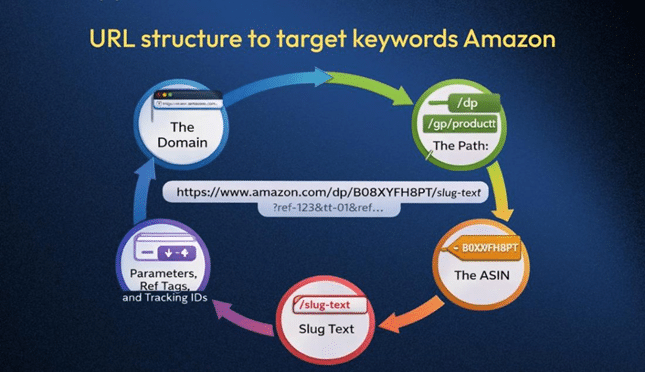
At first glance, Amazon product URLs seem simple. However, once you analyze them across campaigns and platforms, it becomes clear that they carry multiple layers of information.
Breaking down a typical URL reveals which components are essential and which are used only for tracking or analytics. This distinction is crucial for sellers managing large-scale operations, as it determines how Amazon interprets traffic after a click.
Do Marketplace Domains Affect Performance?
Whether a product is accessed through different Amazon domains, it ultimately resolves to the same product listing. The domain itself does not influence ranking or product identity.
However, it can impact session behavior. Different entry points—such as mobile or alternate domains—can affect how sessions are tracked, especially when users switch devices. While Amazon normalizes these differences internally, they can still influence attribution and tracking accuracy before that normalization occurs.
Choosing Between /dp/ and /gp/product/
Amazon URLs typically follow one of two main formats:
/dp/ASIN/gp/product/ASIN
Both lead to the same product page, but they are not identical in structure. The /dp/ format is Amazon’s preferred standard—cleaner, shorter, and more stable. The /gp/product/ format is older and maintained for compatibility.
Although both work, Amazon logs the original request before standardizing it. This can affect how traffic is tracked across systems, even though it doesn’t impact ranking.
The Role of ASIN in URLs
The ASIN is the most important element in any Amazon URL. It is the unique identifier Amazon uses to load a product page.
Everything else in the URL—domain, path, or parameters—is optional. As long as the ASIN is present, the page will load correctly. This explains why different-looking URLs can still lead to the same product while producing different tracking results.
Slug Text and Its Purpose
The descriptive text in a URL, often derived from the product title, exists mainly for readability. It helps users recognize the product and makes links appear more trustworthy.
However, Amazon does not use this text for ranking or product identification. Once the ASIN is processed, the slug is ignored entirely. While it may resemble traditional SEO practices, it has no impact on Amazon’s internal systems.
Tracking Parameters and Attribution
Query parameters and reference tags play a key role in tracking. They indicate where traffic originates and which system should receive credit for a conversion.
Some parameters are retained throughout the session, while others are only used at the moment of entry. Importantly, Amazon records the original request before modifying the URL, meaning these signals are not lost—even if they disappear from the visible link.
Misunderstanding this behavior often leads sellers to assume tracking data is removed, when in reality it is still being processed internally.
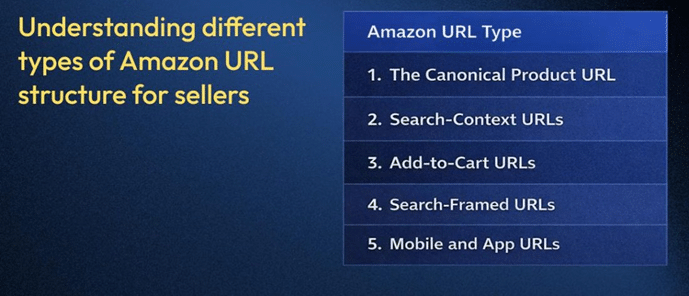
Types of Amazon URLs Sellers Should Know
1. Canonical Product URLs
These are the standard URLs tied directly to the ASIN. They are clean, stable, and ideal for long-term use in blogs or external promotions.
All other variations ultimately resolve back to this format.
2. Search-Context URLs
These URLs include additional parameters that capture search behavior, such as keywords and product position.
They help Amazon understand how a user found the product but do not affect ranking or create duplicate listings.
3. Add-to-Cart URLs
These links allow users to add a product directly to their cart without visiting the product page.
They are useful for high-intent campaigns, such as email marketing, where reducing friction can improve conversions.
4. Search-Framed URLs
These URLs simulate search results while highlighting a specific product. They are often used to test keyword visibility and indexing.
5. Mobile and App URLs
Device-specific URLs are optimized for mobile users. While they may appear different, they all lead to the same product internally and do not require optimization.
Common Myths About Amazon URL Structure
Myth 1: Keywords in URLs Improve Ranking
Many sellers believe adding keywords to URLs boosts rankings. In reality, Amazon relies on performance metrics such as sales and conversion rates, not URL text.
Myth 2: Long URLs Reduce Conversions
Although long URLs may look complex, they do not impact conversion rates. Buyers focus on the product page experience rather than the link itself.
Myth 3: Duplicate URLs Cause Penalties
Unlike traditional SEO, Amazon does not penalize multiple URLs pointing to the same product. All variations resolve to a single ASIN.
Myth 4: Separate URLs Are Needed for SEO and Ads
There is no need for different URLs for SEO and advertising. Amazon consolidates all traffic at the ASIN level, regardless of the link format used.
How Smart Sellers Use URL Structure
Experienced sellers treat URLs as part of their data strategy rather than a ranking factor. They standardize link usage across teams and campaigns to maintain consistent tracking.
When multiple URL versions are used without coordination, reporting becomes fragmented. This can lead to incorrect conclusions and poor decision-making.
By simplifying and standardizing URLs, sellers reduce confusion and improve the reliability of their analytics.
Final Thoughts
Amazon URLs are not designed to influence rankings. Instead, they serve as tools for tracking user behavior and attribution.
Successful sellers focus on consistency rather than complexity. By using a clean, standardized URL structure, they gain clearer insights, make better decisions, and avoid costly reporting errors.
In the end, accurate data matters more than any perceived optimization trick—and a well-managed URL structure is a key part of achieving that clarity.