
Third-party sellers who rely on arbitrage to source products for resale on Amazon typically choose between two popular models: online arbitrage and retail arbitrage.
But what exactly do these models mean? And how do you know which one is right for you? In this blog, we’ll break down both approaches and compare their advantages and challenges.
What Is Arbitrage?
Arbitrage is a resale strategy where a seller researches a product’s market price before purchasing it. The goal is to profit from price differences between two marketplaces.
In most cases, sellers pay upfront for the inventory and are not required to meet minimum order quantities.
Amazon arbitrage has become increasingly popular among third-party sellers. The concept is simple: find products in retail stores or online marketplaces at a lower price and resell them on Amazon at a higher price. Some sellers use barcode scanning apps or research tools to quickly identify profitable items.
When selling on Amazon through arbitrage, you generally choose between two methods: online arbitrage or retail arbitrage.
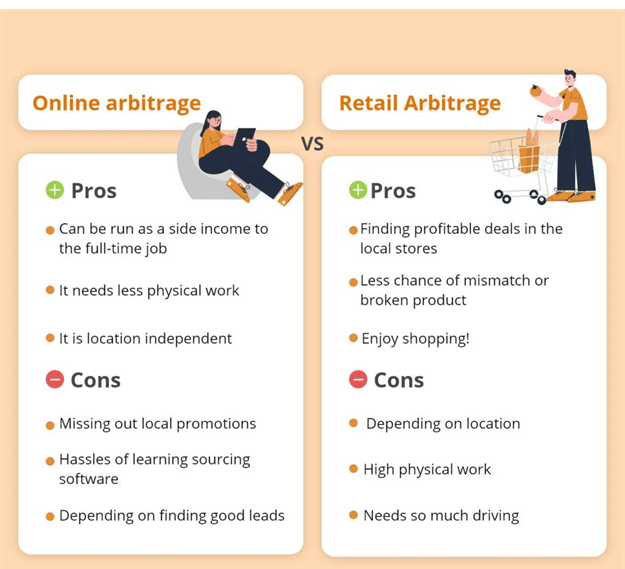
Online Arbitrage vs Retail Arbitrage
One of the major advantages of arbitrage is flexibility. You are not required to stick to just one approach. Many sellers use both online and retail arbitrage simultaneously, depending on opportunity and convenience.
Let’s explore each model in detail.
What Is Online Arbitrage?
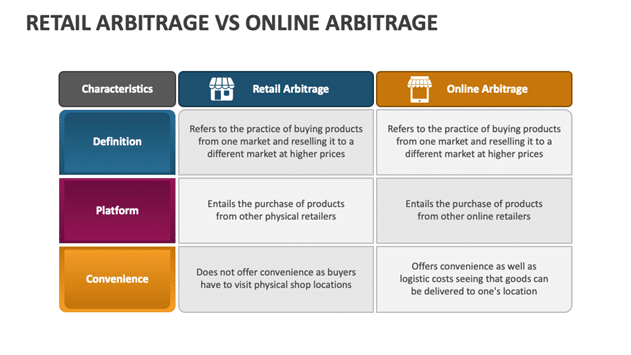
Online arbitrage involves purchasing a product from an online store at a discounted rate and reselling it on Amazon at a higher price.
One of the biggest benefits of online arbitrage is convenience. You can research, buy, and manage everything from home. For example, you might discover discounted products on marketplaces like AliExpress and list them on Amazon with a markup.
Keep in mind, however, that shipping fees and additional costs reduce your overall margin. Individual profits may be smaller per unit, but consistent sales can help you build momentum and establish a steady stream of revenue. Even established e-commerce brands sometimes turn to online arbitrage to fill inventory gaps or test new product ranges.
In simple terms, online arbitrage is about identifying pricing gaps between online marketplaces and capitalizing on them. The entire operation is digital, and in some cases, sellers never physically handle the products.
Many online arbitrage sellers leverage Amazon’s massive customer base while simultaneously selling on other platforms to maximize exposure.
What Is Retail Arbitrage?
Retail arbitrage, on the other hand, involves physically visiting brick-and-mortar stores to find discounted items, purchasing them, and reselling them on Amazon for a profit.
Liquidation outlets and clearance sales often provide products at significantly lower prices than Amazon’s retail listings. Sellers purchase these discounted goods and resell them at competitive prices. This works because most consumers do not have access to such liquidation deals and prefer the convenience of buying directly from Amazon.
Scalability in Retail Arbitrage
Retail arbitrage is often viewed as one of the fastest ways to start selling on marketplaces like eBay and Amazon. With relatively low risk and minimal startup investment, it serves as an entry point into Amazon FBA.
When sourcing inventory through retail arbitrage, you can buy as many units as you like. There is no need to wait for manufacturing or overseas shipping. Once purchased, you simply send your inventory to Amazon’s fulfillment centers, list the products, and begin selling.
Because of its simplicity and low barrier to entry, retail arbitrage is a popular side hustle model.
After building confidence and capital through retail arbitrage, sellers often expand into wholesale, private label, or brand-building models.
From a financial perspective, retail arbitrage is especially attractive to new sellers who may not have the capital required to launch a private label or branded product line.
What’s the Challenge?
Despite its simplicity, retail arbitrage comes with limitations—particularly when it comes to scaling.
The biggest drawback is time consumption. You must spend hours:
- Searching for deals, discounts, and sales
- Scanning barcodes at major retailers like Walmart
- Sorting and organizing purchased items
- Wrapping and packaging products for shipment
In the beginning, retail arbitrage can be exciting and rewarding. Physically sourcing and preparing items often gives sellers a strong sense of accomplishment. However, driving to stores, scanning shelves, prepping products, and shipping them requires significant time and energy.
That said, seeing consistent sales roll in can be highly motivating.
What Do You Need for Online Arbitrage?
Starting an online arbitrage business requires an investment of time upfront. Efficiency improves significantly when you use research and automation tools to streamline operations.
Product Research
Thorough product research is critical. You need to understand what’s trending, what’s stable, and what offers sustainable margins.
Consumers are often uncertain about pricing for newly launched products, which can create higher-margin opportunities. Tools like Google Trends can help you identify trending categories and growing demand patterns.
Analyze Competition
It’s essential to evaluate the competitive landscape on Amazon before sourcing a product.
Key metrics to monitor include historical sales trends, the number of competing sellers, and pricing stability. Tracking a product’s price movement over time also helps you avoid sudden price drops that can hurt profitability.
Setting up alerts for pricing changes, listing updates, and review activity can give you a competitive advantage and help you react quickly to market shifts.
Having reliable Amazon seller tools can significantly improve efficiency as you scale. Some tools require a learning period, so experiment to find what works best for your workflow.
Beware of Costs
One major mistake arbitrage sellers make is focusing too much on revenue rather than net profit.
No matter how high your sales volume is, success depends on maintaining healthy margins after deducting all expenses.
Here are the primary costs to consider:
Purchase Costs
This includes the amount spent on acquiring inventory.
Marketplace Fees
Amazon typically charges a monthly subscription fee for professional sellers, along with referral fees that often range between 8% and 17% depending on the category. Certain categories like books or media may include additional closing fees. Understanding the full fee structure is critical before listing products.
Fulfillment Costs
Using Amazon FBA means Amazon handles picking, packing, shipping, and customer service. While this offers advantages like Prime eligibility and better Buy Box visibility, it also includes fulfillment fees, storage fees, and long-term storage charges.
If you choose to self-fulfill, you must calculate your own shipping, packaging, and customer support expenses.
Other Operational Costs
These include software subscriptions, labor, and marketing spend.
When starting out, Return on Investment (ROI) is a crucial metric. Many sellers target a minimum ROI between 35% and 60%, depending on their niche, to ensure sustainable profitability.
General Selling Questions About Online Arbitrage
Can You Succeed with Online Arbitrage?
Online arbitrage is often marketed as an easy opportunity. While it can be profitable, it is not a get-rich-quick scheme.
Success depends heavily on sourcing products at the right price, managing costs, and staying consistent. Sellers must invest time, money, and effort, and it may take several months before seeing stable results.
Is Online Arbitrage Legal on Amazon?
Yes, online arbitrage is legal on Amazon.
However, sellers must ensure they avoid counterfeit goods and respect brand restrictions. Some brands only allow authorized resellers. Violating these policies can lead to account suspension, so proper research and compliance are essential.
Final Thoughts
Both online arbitrage and retail arbitrage can serve as profitable business models or side hustles. Your choice depends on your lifestyle, available time, capital, and long-term goals.
If you’re selling on Amazon, leveraging available research tools and maintaining strong cost control can significantly improve your chances of success. Whether you choose online arbitrage, retail arbitrage, or a combination of both, disciplined execution and consistent analysis are the keys to sustainable growth.