
Strong brand positioning allows your business to secure a meaningful space in the minds of consumers despite today’s overwhelming competition.
To earn that space, you must clearly communicate who you are, what you stand for, and how you want to be perceived.
Modern online retail gives customers endless options. From social media discussions and word-of-mouth referrals to platforms like Amazon and Etsy, buyers are influenced from multiple directions. Interestingly, many shoppers now trust Amazon reviews even more than traditional search engine results.
If you sell on Amazon, you may wonder: Does being associated with such a massive marketplace strengthen or dilute my brand positioning?
The truth is that brands should use every available channel to amplify their online presence and authority. But what exactly shapes your brand both on and off Amazon? And in a constantly evolving consumer landscape, how do you stand out from the competition?
Let’s explore.
1. Brand Positioning On and Off Amazon
In this guide, we’ll walk through practical strategies to help your brand succeed inside Amazon’s marketplace and beyond.
Before diving in, let’s clarify what brand positioning actually means.
Brand positioning is the process of shaping how customers perceive your business. It involves building clear associations in consumers’ minds so they view your brand exactly how you intend them to. When aligned with customer expectations, effective positioning increases loyalty, improves purchase intent, and strengthens credibility.
To understand strong positioning, we can learn from one of the most dominant retailers in the world: Amazon.
Why Has Amazon Been So Successful?
At its core, Amazon’s success stems from an unwavering focus on customer experience.
Its mission has always centered on customer satisfaction. Every innovation, feature, and strategic initiative is designed to improve convenience and value for buyers.
Originally branded as “Earth’s Biggest Bookstore,” Amazon quickly expanded far beyond books. Today, it operates as the world’s largest e-commerce platform, offering nearly everything consumers could want. Product variety has become one of its strongest brand advantages.
Pricing has also played a crucial role in Amazon’s growth. The company consistently prioritizes competitive pricing. Add to that Amazon Prime, fast shipping, and customer-first innovations, and it becomes clear: Amazon’s brand positioning revolves entirely around customer-centricity — with constant communication about updates and improvements.
Speak Your Customer’s Language
If you want customers to connect with your brand, you must communicate the way they do.
Take Netflix as an example. As an entertainment brand, it avoids overly corporate messaging and instead maintains a casual, engaging tone. That voice resonates directly with its audience.
How can you do the same?
Start by understanding what truly matters to your buyers. Are they price-sensitive? Do they value convenience? Are they focused on premium quality?
In digital marketing, relevance determines success. The gap between what you want to promote and what customers actually care about can define your results.
Identify what motivates purchasing decisions and emphasize those factors in your Amazon listings, visuals, campaigns, and content strategies.
Today, delivering relevance and value isn’t optional — it’s essential.
Develop a Compelling Brand Story
Every brand has a story — but many hesitate to tell it because they believe it isn’t impressive enough.
That assumption is usually wrong.
An authentic brand story humanizes your business. Whether through a powerful slogan or a relatable founder journey, storytelling builds emotional connections.
Reflect on why you launched your product or service in the first place. What problem were you trying to solve?
As Simon Sinek famously said, “People don’t buy what you do; they buy why you do it.”
When customers feel connected to your mission, they’re more likely to remain loyal long-term.
Consistency Is Non-Negotiable
One of the biggest branding mistakes businesses make is inconsistency.
Once you define your core message, tone, and identity, you must maintain them across all platforms — your website, product listings, blogs, ads, videos, and social media.
Consistency strengthens brand recognition and trust.
An essential part of this is documenting your brand guidelines — from key messaging frameworks to core values — whether you’re working alone or with a team.
Social media also plays a major role. The average person spends over an hour and a half daily browsing social channels. That presents a huge opportunity to showcase your products and values across platforms like Instagram, Facebook, YouTube, and Pinterest.
Your brand’s reputation can be heavily influenced by its social media presence. Staying active doesn’t necessarily mean spending heavily on ads — it means engaging meaningfully.
You can:
- Offer exclusive discounts and promotions
- Share behind-the-scenes insights
- Conduct polls and gather customer feedback
- Partner with influencers who share your target audience
Engagement builds trust — and trust builds long-term brand equity.
2. Branding on Amazon
The strategies discussed so far strengthen your overall e-commerce positioning. However, Amazon requires additional tactical considerations.
Amazon accounts for a significant portion of total e-commerce sales in the United States. Its dominance makes it a critical channel for brands seeking both revenue and visibility.
This raises important questions:
How can you grow Amazon sales without weakening your brand identity?
Can Amazon’s massive audience become a source of customer loyalty?
Let’s break it down.
Take Ownership of Your Brand on Amazon
If you want to strengthen your presence on Amazon, consider the following:
Use Amazon tools to enhance customer experience within your brand ecosystem.
Conduct competitor research to uncover gaps and growth opportunities.
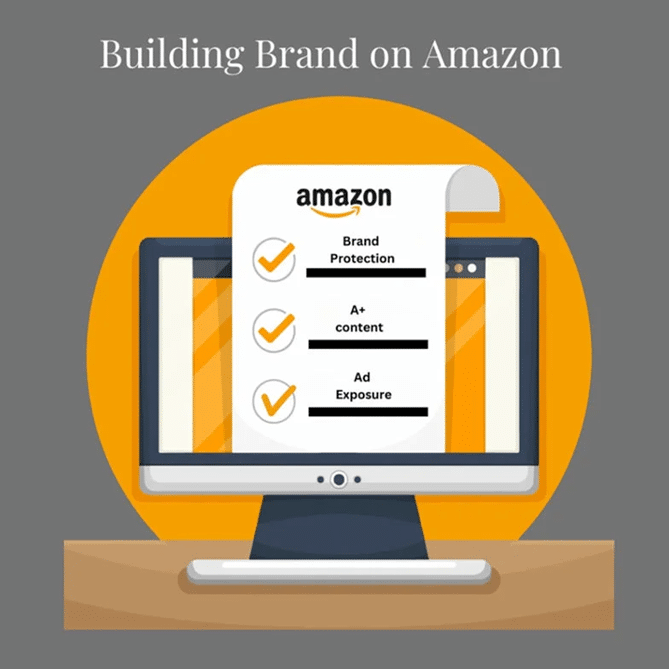
Build a cohesive brand identity across product detail pages, A+ Content, and your Amazon Storefront. Enhanced content and dedicated storefronts significantly elevate customer perception.
With fulfillment handled through Amazon FBA — including inventory, shipping, and returns — brand-focused design elements such as customized landing pages help you stand out.
Continuously refine listing optimization strategies. Improve keywords, imagery, copy, and pricing as needed to maintain performance.
Include Amazon in Your Omnichannel Strategy
Rather than viewing Amazon as your entire business, treat it as one channel within a broader ecosystem.
Leverage your existing brand credibility alongside Amazon’s marketplace authority to reinforce customer trust.
Amazon’s reporting features also provide valuable insights. Metrics like “new-to-brand” help identify first-time buyers, allowing you to measure acquisition efforts accurately.
A comprehensive understanding of your advertising and listing performance ensures smarter strategic decisions.
Consider Amazon DSP
Even businesses that do not directly sell on Amazon can benefit from its advertising ecosystem.
Amazon DSP (Demand-Side Platform) allows advertisers to use Amazon’s rich audience data to target customers based on behavior, interests, shopping patterns, and more. Brands that combine search advertising with display advertising often see substantial revenue growth. For expanding businesses, incorporating diverse Amazon ad formats into your marketing strategy can unlock additional customer segments.
Stay Updated with Amazon’s Innovations
Amazon continuously introduces new programs and tools to support sellers and brands.
Initiatives such as Amazon Moments, Amazon Attribution, and the Influencer Program provide additional opportunities for brand exposure and analytics insights.
Experimenting with new features early can position your brand ahead of competitors and allow you to adapt quickly to marketplace changes.
3. Final Thoughts
Whether launching a new product, refreshing your existing lineup, or reshaping customer perceptions, strategic brand repositioning can transform your business trajectory.
A well-defined brand influences everything — from internal team culture to external customer loyalty.
Seize every opportunity to understand your audience, refine your message, and differentiate from competitors. Run A/B tests, prioritize customer satisfaction, and incorporate Amazon thoughtfully into your broader marketing approach.
Future-proofing your brand requires adaptability, clarity, and consistent execution — both on and off Amazon.