
Google dominates the world of web search, while Amazon leads the global e-commerce marketplace. Every day, millions of users rely on these two platforms to find information and shop for products. For online sellers, understanding how each search engine works is essential for building an effective digital marketing strategy and improving product visibility.
Although both platforms help users discover what they’re looking for, they operate very differently. Knowing how Amazon SEO compares to Google SEO can help you attract the right audience, increase conversions, and grow your business more efficiently.

Amazon Has Become the Preferred Platform for Product Searches
While Google remains the world’s largest search engine overall, many shoppers now begin their buying journey directly on Amazon. Consumers often trust Amazon as their first stop when searching for products, making it one of the most influential search engines for e-commerce.
Because of this shift in customer behavior, sellers need to understand how Amazon’s ranking system works and optimize their listings accordingly.
How Amazon Works
Amazon is one of the most trusted online marketplaces worldwide. Even when shoppers discover products elsewhere, many still visit Amazon before making a purchase. This makes Amazon product optimization essential for sellers who want to increase visibility and generate more sales.
Unlike Google, Amazon’s search algorithm focuses entirely on activity within its own marketplace. External website performance has little impact on product rankings. Instead, Amazon evaluates listings using customer-focused performance signals such as:
- Relevant customer search queries
- Product conversion rates
- Customer reviews
- Product ratings
To improve rankings on Amazon, sellers must optimize listings according to Amazon’s best practices while consistently earning positive customer feedback and increasing conversions.
How Google Works
Google is widely recognized as the foundation of modern SEO. Like Amazon, it relies heavily on keywords to determine which pages appear in search results. However, the ranking factors differ significantly.
Google considers various website quality signals, including:
- High-quality backlinks
- User engagement and click-through rates
- Fast-loading pages
- Strong domain authority
Technical SEO also plays an important role. Website owners must regularly monitor indexing issues, crawling errors, and overall site performance to maintain healthy rankings.
Similarities Between Amazon SEO and Google SEO
1. Relevance Determines Rankings
Both Amazon and Google prioritize showing users the most relevant results.
Amazon rewards listings that generate strong sales and customer engagement, while Google favors pages that consistently attract qualified traffic. In both cases, relevance plays a central role in improving visibility for important keywords.
2. Continuous Optimization Is Essential
Success on either platform requires ongoing optimization rather than one-time improvements.
For Google SEO, optimizing page titles, headings, URLs, meta descriptions, images, and alternative text helps improve search visibility.
Similarly, Amazon listings benefit from regular updates based on customer behavior, keyword performance, and changing market trends. Long-term optimization generally produces better results than making occasional adjustments.
3. Both Offer Paid and Organic Results
Amazon and Google both display a combination of paid advertisements and organic search listings.
Advertising represents a major revenue stream for both companies. However, Google’s advertising platform offers more advanced targeting capabilities because of its longer development history.
Amazon’s advertising solutions continue to evolve, providing sellers with more opportunities through sponsored ads and expanded advertising features.
Major Differences Between Amazon SEO and Google SEO
1. Keyword Optimization
Keyword strategy differs significantly between the two platforms.
For Google SEO, best practices usually include:
- Targeting relevant long-tail keywords
- Maintaining natural keyword placement throughout the content
- Optimizing page images
- Including keywords in meta descriptions
- Using keywords in headings and page titles
Amazon keyword optimization follows a different approach.
Customers generally search using product-specific phrases instead of lengthy questions. Effective Amazon keywords typically focus on product features, benefits, and buying intent.
Unlike traditional SEO, repeating keywords multiple times isn’t necessary. Using relevant keywords naturally within the listing is often sufficient.
Thorough keyword research remains one of the most important parts of Amazon SEO. Identifying search terms that customers actually use can significantly improve product discoverability.
One effective approach is to analyze competing products to identify valuable keywords, search rankings, and customer search trends before optimizing your own listings.
2. External Links
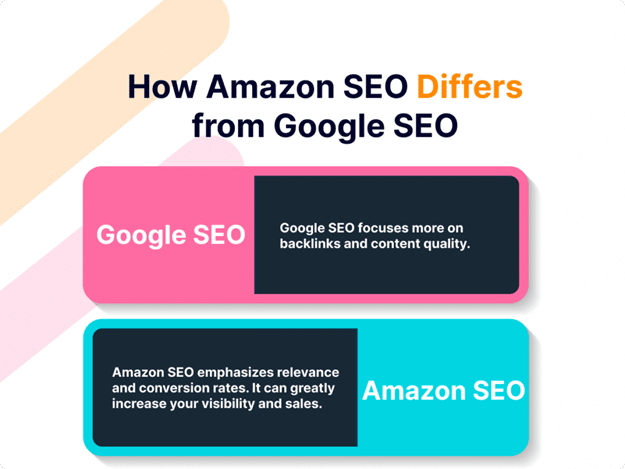
Backlinks remain one of Google’s strongest ranking signals.
Websites that earn high-quality external links generally build greater authority, making it easier to rank higher in search engine results.
Amazon works differently.
Product rankings are not influenced by backlinks. Instead, Amazon primarily evaluates product performance through sales history, conversions, and customer satisfaction.
Even though backlinks don’t directly impact Amazon rankings, external traffic can still provide value.
Creating informative blog content that links to your Amazon listings can attract interested buyers from Google. When those visitors convert into customers, stronger sales performance may positively influence your Amazon rankings. Many sellers also direct visitors to customized landing pages before sending them to Amazon listings, helping improve conversion rates while maintaining better control over the customer journey.
3. Optimization Based on Performance Insights
Focus
Google and Amazon measure success differently.
Google primarily evaluates how often users click on search results because it cannot always determine whether visitors ultimately complete their intended actions after leaving the search engine.
Amazon has a much clearer objective—whether shoppers purchase the product. As a result, customer satisfaction, conversion rates, and click-through rates all contribute significantly to product rankings.
Analytics
Google provides website owners with a wide range of analytics tools that help measure traffic, user behavior, technical performance, and search visibility.
Amazon, on the other hand, offers more limited marketplace data for sellers. This makes it important to regularly monitor available performance metrics such as sales, click-through rates, conversion rates, pricing, and keyword rankings using reliable analytics solutions.
Although Amazon’s SEO ecosystem continues to evolve, sellers who understand its ranking factors can still build strong product visibility through consistent optimization and data-driven improvements.
Final Thoughts
Amazon SEO and Google SEO serve different purposes, but both are valuable components of a successful online marketing strategy.
Google helps businesses generate awareness, attract organic visitors, and build long-term authority. Amazon focuses on connecting shoppers with products that are most likely to convert into sales.
Rather than choosing one over the other, sellers should leverage both platforms together. Driving qualified traffic from Google while optimizing Amazon listings for conversions creates a stronger overall strategy that can increase visibility, improve rankings, and generate sustainable business growth.