
The online business landscape is expanding rapidly. Today, there are estimated to be between 12 million and 24 million ECommerce businesses operating worldwide.
With such a massive number of online stores—and new ones launching every day—competition has become extremely intense. To stand out, businesses must sharpen their marketing strategies to attract attention and convert visitors into customers.
Once you successfully bring potential buyers to your website, the real challenge begins: convincing them to actually make a purchase.
While high-quality images, engaging descriptions, and appealing product presentation can encourage users to add items to their cart, one critical factor ultimately drives the final decision.
Think from a customer’s perspective—what truly influences your buying choice?
Is it attractive product images?
Superior product quality?
Positive customer reviews?
Or… competitive pricing?
In reality, pricing plays a major role. Customers are naturally drawn to platforms that offer products at appealing prices.
A well-planned pricing strategy is essential for staying ahead of competitors, increasing revenue, and maximizing profits. Businesses may set prices to achieve various goals, such as boosting profit margins, surviving in a competitive market, expanding market share, or outperforming rivals.
Pricing is a fundamental element of any marketing strategy. It is often the first thing customers evaluate before deciding whether to buy a product.
However, pricing decisions involve more than just profit calculations. Businesses must ensure that prices cover production, operational, and marketing costs while still delivering reasonable returns.
To remain profitable and competitive, setting the right price is crucial.
For newcomers to eCommerce, pricing can feel complex and time-consuming. Setting prices too high can drive customers away, while pricing too low can reduce profitability or even lead to losses.
In this article, we’ll explore key pricing strategies that can help you find the ideal balance between competitiveness and profitability.
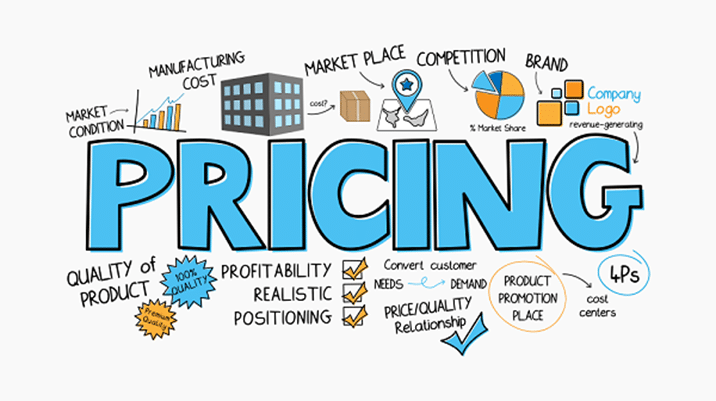
Seven Essential Ecommerce Pricing Strategies To Beat Your Competition
1. Cost-Based Pricing
Cost-based pricing is one of the most widely used approaches, especially among beginners in eCommerce.
This method focuses primarily on internal costs rather than customer perception. Businesses calculate prices based on expenses and desired profit margins without considering how much customers are willing to pay.
To determine the selling price, you add product cost, operational expenses, and your target profit per unit.
For example, if a product costs $10, with $4 in shipping and $5 in packaging, and you aim for a $6 profit, the final price becomes $25.
2. Competitor-Based Pricing
Another commonly used approach is competitor-based pricing, which requires market research.
Businesses monitor competitors selling similar products and analyze their pricing. By identifying the highest and lowest prices in the market, companies can determine an average price point.
However, many beginners make the mistake of pricing below average, which can hurt profitability and make it difficult to sustain business operations.
For instance, if your total cost is $21 and the average market price is $30, your potential profit would be $9 per unit.
3. Consumer-Based Pricing
Also known as value-based pricing, this strategy combines cost and competitor insights while focusing on perceived customer value.
In addition to covering costs and analyzing market prices, businesses consider what unique benefits they offer customers.
This could include superior quality, better packaging, exceptional service, or any unique selling point (USP).
For example, if your cost is $12 and the average market price is $18, your profit is $6. By adding value—such as premium packaging—you may increase the price to $20, raising your profit to $8 per unit.
4. Dynamic Pricing
Dynamic pricing involves adjusting prices based on market conditions, including demand, supply, and competition.
Prices can fluctuate depending on factors such as increased competition, seasonal demand, or excess inventory.
For example, prices may drop when competition intensifies or rise when demand is high and supply is limited.
This strategy works best for businesses that can continuously monitor market trends and competitor pricing.
5. Bundle Pricing
Bundle pricing is highly effective in competitive markets and helps increase average order value.
This strategy involves combining related products and selling them at a discounted price compared to buying them individually.
For example, if a pair of jeans costs $15, a t-shirt $5, and sunglasses $10, selling them as a bundle for $24 encourages customers to purchase more while saving money.
Bundling is also useful for promoting slow-moving or less popular items.
6. Loss Leader Pricing
Loss leader pricing attracts customers by offering certain products at very low prices, sometimes even below cost.
The goal is not to profit from these items but to bring customers into your store, where they are likely to purchase additional products.
For example, a company may sell a printer at a low price but generate profit from selling ink refills later.
This strategy is effective for businesses offering consumables or repeat-purchase products.
7. Price Skimming
Price skimming involves initially setting higher prices for exclusive or limited-edition products.
This creates a sense of urgency and exclusivity, encouraging customers to make quick purchasing decisions due to fear of missing out.
Another variation is offering limited-time discounts, such as a 30% sale for 24 hours, which motivates immediate action.

Bonus Ecommerce Pricing Strategies
8. Break-Even Pricing
Break-even pricing focuses on recovering costs without generating profit.
Businesses use this strategy to clear inventory that may expire, become outdated, or lose value.
9. Geographic Pricing
When selling internationally, businesses must adjust prices based on location-specific factors such as taxes, shipping costs, and import duties.
This strategy is often combined with other pricing methods to remain competitive across different markets.
10. Odd Pricing
Odd pricing is a psychological pricing tactic where prices end in numbers like .99 or .95.
For example, a product priced at $4.99 appears significantly cheaper than $5.00, even though the difference is minimal.
This small adjustment can influence customer perception and increase sales.
Final Thoughts
Choosing the right pricing strategy depends on your ecommerce business model and objectives.
Since costs such as raw materials, labor, shipping, and taxes can fluctuate, businesses must remain flexible and adjust pricing accordingly.
Setting fair and competitive prices is essential, as modern consumers are more informed and price-sensitive than ever.
To stay ahead, businesses can also leverage eCommerce data tools to gather accurate pricing insights and refine their strategies effectively.