
Selling through Amazon’s European marketplaces, including Amazon UK and other European stores, can give your business access to millions of potential customers. However, expanding into these markets also means understanding European Value Added Tax Amazon (VAT) and making sure your business meets its tax obligations.
Getting VAT wrong can lead to serious consequences, including penalties, inventory restrictions, tax assessments, and potentially problems with your Amazon selling account.
In this guide, we’ll cover the essential VAT information Amazon sellers need to understand when selling across the UK and European markets, including registration requirements, thresholds, VAT rates, filing options, and reclaiming VAT on eligible expenses.
What Is VAT?
VAT, or Value Added Tax, is a consumption tax applied to many goods and services sold throughout the UK and European markets.
Unlike the US sales tax system, VAT is generally collected at multiple stages of the supply chain. Businesses charge VAT on taxable sales and may be able to recover VAT paid on eligible business purchases and expenses.
Although the final consumer ultimately bears the cost of VAT, businesses are responsible for collecting, reporting, and paying the appropriate amount to the relevant tax authority.
How Does VAT Work?
VAT systems differ from one country to another, but the basic process is generally similar.
For example:
- A manufacturer purchases raw materials and pays VAT on those purchases.
- The manufacturer sells finished goods to a wholesaler and charges VAT.
- The wholesaler sells the goods to a retailer and collects VAT.
- The retailer eventually sells the product to the final customer and charges VAT.
At each stage, a business reports the VAT it collected on sales, known as output VAT, and can generally deduct eligible VAT paid on purchases, known as input VAT.
This means the amount a business ultimately pays to the tax authority is generally the difference between its output VAT and recoverable input VAT.
Example
Suppose a manufacturer pays £100 in VAT when purchasing raw materials.
The manufacturer then sells the finished goods to a wholesaler for £500 plus £100 VAT.
The wholesaler collects £100 in VAT from the transaction. If the wholesaler is entitled to deduct the £100 VAT previously paid on eligible purchases, the resulting VAT liability may be £0 for that transaction.
The process continues throughout the supply chain until the product reaches the final consumer, who ultimately bears the VAT cost.
For Amazon sellers, VAT registration can become necessary depending on factors such as where inventory is stored, where the business is established, how goods are shipped, and the applicable cross-border selling rules.
How VAT Differs From US Sales Tax
European VAT and US sales tax both place a consumption tax on goods and services, but they operate differently.
| Feature | VAT in Europe | Sales Tax in the US |
| Payable on Import | Import VAT may be due when inventory enters the EU | Sales tax generally applies at the point of taxable sale rather than simply because inventory enters a warehouse |
| Inclusion in Sale Price | Consumer-facing prices generally include VAT | Sales tax is typically added to the displayed price at checkout |
| Working Capital Impact | Import VAT can create an upfront cash-flow requirement | Sales tax generally becomes payable when a taxable sale occurs |
| Distance Selling Rules | Cross-border EU sales are subject to specific VAT rules and thresholds | US sales tax obligations depend on state-specific nexus rules |
Understanding this difference is especially important for sellers moving from the US marketplace into Amazon’s UK and European markets.
VAT for Distance Selling
Distance selling generally refers to situations where a business sells goods from one country to consumers located in another country.
For example, a business based in France could sell and ship products to customers in Germany. Similarly, a business operating in the UK could send products directly to consumers in another European market.
The growth of e-commerce has significantly increased cross-border sales, making VAT compliance more important for online sellers.
Without rules governing cross-border transactions, tax authorities would have difficulty managing VAT collection from businesses selling internationally.
Distance selling rules were therefore developed to establish when sellers become responsible for VAT in the destination country.
How Distance Selling Thresholds Work
Historically, EU countries operated individual distance-selling thresholds. However, the EU introduced major changes to its cross-border VAT system in 2021, including the €10,000 EU-wide threshold for certain intra-EU distance sales and the One Stop Shop (OSS) system.
The exact VAT obligation depends on the seller’s circumstances, including where the business is established, where inventory is stored, and how the goods are sold.
For qualifying EU distance sales, a seller below the applicable EU-wide threshold may generally apply the VAT rules of the country where the business is established.
Once the relevant threshold is exceeded, destination-country VAT rules can apply, with OSS potentially allowing eligible sellers to report qualifying cross-border sales through a single VAT return.
Amazon sellers should therefore monitor sales by destination and understand when registration or OSS reporting becomes necessary.
Why Distance Selling Thresholds Exist
Distance-selling rules are designed to make cross-border VAT administration more manageable while ensuring businesses compete fairly within the European market.
They help:
- Create clearer VAT obligations for cross-border sellers.
- Reduce the administrative burden for smaller businesses.
- Ensure VAT is collected appropriately as cross-border sales increase.
- Establish a framework for taxation based on where consumers are located.
- Make international e-commerce easier for tax authorities and businesses to administer.
These rules have evolved over time, so sellers should avoid relying on outdated country-by-country thresholds when planning their VAT obligations.
Tips for Managing Distance-Selling VAT
Amazon sellers can take several steps to make VAT management easier:
- Track sales separately by destination country.
- Monitor your cross-border sales against applicable thresholds.
- Review your VAT obligations before entering a new European marketplace.
- Consider registering proactively when your business circumstances require it.
- Use professional VAT support if you sell across multiple countries.
- Make sure the correct VAT treatment is applied to your transactions.
- Submit VAT returns and other required reports before their deadlines.
VAT can seem complicated when you first expand internationally, but consistent record-keeping and early planning can make compliance much easier.
What Happens If You Ignore VAT on Your Amazon Store?
Some sellers may be tempted to postpone VAT compliance, particularly when their business is still relatively small. However, ignoring your obligations can create significant financial and operational risks.
European and UK tax authorities have increased their focus on e-commerce businesses, particularly sellers operating across borders.
If you fail to register or report VAT when required, you could potentially face:
- Penalties and interest on unpaid VAT.
- Retrospective VAT assessments.
- Problems with your inventory.
- Additional compliance costs.
- Restrictions or suspension of your Amazon selling privileges.
Inventory storage is particularly important for Amazon FBA sellers. If your goods are stored in a country, that storage can create VAT registration obligations regardless of the level of your distance sales.
For example, sellers storing inventory in UK FBA facilities may have UK VAT obligations even if they have not reached a domestic sales threshold.
The key takeaway is simple: do not assume that being a small seller automatically means you have no VAT responsibilities.
Always determine your obligations based on your actual business structure, inventory locations, and sales model.
Do You Need to Set Up a Local UK or European Company?
Selling through Amazon UK or European marketplaces does not necessarily mean you need to establish a company in each market.
Depending on your circumstances, a non-UK or non-EU business may be able to sell internationally while remaining incorporated in its home country.
You may need to:
- Register for VAT in countries where you have relevant VAT obligations.
- Obtain appropriate tax or customs registrations.
- Appoint a fiscal representative where local rules require one.
- Maintain proper VAT records and submit required returns.
Creating a local company can have certain commercial or administrative advantages, but it can also introduce additional responsibilities.
These may include:
- More complicated accounting.
- Additional corporate tax obligations.
- Separate financial reporting.
- Local banking requirements.
- Greater administrative costs.
For many Amazon sellers, maintaining their existing business structure while meeting VAT obligations in the relevant markets can be more straightforward.
However, the right structure depends on your business model and should be assessed with qualified tax advice.
VAT Rates and Thresholds by Country
VAT rates vary across European countries, and the rules applicable to Amazon sellers can depend on the type of transaction and where inventory is located.
It is important to verify current rates and registration requirements directly with the relevant tax authority because VAT legislation and thresholds can change.
Common standard VAT rates include:
| Country | Standard VAT Rate |
| Austria | 20% |
| Belgium | 21% |
| Bulgaria | 20% |
| Croatia | 25% |
| Cyprus | 19% |
| Czech Republic | 21% |
| Denmark | 25% |
| Estonia | 24% |
| Finland | 25.5% |
| France | 20% |
| Germany | 19% |
| Greece | 24% |
| Hungary | 27% |
| Ireland | 23% |
| Italy | 22% |
| Latvia | 21% |
| Lithuania | 21% |
| Luxembourg | 17% |
| Malta | 18% |
| Netherlands | 21% |
| Poland | 23% |
| Portugal | 23% |
| Romania | 21% |
| Slovakia | 23% |
| Slovenia | 22% |
| Spain | 21% |
| Sweden | 25% |
| Switzerland | 8.1% |
Important: VAT registration thresholds and distance-selling rules are not interchangeable. Since the EU VAT framework changed significantly in 2021, sellers should check the current rules for their specific situation rather than relying on older country-by-country distance-selling threshold tables.
Pros and Cons of Registering for VAT Early
Some businesses choose to register for VAT before they are legally required to do so. Voluntary registration can provide benefits, but it also creates additional administrative responsibilities.
Advantages of Early VAT Registration
Build Business Credibility:
Having a VAT registration can make your business appear more established when working with suppliers, distributors, and other commercial partners.
Reduce Threshold Concerns:
Once registered, you do not have to worry about delaying registration simply because your sales are approaching a threshold.
Recover Eligible Input VAT:
VAT-registered businesses can generally recover eligible VAT paid on qualifying business expenses, subject to the applicable rules.
Prepare for Expansion:
Registering early can help establish accounting and reporting processes before your international sales become more complex.
Disadvantages of Early VAT Registration
More Administration:
VAT registration means additional records, calculations, reports, and filing deadlines.
Greater Risk of Errors:
Incorrect VAT calculations or reporting can result in penalties, interest, or additional compliance work.
Ongoing Costs:
Businesses that use accountants or VAT specialists will generally have continuing professional fees.
Additional Compliance Responsibilities:
VAT becomes another business process that needs to be monitored consistently.
Before voluntarily registering, sellers should consider both the potential benefits and the administrative costs involved.
How to File VAT Returns
Amazon sellers generally have three broad options for handling VAT returns:
- Filing themselves.
- Hiring a tax professional or VAT agency.
- Using an Amazon-supported VAT service where available.
Each option has different costs, benefits, and levels of involvement.
Self-Filing VAT Returns
With self-filing, you manage your VAT registrations, calculations, records, and returns yourself.
Depending on the country, you may be able to submit returns through the relevant tax authority’s online system. Accounting and VAT software can also help automate calculations and reporting.
The EU’s One Stop Shop (OSS) system can simplify certain qualifying cross-border B2C sales by allowing eligible businesses to declare VAT through a single return rather than registering separately for every destination country.
The Import One Stop Shop (IOSS) can also simplify VAT reporting for certain imported B2C goods valued at no more than €150.
However, OSS and IOSS do not cover every transaction or VAT obligation. Sellers may still need local VAT registrations and filings in particular circumstances.
The biggest advantage of self-filing is control. You can maintain direct visibility over your VAT records and potentially reduce professional fees.
The downside is that VAT regulations can be complex, and mistakes can become costly.
Using a Tax Agency
Another option is to work with a professional accountant or VAT compliance provider.
A tax agency can assist with:
- VAT registration.
- VAT calculations.
- Periodic VAT returns.
- Cross-border compliance.
- Record keeping.
- Communication with tax authorities.
- Understanding country-specific requirements.
This approach can save significant time, particularly for sellers operating across several European countries.
Professional support can also reduce the risk of errors and help you stay informed when tax rules change.
The main disadvantage is the ongoing cost of professional services.
Using Amazon’s VAT Services
Amazon sellers may also have access to Amazon’s VAT-related services, depending on their marketplace and location.
These services can help sellers with VAT registration and ongoing compliance, potentially making international expansion easier for businesses that primarily sell through Amazon.
One benefit is convenience, since sellers can manage certain tax-related services within the Amazon ecosystem.
However, sellers should compare pricing, service coverage, data requirements, and the level of support provided before choosing this option.
Businesses selling through multiple channels may also prefer working with an independent VAT provider that can manage information from Amazon as well as other sales channels.
Choosing the Right VAT Filing Option
There is no single VAT solution that works for every Amazon seller.
A smaller business operating in a limited number of markets may prefer handling its VAT obligations internally if it has the necessary knowledge and systems.
A growing seller operating across multiple European countries may benefit more from professional VAT support.
When comparing your options, consider:
- Number of countries involved.
- Number of transactions.
- Inventory locations.
- Filing frequency.
- Professional service costs.
- Your internal accounting knowledge.
- The time required to manage VAT yourself.
- Whether you sell through other sales channels.
You can also reassess your approach as your business grows. What works for a seller operating in one country may become inefficient once the business expands into several European marketplaces.
Regardless of the method you choose, make sure you understand where you need to register, what transactions must be reported, and which deadlines apply.
Can You Sell on Amazon Without Registering for VAT in the EU or UK?
In some situations, a seller may not immediately need VAT registration based solely on the volume of cross-border sales.
However, VAT registration requirements depend on more than sales volume.
Factors such as inventory storage, business establishment, import activity, marketplace structure, and the type of transaction can create VAT obligations.
For Amazon FBA sellers, inventory location is especially important.
If your goods are stored in a particular country, you may have VAT responsibilities there even when your sales have not reached a traditional distance-selling threshold.
Failing to address VAT obligations can result in:
- Backdated VAT liabilities.
- Penalties and interest.
- Additional accounting costs.
- Problems with tax authorities.
- Potential Amazon account restrictions.
Rather than waiting until a problem occurs, sellers should review their VAT obligations before entering a new market or moving inventory into a new country.
How to Claim Back VAT on Amazon Seller Fees
Amazon sellers may incur VAT on certain marketplace, seller, advertising, storage, or fulfillment-related charges depending on their business location and the applicable tax treatment.
Where VAT has been correctly charged and the business is eligible to recover it, the VAT may potentially be reclaimed through the seller’s VAT return.
This can become significant for businesses with substantial Amazon fees.
Who Can Reclaim VAT on Amazon Fees?
Eligibility depends on the seller’s business location, VAT registration status, the nature of the charge, and the VAT treatment shown on the relevant invoice.
A VAT-registered business may generally recover eligible input VAT where the applicable requirements are met.
Before making a claim, sellers should check their Amazon invoices and consult their accountant or VAT adviser to confirm that the VAT is recoverable.
How Much VAT Can You Reclaim?
The amount you can potentially recover depends on the VAT actually charged and the rules governing the particular expense.
To calculate eligible VAT:
- Review your Amazon tax invoices.
- Download relevant fee and transaction reports from Seller Central.
- Identify charges where recoverable VAT was applied.
- Add the eligible VAT amounts for the reporting period.
- Include the amount in the appropriate VAT return.
For example, if eligible business expenses include £48,000 of charges on which VAT was correctly charged at 20%, the VAT component would be £8,000 if £48,000 represents the VAT-inclusive total.
The calculation must always be based on the actual VAT shown on valid tax invoices rather than simply applying a percentage to every Amazon fee.
Steps to Reclaim VAT on Amazon Fees
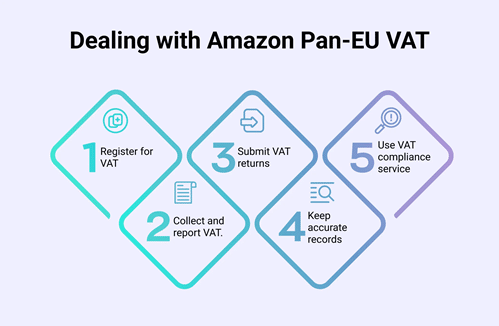
1. Review Your Amazon Tax Documents
Download the relevant invoices, transaction reports, and fee records from Seller Central.
2. Confirm Your VAT Status
Make sure your business is properly registered and eligible to recover the VAT involved.
3. Identify Recoverable VAT
Separate eligible VAT from charges that do not qualify for recovery.
4. Include the Amount in Your VAT Return
Report eligible input VAT through the appropriate VAT return or reclaim process.
5. Keep Supporting Records
Retain invoices and other documentation in case the tax authority requests evidence.
If you believe Amazon has incorrectly charged VAT or you require corrected tax documentation, contact Amazon Seller Support and provide the relevant account and tax information.
Final Thoughts
Understanding VAT is an essential part of selling successfully on Amazon’s UK and European marketplaces.
VAT can initially seem complicated because requirements vary according to the country, transaction type, inventory location, and business structure. However, establishing the right processes early can make compliance much easier as your Amazon business grows.
The most important step is to understand your obligations before expanding into a new marketplace or moving inventory into another country.
Keep accurate records, monitor where your inventory is stored, track your cross-border sales, and stay aware of registration and filing requirements.
If you operate across several European markets, professional VAT support can also save time and reduce the risk of costly compliance mistakes.
Don’t let VAT complexity stop you from expanding internationally. With proper planning, accurate records, and the right compliance strategy, you can approach the UK and European Amazon markets with greater confidence while keeping your business on the right side of tax regulations.