Social commerce has quickly become one of the biggest trends in ecommerce, and TikTok Shop is leading that transformation. Although the platform has only been active for a short time, it has already attracted more than 15 million sellers worldwide. In the United States alone, TikTok Shop sales are projected to reach $17.5 billion, highlighting its remarkable growth and increasing influence in online retail.
The platform’s success is also reflected in customer behavior. In 2024, over 81% of TikTok users made purchases through TikTok Shop, representing a significant increase compared to the previous year. This growth demonstrates that TikTok Shop has not only retained existing customers but has also continued attracting new buyers through its engaging shopping experience.
These figures clearly show that TikTok has found an effective way to turn entertainment into commerce. By combining engaging content with seamless purchasing options, the platform has created a shopping experience that encourages users to buy products while they scroll through their feeds.
However, the biggest question for online sellers remains: Can TikTok Shop compete with Amazon, the world’s largest ecommerce marketplace? While both platforms allow businesses to sell products online, they operate very differently and cater to distinct customer behaviors. Understanding these differences is essential before deciding where to invest your time and resources.
In this guide, we’ll compare TikTok Shop vs Amazon, exploring their business models, selling opportunities, target audiences, marketing tools, fulfillment options, and overall advantages to help you determine which platform best aligns with your ecommerce goals.
TikTok Shop vs Amazon: An Overview
TikTok Shop
TikTok Shop combines social media and ecommerce into a single platform, allowing businesses to showcase and sell products without requiring customers to leave the TikTok app. Instead of searching for products directly, users discover them naturally while watching entertaining videos, livestreams, and creator content.
With a global audience exceeding 1.8 billion monthly active users, TikTok gives sellers access to a massive community of potential customers. The platform simplifies the buying journey by allowing viewers to purchase products with just a few taps, creating a seamless experience from product discovery to checkout.
One of TikTok Shop’s greatest strengths is its recommendation algorithm. Rather than relying solely on keyword searches, TikTok analyzes user behavior—including videos watched, interactions, likes, comments, and interests—to recommend products that are most relevant to each individual. This personalized approach significantly improves product visibility for sellers whose offerings match users’ preferences.
Since launching TikTok Shop in the U.S., the platform has continued refining its social commerce strategy. By focusing on how younger consumers interact with digital content, TikTok has created a marketplace where entertainment and shopping work together, making product discovery feel natural instead of promotional.
Amazon
Amazon takes a much more traditional ecommerce approach. Instead of encouraging product discovery through entertainment, it connects buyers and sellers in a marketplace where customers typically search for products they already intend to purchase.
Over the years, Amazon has built a reputation for reliability, fast delivery, extensive product selection, and strong customer service. Originally launched as an online bookstore, the platform has expanded into one of the world’s largest online marketplaces, offering everything from household essentials and beauty products to electronics, fashion, and industrial supplies.
Its vast customer base and wide range of product categories give sellers access to shoppers with strong purchase intent. Regardless of the niche, businesses have an opportunity to reach customers actively looking for products similar to theirs.
However, Amazon’s popularity also creates intense competition. Standing out among millions of listings requires more than simply uploading products. Sellers often rely on optimized product listings, advertising campaigns, branding tools, and fulfillment services to improve visibility and drive consistent sales.
Although both Amazon and TikTok Shop enable businesses to sell online, they operate on entirely different principles. TikTok Shop revolves around content-driven discovery and impulse buying, while Amazon focuses on search-driven shopping and intentional purchasing. Understanding these differences is the first step toward choosing the platform that best fits your business strategy.
TikTok Shop vs Amazon Business Model
When comparing TikTok Shop and Amazon, the biggest distinction lies in how each platform encourages customers to make purchases.
TikTok Shop is built around social commerce, where engaging videos, influencer content, and livestreams introduce products to potential buyers. Instead of actively searching for items, users discover them while consuming entertaining content. The shopping experience is designed to feel organic, making purchases a natural extension of the content viewers already enjoy.
Amazon, on the other hand, follows the traditional ecommerce marketplace model. Customers usually visit Amazon with a specific goal—finding a product, comparing options, and completing a purchase. Rather than relying on entertainment, Amazon prioritizes convenience, product availability, customer trust, and efficient order fulfillment.
Another major difference is the purchasing mindset of customers.
TikTok Shop encourages impulse buying. Viral videos, influencer recommendations, and limited-time offers often motivate users to make quick purchasing decisions before they leave the app. Since the checkout process is fast and convenient, customers can complete purchases within moments of discovering a product.
Amazon shoppers typically display high purchase intent. They visit the platform because they already need or want a product, making their buying decisions more deliberate. Customers often compare reviews, prices, product features, and seller ratings before placing an order.
For sellers, this distinction is significant. TikTok Shop excels at generating product awareness and driving spontaneous purchases, while Amazon is better suited for capturing shoppers who are already prepared to buy. Both approaches can be highly effective, but the right choice depends on your products, marketing strategy, and long-term business objectives.
TikTok Shop vs Amazon: Market Entry
TikTok Shop
Getting started on TikTok Shop involves more than simply creating a seller account. Since the platform is built around social commerce, success largely depends on producing engaging content that attracts viewers and encourages purchases. Once you register through the TikTok Seller Center, you can list your products and begin selling in eligible regions.
At present, TikTok Shop is available in selected markets, including the United States, the United Kingdom, and several Asian countries. While its availability is expanding, it still doesn’t have the same global reach as Amazon.
To stand out on TikTok Shop, sellers need to invest in content creation. High-quality product images and detailed descriptions remain important, but short-form videos, live shopping sessions, and participation in trending topics often have a greater impact on visibility. Businesses that consistently create entertaining or educational content are more likely to gain traction and attract new customers through TikTok’s recommendation algorithm.
Unlike traditional ecommerce platforms, TikTok rewards creativity and audience engagement. Sellers who adapt to viral trends and produce authentic content often experience stronger organic reach and higher product exposure.
Amazon
Launching a business on Amazon is generally more straightforward for sellers who prefer a traditional ecommerce model. After creating an account through Amazon Seller Central, sellers can choose the selling plan that best fits their business and begin listing products.
Unlike TikTok Shop, Amazon doesn’t require businesses to become content creators. Instead, success depends on creating well-optimized product listings, maintaining competitive pricing, and providing excellent customer service.
Amazon offers a wide range of tools to help sellers grow their businesses. Features such as Brand Registry, Seller Central analytics, inventory management tools, and advertising solutions enable businesses to improve their listings, protect their brand, and increase product visibility.
Search engine optimization also plays a crucial role on Amazon. By conducting keyword research, optimizing product titles and descriptions, and utilizing Amazon’s search term reports, sellers can improve their rankings in search results and attract more qualified buyers organically.
Additionally, Amazon Advertising provides multiple promotional options—including Sponsored Products, Sponsored Brands, and Sponsored Display campaigns—that help sellers reach shoppers who are actively searching for related products. These advertising tools can significantly increase traffic and sales when managed effectively.
Overall, Amazon offers a structured environment where sellers can focus on product optimization, inventory management, and customer satisfaction without relying heavily on social media content.
TikTok Shop vs Amazon: Target Audience
One of the biggest differences between TikTok Shop and Amazon is the type of audience each platform attracts and how customers interact with products.
TikTok Shop is designed for users who enjoy discovering products while consuming entertaining content. Its audience is largely made up of Gen Z and younger Millennials, who spend significant time watching short-form videos, engaging with creators, and following online trends. The platform encourages spontaneous shopping by integrating products directly into videos, livestreams, and creator content.
Visual storytelling plays a central role in TikTok’s shopping experience. Interactive product demonstrations, strong calls to action, and live selling events help brands capture attention quickly and encourage immediate purchases before users continue scrolling.
Amazon, on the other hand, serves a much broader customer base. With decades of brand recognition and millions of active shoppers worldwide, Amazon attracts customers across nearly every age group and product category.
Most Amazon users visit the platform with a clear purpose. Whether they’re searching for electronics, household essentials, beauty products, or business supplies, they typically have a purchase intention before they even begin browsing. This behavior makes Amazon one of the most trusted search destinations for online shopping.
Its extensive product catalog, reliable shipping network, and strong customer service have helped Amazon build long-term consumer trust, making it a preferred marketplace for buyers seeking convenience and reliability.
TikTok Shop vs Amazon: Which Platform Is Better for Younger Audiences?
If your primary goal is to reach younger consumers, TikTok Shop offers a significant advantage.
The platform’s algorithm continuously recommends products based on users’ interests, viewing habits, and engagement history. As a result, businesses can expose their products to highly relevant audiences without requiring customers to actively search for them.
TikTok’s short-form videos, influencer collaborations, and livestream shopping experiences align closely with the shopping habits of Gen Z consumers, who often make purchasing decisions based on trends, recommendations, and social proof.
For sellers, this creates excellent opportunities to generate rapid sales through engaging content. However, because many purchases are driven by impulse, businesses may also experience higher rates of order cancellations or returns compared to more intentional shopping platforms.
Amazon remains an excellent option for reaching customers across all demographics, including younger shoppers. However, its shopping experience is built around search intent rather than entertainment, making it better suited for consumers who already know what they want to buy.
Ultimately, businesses targeting trend-conscious, social-media-driven audiences may benefit more from TikTok Shop, while those seeking long-term, broad-market growth often find Amazon to be the stronger platform.
TikTok Shop vs Amazon: Product Listings
TikTok Shop
TikTok Shop gives sellers a simple and user-friendly interface for creating and managing product listings. Businesses can upload high-quality images, write compelling product descriptions, add variations such as size or color, and enhance listings with short-form videos that demonstrate products in action.
A key advantage of TikTok Shop is that product listings are closely connected to the platform’s content ecosystem. Rather than relying primarily on keyword searches, TikTok recommends products based on user engagement, viewing habits, and personal interests. This allows products to appear naturally in users’ feeds, increasing the chances of reaching potential customers who are most likely to make a purchase.
Because the platform is driven by its recommendation algorithm, sellers should optimize every listing with relevant keywords, descriptive product information, and eye-catching visuals. Well-optimized listings improve discoverability and help the algorithm understand which audience is most relevant for each product.
Another standout feature is product tagging. Sellers can tag products directly within videos, livestreams, and other content, allowing viewers to purchase an item without leaving the app. This seamless shopping experience shortens the path from product discovery to checkout and encourages higher conversion rates.
Amazon
Amazon provides a far more comprehensive product listing system, making it suitable for businesses with large product catalogs and long-term growth strategies.
Sellers can create detailed product pages that include optimized titles, bullet points, comprehensive descriptions, high-resolution images, videos, and A+ Content for enhanced brand storytelling. These elements help shoppers understand product features while building trust in the brand.
Unlike TikTok Shop, Amazon’s product discovery is primarily driven by customer searches. Buyers typically enter keywords related to the products they need, making search engine optimization (SEO) one of the most important factors in achieving visibility.
To improve rankings, sellers should focus on keyword-rich titles, informative descriptions, backend search terms, competitive pricing, and strong customer reviews. Optimized listings are more likely to appear higher in Amazon’s search results, increasing both traffic and sales.
While TikTok Shop relies on personalized recommendations and engaging content to surface products, Amazon rewards well-optimized listings that match customer search intent. As a result, SEO plays a much larger role in driving organic visibility on Amazon.
TikTok Shop vs Amazon: Advertising Opportunities and Promotions
Both offer powerful advertising solutions, but they are designed around different customer behaviors and marketing objectives.
TikTok Shop
TikTok’s advertising ecosystem is built around content engagement and social interaction. Brands can leverage multiple promotional tools to increase product visibility and encourage purchases.
Hashtag Campaigns
Branded hashtag campaigns allow businesses to participate in trending conversations or launch custom challenges that encourage user-generated content. These campaigns can significantly expand brand reach and increase audience engagement.
In-Feed Ads
TikTok’s native in-feed ads appear naturally within the For You feed, blending seamlessly with organic content. Because these ads match users’ viewing preferences, they often generate strong engagement without interrupting the browsing experience.
Live Shopping
Live shopping events enable sellers to showcase products, answer customer questions, demonstrate product features, and offer limited-time deals in real time. This interactive format creates urgency and often leads to higher conversion rates.
TikTok Ads Manager
The TikTok Ads Manager provides businesses with tools to create, manage, optimize, and analyze advertising campaigns. Sellers can target specific audiences, monitor campaign performance, and refine their marketing strategies using detailed performance metrics.
TopView Ads
TopView is one of TikTok’s premium advertising formats. These full-screen ads appear immediately when users open the app, delivering maximum visibility and making them ideal for major product launches or large-scale branding campaigns.
Branded Effects
Businesses can create custom filters, stickers, and augmented reality effects that encourage users to interact with their brand. These creative experiences increase engagement while helping brands reach a wider audience through user-generated content.
Amazon
Amazon’s advertising platform focuses on helping sellers reach customers who are actively searching for products. Its advertising solutions are designed to increase visibility throughout the shopping journey.
Sponsored Products
Sponsored Products are Amazon’s most widely used pay-per-click (PPC) advertising format. These ads appear within search results and product detail pages, helping individual listings gain more visibility and drive qualified traffic.
Sponsored Brands
Sponsored Brands allow businesses to promote multiple products alongside their brand logo and custom headline. These advertisements typically appear at the top of Amazon search results, making them effective for increasing brand awareness and driving shoppers to a branded storefront.
Sponsored Display
Sponsored Display ads extend beyond Amazon’s search results. They can appear across Amazon’s marketplace as well as third-party websites, making them valuable for retargeting shoppers who previously viewed a product but didn’t complete a purchase.
Amazon Live
Amazon Live gives brands the opportunity to host interactive livestreams where they can demonstrate products, answer customer questions, and engage directly with shoppers. Similar to live shopping on social platforms, this feature helps build customer trust while showcasing products in real time.
Custom Brand Storefronts
Eligible brands can build customized storefronts that showcase their complete product catalog within Amazon. These digital storefronts provide a branded shopping experience, making it easier for customers to browse related products and learn more about the business.
While both platforms offer effective advertising solutions, their approaches differ significantly. TikTok Shop emphasizes content-driven engagement, viral reach, and social interaction, whereas Amazon focuses on capturing high-intent shoppers through search-based advertising and brand visibility. Businesses can achieve excellent results on either platform by choosing the advertising strategy that aligns with their target audience and sales objectives.
TikTok Shop vs Amazon: Selling Fees
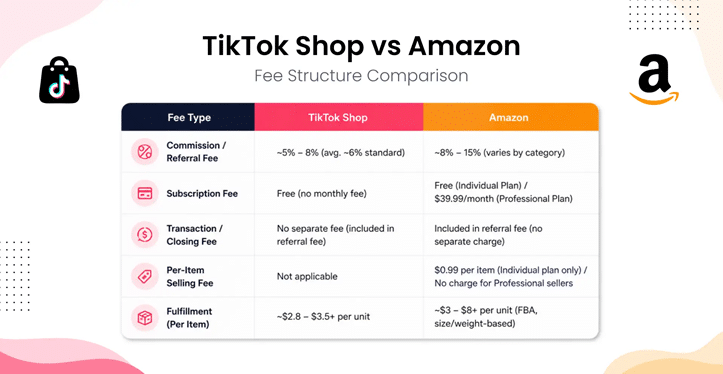
Before choosing between TikTok Shop and Amazon, it’s important to understand the costs involved. While both platforms charge selling fees, their pricing structures are quite different.
| Fee Type | TikTok Shop | Amazon |
| Commission Fee | Promotional rates may apply for new sellers, with standard commission varying by marketplace. | Usually ranges from 8% to 15%, depending on the product category. |
| Transaction Fee | Varies by country and marketplace. | Not applicable. |
| Closing Fee | Not applicable. | May apply to certain product categories and selling plans. |
| Monthly Subscription | No monthly subscription for most sellers. | Professional selling plan requires a monthly subscription fee. |
TikTok Shop generally has lower upfront costs, making it attractive for new businesses and smaller brands looking to enter social commerce. Since there is typically no recurring monthly subscription, sellers can start with relatively low operating expenses.
Amazon, on the other hand, charges referral fees based on product categories, and sellers who choose the Professional selling plan pay a monthly subscription. Although the overall costs can be higher, Amazon provides access to a mature marketplace, advanced seller tools, and one of the world’s largest online customer bases.
When evaluating costs, sellers should look beyond platform fees alone. Marketing expenses, fulfillment costs, advertising budgets, and customer acquisition strategies all contribute to the overall profitability of selling on either marketplace.
FBA vs FBT: What’s the Difference?
Order fulfillment is another major factor when comparing TikTok Shop and Amazon.
Fulfillment by TikTok (FBT)
It offers several fulfillment options, including self-fulfillment, platform-supported shipping, and Fulfillment by TikTok (FBT). Through FBT, sellers can store inventory in TikTok-operated fulfillment centers, allowing the platform to handle storage, packing, and shipping on their behalf.
Although FBT offers a convenient fulfillment solution, it is currently available only in selected markets such as the United States and the United Kingdom. In addition, access may be limited depending on eligibility requirements, making it unavailable to some sellers.
As TikTok continues expanding its ecommerce ecosystem, its fulfillment network is expected to grow, but it is still relatively new compared to more established logistics programs.
Fulfillment by Amazon (FBA)
Amazon’s Fulfillment by Amazon (FBA) remains one of the platform’s strongest advantages. Sellers send their inventory to Amazon’s fulfillment centers, where Amazon manages storage, order processing, shipping, customer service, and returns.
Unlike newer fulfillment programs, FBA is widely available to Amazon sellers across numerous marketplaces, making it a practical solution for businesses looking to scale both domestically and internationally.
FBA also provides access to Amazon’s extensive logistics infrastructure, fast shipping services, and trusted customer support, helping sellers deliver a consistent buying experience while reducing the operational burden of managing orders themselves.
Comparing FBA and FBT
While both fulfillment programs simplify order management, there are several notable differences.
TikTok’s fulfillment service is still expanding and has a more limited geographic reach. Amazon FBA, in contrast, has been refined over many years and supports sellers across a much larger global network.
Both programs help reduce the workload associated with packing and shipping orders, allowing sellers to focus on growing their businesses. However, Amazon’s mature logistics ecosystem, wider availability, and proven reliability currently make FBA the more comprehensive fulfillment solution for businesses planning long-term growth.
For sellers targeting social commerce audiences, TikTok’s fulfillment services continue to improve and may become an increasingly attractive option as the platform expands into new markets.
Cross-Platform Strategy for Long-Term Success
Choosing between Amazon and Tiktok Shop doesn’t have to be an either-or decision. Many successful ecommerce brands use both platforms together to maximize their reach, attract different types of customers, and increase overall sales.
It excels at generating product awareness through engaging videos, creator collaborations, and viral content. Amazon, on the other hand, provides a trusted marketplace where shoppers often complete purchases after researching products and comparing options. Combining the strengths of both platforms allows businesses to build a more effective and balanced sales strategy.
Here are a few best practices for creating a successful cross-platform approach:
Maintain Consistent Branding
Use the same brand identity across both platforms. Your logo, color palette, messaging, and product presentation should remain consistent to strengthen brand recognition and build customer trust. A unified brand experience makes your business look more professional and memorable.
Optimize Product Listings
Ensure your product information is accurate and consistent across both marketplaces. Use high-quality images, detailed descriptions, and up-to-date pricing so customers receive the same reliable information regardless of where they discover your products.
Leverage Each Platform’s Strengths
Take advantage of ability to generate excitement through short-form videos, livestreams, and trending content to introduce your products to new audiences. At the same time, use Amazon’s established reputation, search visibility, and fulfillment network to convert high-intent shoppers into loyal customers.
Rather than treating the platforms as competitors, businesses can use them together to create a stronger ecommerce presence and diversify their sales channels.
Final Thoughts: Which Platform Is Better?
The choice between Amazon and Tiktok Shop ultimately depends on your business goals, target audience, and growth strategy.
If your objective is to build a scalable ecommerce business with access to a large global customer base, reliable logistics, and advanced selling tools, Amazon remains one of the strongest marketplaces available. Its mature ecosystem, fulfillment services, and search-driven shopping experience make it well suited for businesses focused on sustainable, long-term growth.
On the other hand, if your products perform well through visual storytelling, influencer marketing, and trend-driven content, TikTok offers an exciting opportunity to reach highly engaged audiences. The platform is particularly effective for brands targeting Gen Z and younger Millennial shoppers who frequently discover products through social media.
Each marketplace has unique advantages. Amazon provides trust, stability, and operational efficiency, while TikTok delivers creativity, product discovery, and strong engagement through social commerce.
Instead of choosing one over the other, many businesses achieve the best results by incorporating both platforms into their ecommerce strategy. It can generate awareness and attract new customers, while Amazon can provide a trusted environment where shoppers confidently complete their purchases.
By understanding how each platform works and aligning them with your business objectives, you can create a diversified selling strategy that supports both short-term sales and long-term growth at Tiktok shop vs Amazon.