
Standing out on Amazon is becoming more challenging as millions of products compete for shoppers’ attention every day. Success isn’t just about having a great product—it’s about placing that product in front of customers who are already interested in buying something similar. This is where Amazon Product Targeting becomes one of the most effective advertising strategies available to sellers.
Instead of relying solely on keyword-based campaigns, Amazon Product Targeting allows advertisers to position their products on relevant product pages and within related shopping categories. By showing ads to shoppers who are already browsing similar products, sellers can improve visibility, attract qualified traffic, and increase the chances of generating conversions.
As Amazon’s advertising platform continues to evolve, Sponsored Ads have become far more sophisticated than they were a few years ago. Alongside traditional keyword targeting, advertisers can now use advanced product and category targeting options to reach highly relevant audiences. These capabilities give brands greater control over where their ads appear and who sees them.
Today’s shoppers expect personalized experiences when browsing online. As eCommerce continues to grow, businesses that leverage tools like Amazon PPC Product Targeting and Amazon Product Attribute Targeting gain a competitive advantage by delivering relevant advertisements at the right moment in the customer’s buying journey.
In this guide, you’ll learn how Amazon Product Targeting works, how to build successful campaigns, when to use category or ASIN targeting, and how to optimize your advertising strategy to maximize sales while improving your return on ad spend.
What is Amazon Product Attribute Targeting?
Amazon Product Attribute Targeting is an advertising feature that enables sellers to display Sponsored Product ads based on the characteristics of specific products rather than relying only on search keywords.
Simply put, this targeting method allows your advertisements to appear on competing product listings, relevant product detail pages, and category shopping results. Instead of waiting for customers to search for a keyword, you can place your products directly in front of shoppers already considering similar items.
The feature provides advertisers with greater precision by allowing campaigns to target products based on factors such as:
- Brand
- Product category
- Price range
- Customer ratings
- Individual ASINs
This level of targeting makes it easier to connect with shoppers who are actively researching products similar to yours, helping increase visibility among high-intent buyers.
Amazon Product Attribute Targeting can generally be divided into two primary approaches:
- Manual Product Targeting, which gives advertisers complete control over product selection and audience refinements.
- Enhanced Automatic Targeting, where Amazon identifies suitable products and search opportunities using its advertising algorithm while still offering improved targeting options compared to traditional automatic campaigns.
Both approaches serve different purposes and, when used strategically together, can create a well-balanced advertising strategy that improves exposure, drives qualified traffic, and supports long-term sales growth.
Best Strategies for Amazon Product Attribute Targeting
Simply enabling Product Targeting isn’t enough to achieve strong advertising results. To maximize your return on investment, you need a strategy that aligns with your business goals, product lifecycle, and competition. Below are some of the most effective ways to use Amazon Product Targeting to improve visibility and drive more sales.
1. Increase Visibility During Product Launches
Launching a new product on Amazon can be challenging because there is little historical data available to determine which keywords will perform best. During this stage, the primary objective is to generate awareness, attract shoppers, and build initial sales momentum.
Product Targeting provides an excellent solution by allowing you to advertise on product pages that already receive significant customer traffic. Instead of waiting for your listing to rank organically, you can position your product alongside established brands and popular listings where shoppers are actively browsing.
This strategy works especially well for products that offer improved features, better quality, or unique advantages over existing alternatives. By targeting similar products, you introduce your brand to customers who are already interested in that product category.
For example, if you’ve developed a sunscreen with longer-lasting protection or cleaner ingredients, advertising on popular sunscreen listings can help you capture shoppers looking for similar products.
Pro Tip: Always research your competitors before launching your campaign. Your pricing, product quality, and overall value proposition should be competitive. If your product targets budget-conscious shoppers, avoid placing ads on premium luxury brands where buying behavior differs significantly.
2. Win Customers from Your Competitors
One of the most powerful uses of Amazon Product Targeting is reaching customers who are already considering competing products.
Instead of relying only on keyword searches, you can display your ads directly on competitor listings, giving shoppers an alternative option before they complete their purchase.
However, successful competitor targeting requires careful analysis rather than targeting every competing ASIN.
Start by reviewing your advertising reports and identifying which competitor products already generate clicks and conversions. These listings often represent the strongest opportunities for expanding your market share.
When selecting competitors, pay close attention to factors such as:
- Customer ratings
- Product pricing
- Review count
- Listing quality
- Overall product value
In many cases, targeting products with lower ratings, fewer reviews, or higher prices can produce better conversion rates because shoppers are already looking for better alternatives.
On the other hand, aggressively targeting listings that outperform your product in every aspect may result in lower click-through rates and higher advertising costs.
The goal isn’t simply to compete—it’s to present shoppers with a compelling reason to choose your product instead.
3. Protect Your Brand and Market Share
Product Targeting isn’t only designed to attract competitors’ customers—it can also help you retain your own.
By advertising your products on your own listings, you reduce the likelihood of shoppers clicking competitor Sponsored Ads that appear alongside your products.
This defensive advertising strategy is particularly effective for brands with multiple complementary products or product variations.
For example, if a customer is viewing one of your products, you can advertise another related item from your catalog to encourage additional purchases instead of allowing competitors to capture that traffic.
Focus this strategy on products that already have:
- Strong customer reviews
- High star ratings
- Competitive pricing
- Consistent sales performance
You can also cross-promote accessories, upgraded versions, or related products that naturally fit the customer’s shopping journey.
Protecting your own product pages helps strengthen brand loyalty, increase average order value, and reduce the chances of losing potential buyers to competing brands.
How to Set Up Amazon Product Targeting Ads
Creating a Product Targeting campaign is straightforward within Amazon Advertising. During campaign setup, simply choose Manual Targeting, then select Product Targeting instead of Keyword Targeting.
From there, Amazon allows you to target either:
- Product Categories
- Individual Products (ASINs)
Each option offers different advantages depending on your campaign objectives, advertising budget, and overall marketing strategy. The next section explains both targeting methods in detail and helps you determine when each should be used.
Understanding Manual Product Targeting
Amazon’s Manual Product Targeting gives advertisers greater control over where Sponsored Product ads appear. Instead of relying on Amazon’s algorithm to determine placements, you can manually choose the products or categories that best match your advertising goals.
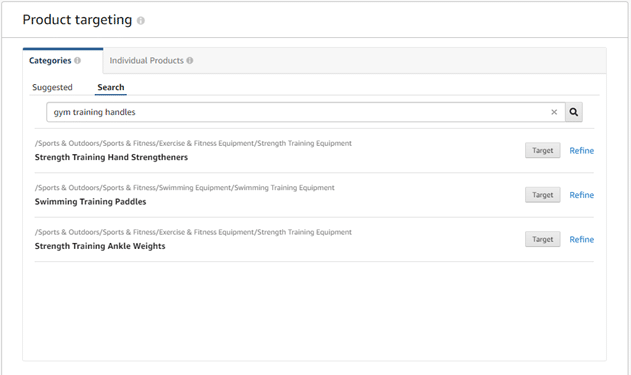
When creating a Manual Product Targeting campaign, Amazon offers two primary targeting options:
- Category Targeting
- Individual ASIN Targeting
Each serves a different purpose and should be used strategically based on your campaign objectives.
1. Category Targeting
Category Targeting allows your ads to appear across an entire product category instead of targeting individual products. This approach gives your campaigns broader exposure and helps your products reach shoppers exploring similar items.
Amazon also provides several refinement options within Category Targeting, enabling advertisers to narrow their audience using filters such as:
- Brand
- Price range
- Customer star ratings
These refinements help ensure your ads are displayed to shoppers browsing products that closely match your ideal customer profile.
Category Targeting is especially useful for:
- Launching new products
- Building brand awareness
- Introducing shoppers to a new product line
- Increasing visibility across a competitive niche
Since your ads can appear across a wide range of listings, this strategy is ideal when your goal is expanding reach rather than focusing solely on immediate conversions.
Best Practice: Don’t target every available category. Instead, identify categories that closely align with your products and refine them using filters such as pricing, ratings, and brands to improve campaign efficiency.
2. Individual ASIN Targeting
Individual ASIN Targeting provides much greater precision than category targeting.
Rather than targeting an entire category, you manually choose the exact Amazon products where you’d like your Sponsored Product ads to appear.
Amazon offers several ways to build your ASIN list:
- Select recommended products suggested by Amazon
- Search for individual ASINs manually
- Upload a list of ASINs in bulk
This targeting method allows advertisers to place products directly in front of shoppers who are actively considering specific competing products.
Individual ASIN Targeting works particularly well when you’ve already identified products that closely compete with yours or products where your offering provides a stronger value proposition.
Because your audience is much more focused, these campaigns often deliver higher conversion rates and better control over advertising spend.
Category Targeting vs. Individual ASIN Targeting
Although both targeting methods serve the same overall purpose, they are designed for different stages of an advertising strategy.
When to Use Category Targeting
Category Targeting is best suited for campaigns focused on maximizing exposure.
Since your ads become eligible to appear across many products within an entire category, you can generate significant impressions and introduce your brand to a much larger audience.
This approach is ideal when:
- Launching a new product
- Expanding brand awareness
- Testing new product categories
- Growing visibility before optimizing for profitability
However, because the audience is broader, conversion rates may initially be lower. Without proper optimization, advertising costs and ACoS can increase.
When to Use Individual ASIN Targeting
Individual ASIN Targeting is better suited for sellers seeking greater precision and stronger conversion performance.
By selecting specific competitor products or complementary listings, you gain far more control over where your ads appear.
This strategy is especially effective when:
- You know which competitors you want to target.
- Your product offers better value or pricing.
- You want to defend your market share.
- Historical campaign data identifies high-performing ASINs.
Although the audience size is smaller compared to Category Targeting, the traffic is generally more qualified, resulting in stronger conversion potential and improved return on ad spend.
Refining Product Targets for Better Results
One of the biggest advantages of Category Targeting is the ability to narrow your audience using refinement filters.
Instead of advertising across an entire category, you can focus on products that closely match your ideal customer.
Brand Targeting
Brand refinement allows advertisers to display ads alongside products from selected brands.
This strategy works well when targeting established brands that receive consistent traffic and customer attention. By appearing on these listings, your products gain exposure to shoppers already interested in that market segment.
Price Targeting
Price refinement enables you to target products within a specific price range.
Many advertisers use this feature to position competitively priced products alongside higher-priced alternatives, giving shoppers a compelling reason to consider a more affordable option without sacrificing quality.
Rating Targeting
Customer ratings can also be used to refine your campaigns.
Targeting products with lower star ratings allows your product to appear before shoppers who may be dissatisfied with competing options.
If your listing has stronger reviews, better ratings, or additional features, this strategy can significantly improve your chances of winning the sale.
Advantages of Amazon Product Attribute Targeting
Amazon Product Attribute Targeting offers several advantages over traditional keyword-only campaigns.
Broader Reach with Greater Control
Instead of targeting one keyword at a time, advertisers can reach entire product categories while still applying filters that keep campaigns highly relevant.
Highly Targeted Customer Segmentation
Product Targeting helps advertisers reach shoppers based on their purchasing behavior, interests, product preferences, and browsing patterns, allowing for more relevant ad placements.
Stronger Brand Visibility
Whether promoting your own catalog or competing with established brands, Product Targeting increases exposure across Amazon and helps strengthen brand recognition throughout the customer’s shopping journey.
The Evolution of Amazon Enhanced Automatic Campaigns
Amazon has continued to improve its advertising platform, and one of the biggest enhancements has been the evolution of Automatic Campaigns. These updates give advertisers more control over how their products are matched with customer searches and product listings, making automatic campaigns much more effective than they were in the past.
If you create a new Automatic Sponsored Products campaign today, you’ll notice additional targeting options available within the ad group settings. These advanced targeting methods help Amazon better understand where your ads should appear while giving advertisers valuable insights for future optimization.
The Biggest Advantage of Enhanced Automatic Campaigns
Earlier versions of Amazon Automatic Campaigns gave sellers very little control. Amazon decided which keywords and products were relevant, leaving advertisers with limited visibility into why certain placements performed well or poorly.
If a keyword generated excellent results, advertisers could move it into a Manual Exact Match campaign and increase bids to maximize performance. However, there was no efficient way to capitalize on high-performing product placements or ASINs discovered through automatic campaigns.
Enhanced Automatic Campaigns changed that.
Now, advertisers can identify which products and ASINs generate the best results and use those insights to build more focused Manual Product Targeting campaigns.
This creates a continuous optimization cycle:
- Discover high-performing products through Automatic Campaigns.
- Move successful ASINs into Manual Product Targeting campaigns.
- Increase bids on profitable targets.
- Remove or reduce spending on underperforming placements.
Rather than relying entirely on Amazon’s automation, sellers can now combine automation with manual optimization to improve campaign efficiency and maximize return on ad spend.
Understanding Amazon Auto Campaign Match Types
Amazon now offers four automatic targeting options that help determine where Sponsored Product ads are displayed.
By default, all four targeting types are enabled when creating a new Automatic Campaign.
These targeting methods include:
- Close Match
- Loose Match
- Substitutes
- Complements
The first two focus primarily on customer search queries, while the remaining two target related product listings across Amazon.
Close Match
Close Match targets customer searches that closely relate to your product listing.
Amazon analyzes your product title, bullet points, backend keywords, and other listing information to determine highly relevant search terms where your product should appear.
For example, if you sell pet grooming gloves, Amazon may display your ads for searches such as:
- Pet grooming gloves
- Cat grooming gloves
- Dog grooming gloves
- Pet grooming gloves for short hair
Because Close Match relies heavily on listing relevance, maintaining a well-optimized product listing is essential. Accurate titles, keyword-rich descriptions, and informative bullet points improve Amazon’s ability to match your products with relevant customer searches.
Close Match generally delivers more qualified traffic since shoppers are actively searching for products similar to yours.
Loose Match
Loose Match expands your advertising reach by showing your ads for search terms that are related—but not necessarily identical—to your product.
This broader targeting helps Amazon introduce your products to shoppers who may not have searched for your exact keywords but could still be interested in what you offer.
Loose Match is particularly valuable for:
- Product discovery
- Building brand awareness
- Finding new customer segments
- Expanding keyword opportunities
Although conversion rates may be lower than Close Match, this targeting option often uncovers valuable search terms that can later be added to Manual Keyword campaigns.
Substitutes
Substitutes Targeting places your Sponsored Product ads on listings that customers may consider as alternatives to your product.
This strategy is ideal for attracting shoppers who are comparing similar products before making a purchase.
For instance, if you sell organic butter, Amazon may display your ads on listings featuring margarine or other butter alternatives.
Substitute targeting works especially well when your product offers advantages such as:
- Better pricing
- Higher quality
- Improved features
- Superior customer reviews
- Unique selling points
By positioning your product as a stronger alternative, you increase the chances of winning customers away from competing brands.
Complements
Complements Targeting focuses on products that are commonly purchased alongside your own rather than replacing them.
Instead of targeting direct competitors, Amazon places your ads on complementary product listings that attract similar shoppers.
For example, if you sell hair conditioner, your ads may appear on pages featuring:
- Shampoo
- Hair masks
- Hair coloring products
- Hair care accessories
Likewise, a seller offering coffee mugs might advertise on coffee maker listings, while someone selling phone cases could appear on smartphone product pages.
Complement Targeting is an excellent strategy for:
- Cross-selling related products
- Reaching new customer audiences
- Increasing brand exposure
- Driving additional traffic from complementary shopping journeys
Because shoppers are already interested in related products, these placements often generate highly relevant traffic with strong purchase intent.
Strategies to Get the Best Results from Enhanced Automatic Targeting
Launching an Automatic Campaign is only the beginning. The real success comes from regularly monitoring performance, analyzing data, and making strategic improvements. Since Automatic Campaigns often reach a broader audience, continuous optimization is essential to ensure your advertising budget is spent on placements that generate meaningful results.
Rather than letting campaigns run without oversight, review your advertising reports frequently to identify which search terms, ASINs, and targeting types are driving impressions, clicks, conversions, and sales. This data provides valuable insights that can be used to strengthen your overall PPC strategy.
As your campaigns gather more performance data, look for opportunities to:
- Increase bids on high-performing ASINs and search terms.
- Reduce bids or pause targets that consistently underperform.
- Add successful keywords and ASINs to dedicated Manual campaigns for greater control.
- Use negative keywords to eliminate irrelevant traffic.
- Regularly test new targeting opportunities while refining existing campaigns.
The goal is to continuously improve campaign efficiency by investing more in what works and reducing spend on placements that don’t contribute to profitable sales.
Best Practices for Amazon Product Targeting
Whether you’re using Manual Product Targeting or Enhanced Automatic Campaigns, following proven PPC practices can significantly improve your advertising performance.
Conduct Thorough Competitor Research
Before selecting products or categories to target, analyze competing listings carefully. Compare pricing, customer reviews, ratings, images, and product features to determine where your product has a competitive advantage.
Separate Campaign Types
To maintain cleaner reporting and simplify optimization, create separate campaigns for different targeting methods instead of combining them.
For example:
- Manual Keyword Targeting
- Category Product Targeting
- Individual ASIN Targeting
- Automatic Campaigns
Keeping these campaign types separate makes it much easier to evaluate performance and adjust budgets accordingly.
Continue Testing and Refining
Consumer behavior changes over time, and so does marketplace competition. Regularly test new product categories, competitor ASINs, bidding strategies, and targeting refinements to discover additional growth opportunities.
Even small adjustments can produce noticeable improvements in click-through rates, conversion rates, and overall advertising performance.
Focus on Long-Term Optimization
Successful Amazon advertising isn’t about making one-time changes—it’s an ongoing process of testing, measuring, and improving.
Review campaign metrics consistently, identify trends, and make data-driven decisions to maximize profitability while minimizing wasted ad spend.
Advertisers who optimize their campaigns regularly are far more likely to achieve sustainable growth than those who rely solely on default settings.
Conclusion
Amazon Product Targeting has transformed the way sellers advertise by providing far greater control over where Sponsored Product ads appear. Instead of depending exclusively on keyword targeting, advertisers can now place their products directly in front of shoppers browsing relevant categories, competing products, and complementary items.
When combined with Enhanced Automatic Campaigns, Product Targeting creates a powerful advertising strategy that balances automation with manual control. Automatic Campaigns help uncover valuable opportunities, while Manual Product Targeting allows sellers to focus their budget on the products and audiences most likely to convert.
The key to long-term success lies in continuous optimization. Monitor campaign performance, refine targeting options, adjust bids based on results, and separate campaign types for clearer reporting. Over time, these small but consistent improvements can lead to stronger visibility, higher conversion rates, and a better return on advertising investment.
Whether you’re introducing a new product, increasing brand awareness, defending your market share, or competing against established sellers, Amazon Product Targeting offers the flexibility and precision needed to reach shoppers at every stage of their buying journey.
By applying the strategies outlined in this guide and continually refining your campaigns, you’ll be better positioned to maximize your PPC performance, grow sales, and build a stronger presence on Amazon in 2026 and beyond.