By now, most retailers understand the value of selling on Amazon, and gaining access to Amazon Prime can make that opportunity even more valuable. Amazon offers sellers two major fulfillment options that can provide access to Prime benefits: Fulfillment by Amazon (FBA) and Seller Fulfilled Prime (SFP).
Although both programs can help sellers qualify their products for Prime, they operate in very different ways. FBA allows Amazon to handle inventory storage, packing, shipping, and customer service, while SFP allows sellers to manage fulfillment themselves while meeting Amazon’s strict Prime standards.
For businesses that already operate their own warehouses and shipping systems, SFP can provide greater control over fulfillment while still allowing eligible products to display the Prime badge. However, meeting Amazon’s delivery and performance expectations requires careful planning and consistent execution.
Let’s take a closer look at how Seller Fulfilled Prime works, its requirements, advantages, disadvantages, and how it compares with FBA.

What Is Seller Fulfilled Prime (SFP)?
Amazon launched Seller Fulfilled Prime in 2015 as a way for qualified sellers to offer Prime-eligible products while fulfilling orders from their own facilities. Instead of sending inventory to Amazon’s fulfillment centers, sellers handle the storage, packing, and shipping process themselves.
However, SFP isn’t automatically available to every seller. Businesses must first meet Amazon’s eligibility requirements and successfully complete the required trial period.
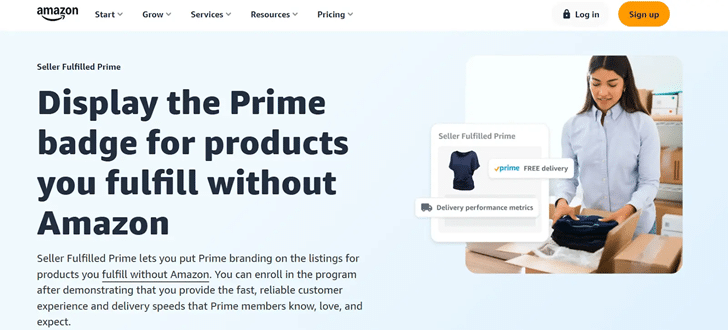
Once a seller qualifies, eligible products can receive the recognizable Prime badge, which can make listings more appealing to Amazon customers.
According to Amazon, seller-fulfilled product listings that became Prime-eligible through SFP experienced an average sales uplift of more than 50%.
Amazon Seller Fulfilled Prime Requirements
Seller Fulfilled Prime isn’t an open program for every Amazon seller. Because Prime customers expect fast and reliable delivery, Amazon has established strict performance requirements that sellers must meet before they can participate.
To qualify, sellers must generally complete the SFP trial period and qualify for Premium Shipping.
During the trial period, products don’t receive the Prime badge. Sellers must also ship SFP-enrolled orders on the same day, provided the orders are placed before the applicable cutoff time.
Only after successfully completing the trial can a seller participate in SFP and have the Prime badge displayed on eligible products.
What Are the Requirements for Seller Fulfilled Prime?
Before considering enrollment, sellers should make sure they can consistently meet Amazon’s performance standards. The source outlines the following requirements:
- Maintain a 99% timely shipment rate
- Maintain a 99% valid tracking rate
- Offer Premium Shipping
- Keep the cancellation rate at 0.5% or lower
- Use Amazon Buy Shipping for at least 98.5% of orders
- Follow Amazon’s return policies
- Use an Amazon-approved carrier
- Allow Amazon to manage customer inquiries
The source also notes that Amazon was not accepting new SFP applications in the United States at the time it was written. When enrollment is available, the process involves several stages.
How Does Amazon Seller Fulfilled Prime Work?
1. Qualify for Premium Shipping
Before entering the SFP trial, sellers must demonstrate that they can consistently provide Premium Shipping services. Sellers cannot simply begin offering Premium Shipping immediately before starting the SFP trial; they must first qualify for it.
2. Enroll in Seller Fulfilled Prime
Once eligible, sellers can enroll through Seller Central. They then assign the products they want to test to the “Prime trial” shipping template.
Only products assigned to this template are included when Amazon evaluates the seller’s performance during the trial period.
3. Complete the Trial Period
The SFP trial period can last between 5 and 90 days and requires a minimum of 200 orders. During this period, sellers need to maintain strong overall performance and consistently meet the required standards.
4. Maintain SFP Status
Passing the trial isn’t the end of the process. Sellers must continue meeting Amazon’s performance requirements after becoming part of SFP.
Maintaining reliable fulfillment, accurate tracking, timely shipments, and consistent customer service is essential for keeping SFP status.
Premium Shipping vs. Seller Fulfilled Prime
Premium Shipping and Seller Fulfilled Prime are often mentioned together, but they are not the same program.
Premium Shipping allows sellers to provide faster shipping options while continuing to fulfill orders themselves. To qualify, sellers need to meet specific performance standards over a 30-day period, including:
- A 99% valid tracking rate
- A 97% on-time delivery rate
- A 0.5% or lower seller cancellation rate
Once qualified, sellers can offer Premium Shipping options to customers for an additional charge. The source identifies 1-day delivery and 2-day shipping as examples of Premium Shipping options in the United States.
The key distinction is simple: Premium Shipping provides faster delivery options, while Seller Fulfilled Prime allows eligible seller-fulfilled products to receive the Prime badge without using FBA.
Why Did Amazon Launch Seller Fulfilled Prime?
Amazon’s focus on customer experience is one of the main reasons behind SFP. Prime customers expect dependable and fast delivery, but they also benefit from having a wider selection of products to choose from.
According to the source, the key objectives of SFP include:
- Helping customers receive orders quickly and reliably
- Expanding the range of products available to customers
- Providing Prime-level shipping without charging customers additional shipping costs
Seller Fulfilled Prime vs. FBA: Key Differences
FBA and SFP can both provide access to Prime benefits, but the way orders are fulfilled is substantially different.
With SFP, sellers retain responsibility for fulfillment and shipping. With FBA, Amazon handles fulfillment on the seller’s behalf. The source also highlights differences in customer service, shipping control, fulfillment costs, and operational responsibility.
One of the most important differences is shipping. SFP sellers manage their own fulfillment and are responsible for the associated shipping costs while meeting Amazon’s delivery expectations.
With FBA, Amazon takes care of shipping and fulfillment, but sellers pay applicable FBA fees. For some large, heavy, slow-moving, or unusual-sized products, those costs may become significant. At the same time, managing your own warehouse, employees, systems, and software can also create substantial operating expenses.
For this reason, sellers need to evaluate their products, order volume, infrastructure, and fulfillment costs before deciding which model fits their business.
What Happens If Seller Fulfilled Prime Is Suspended?
There may be situations where Amazon suspends a seller’s SFP status. According to the source, sellers are notified through the email address associated with their Amazon account.
A suspension can occur when a seller fails to maintain the required performance standards.
Common Reasons for SFP Suspension
Some of the reasons identified in the source include:
- Timely shipment rate falls below the required level: A rate below 99% can result in SFP deactivation and removal of the Prime badge.
- Valid tracking performance drops: Sellers need to maintain the required tracking standards.
- Cancellation rate increases: A higher-than-allowed cancellation rate can negatively affect SFP status.
The source also lists the following performance figures for Premium Shipping and SFP:
Premium Shipping:
- Timely delivery rate: 97% or higher
- Valid tracking rate: 100%
- Cancellation rate: 0.5% or lower
SFP:
- Timely shipment rate: 99%
- Timely delivery rate: 97%
- Buy Shipping usage: 98%
- Cancellation rate: 0.5%
Because these metrics directly affect eligibility, sellers should monitor fulfillment performance regularly rather than waiting until an issue leads to suspension.
Pros and Cons of Seller Fulfilled Prime
SFP can provide sellers with greater control over their fulfillment operations, but that control also comes with additional responsibilities. Before enrolling, businesses should consider both sides of the program.
Pros of Seller Fulfilled Prime
1. Increased Visibility With the Prime Badge
After successfully completing the SFP trial, eligible products can receive the Prime badge. This can increase the visibility and appeal of listings among Amazon customers.
The badge also communicates that the seller has met Amazon’s requirements for Prime fulfillment, which can help reinforce customer confidence.
2. Potentially Lower Fulfillment Costs Than FBA
SFP can help sellers avoid certain FBA-related storage, fulfillment, and handling expenses because inventory remains within their own fulfillment operation.
Instead of sending inventory to Amazon’s fulfillment centers, SFP sellers can distribute and manage products through their own facilities while still pursuing Prime eligibility.
However, this doesn’t necessarily mean SFP will always be cheaper. Sellers still need to account for warehouse expenses, labor, packaging, shipping, software, and other fulfillment costs.
3. Amazon Customer Support
SFP customers can access Amazon’s after-sales customer support. Customers can also track orders, initiate returns, and request refunds through Amazon’s existing systems.
This can reduce some of the customer-service workload associated with managing seller-fulfilled orders.
4. Greater Control Over Fulfillment
One of the biggest advantages of SFP is the control it gives sellers over their inventory and fulfillment operations.
Because products remain in the seller’s own facility, businesses can have greater visibility into inventory and more direct control over packaging and fulfillment processes while still maintaining Prime eligibility.
Cons of Seller Fulfilled Prime
SFP also introduces several challenges, particularly for businesses that are trying to scale their operations.
1. Strict Eligibility and Performance Requirements
SFP has demanding requirements because Amazon needs participating sellers to maintain the level of service Prime customers expect.
Failing to meet those requirements consistently can result in the loss of SFP status and the Prime badge.
2. Higher Shipping Costs
Fast and reliable delivery can be expensive when sellers are responsible for fulfillment themselves. Meeting Prime delivery expectations may increase shipping expenses, particularly when serving customers across larger geographic areas.
Sellers therefore need to carefully plan their delivery coverage and determine where they can offer Prime shipping while keeping fulfillment costs manageable.
3. Scaling Fulfillment Can Become Difficult
SFP gives sellers significant control over their fulfillment operations, but that responsibility can become increasingly difficult as order volume grows.
Businesses need efficient processes for inventory management, packaging, shipping, cutoff times, staffing, and carrier coordination. Without a well-organized fulfillment infrastructure, handling larger order volumes while maintaining SFP standards can become challenging.
Conclusion
Amazon has significantly changed the way retailers approach e-commerce fulfillment, while programs such as FBA and SFP provide different ways for sellers to meet customer expectations.
Seller Fulfilled Prime can be particularly relevant for businesses that already have established warehousing and fulfillment capabilities and want to retain greater control over their operations while pursuing Prime eligibility.
However, SFP also comes with strict performance requirements and ongoing shipping responsibilities. FBA, meanwhile, places much of the fulfillment process in Amazon’s hands but comes with its own fees and operational considerations.
Ultimately, the choice between FBA and SFP depends on factors such as the products being sold, order volume, fulfillment infrastructure, shipping costs, and the level of operational control a business wants to maintain.