
The term keyword is familiar to nearly every Amazon seller. Building a successful business on Amazon involves several important activities, including Amazon SEO, keyword research, listing optimization, and selecting the right keywords for advertising campaigns. While keywords are a major part of Amazon SEO, search terms are just as important.
Because the meanings of keywords and search terms are closely related, many sellers find it difficult to distinguish between them. A common question is:
What exactly is the difference between a keyword and a search term? To understand their relationship, it is important to first define each one.
Difference Between Keywords and Search Terms
A keyword can be a single word or a group of words used strategically to improve a product’s visibility and support its growth on Amazon. Sellers use keywords in product listings and advertising campaigns to help their products reach relevant shoppers.
A search term is the actual word or phrase a customer enters into the Amazon search bar when looking for a particular product.
The primary difference is that keywords are selected and targeted by sellers, particularly in PPC campaigns, where advertisers can place bids to make their ads eligible to appear for relevant customer searches.
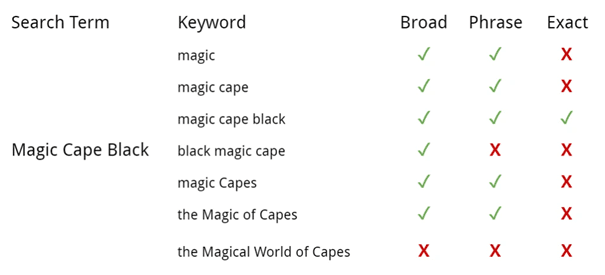
What Are the Different Keyword Match Types?
Amazon allows advertisers to bid on keywords and determine how closely a shopper’s search query needs to relate to those keywords before an ad becomes eligible to appear. These targeting options are known as keyword match types.
Keyword match types help advertisers control the relationship between their selected keywords and the search terms used by customers. Amazon offers three primary keyword match types:
- Broad Match
- Phrase Match
- Exact Match
Broad Match Type
Broad match provides the widest level of reach. With this match type, Amazon can match your targeted keyword with a broad range of relevant customer search terms, including variations and related combinations.
For example, if you target the keyword “bracelet” using broad match, your advertisement may be eligible to appear for searches such as “gold bracelets for women” or “high-quality bracelets.”
Broad match can be useful when your goal is to reach a larger audience and discover new customer search terms.
Phrase Match Type
With phrase match, you target a specific keyword phrase, and your advertisement can appear when a customer’s search term includes that phrase or a close variation in the relevant order.
This match type provides a balance between broad reach and targeting control.
For example, if your targeted keyword is “gold bracelet,” your ad may be matched with relevant searches such as “gold bracelets for women” or “handmade gold bracelets.”
Phrase match can help advertisers reach additional shoppers without making their targeting as broad as a broad-match campaign.
Exact Match Type
Exact match provides the highest level of targeting precision among the three match types. It is designed to target customer searches that closely match the keyword you have selected.
This match type is particularly useful when you want to focus your advertising budget on highly specific searches with strong relevance to your product.
For example, if your keyword is “handmade gold bracelet for women,” your ad is intended to target searches that closely correspond to that keyword.
Relationship Between Keywords and Search Terms
Keywords and search terms are closely connected because Amazon matches the keywords selected by advertisers with the actual search queries entered by shoppers.
Sellers choose keywords for their campaigns based on keyword research, customer behavior, and data from real searches. These keywords are then used to target relevant audiences and increase the chances of advertisements appearing for appropriate customer queries.
One keyword can be associated with multiple customer search terms. Similarly, depending on the targeting method and match type, similar search terms may be connected to different keywords across campaigns.
This relationship is especially important when analyzing advertising performance. Keywords represent the terms selected and targeted by advertisers, while search terms show the actual queries customers used when they saw or interacted with an ad.
| Metric | Search Terms | Keywords |
| Impressions | ✅ | ✖ |
| Clicks | ✅ | ✖ |
| Spend | ✅ | ✖ |
| CPC | ✅ | ✖ |
| ACoS | ✅ | ✖ |
| Orders | ✅ | ✖ |
| Sales | ✅ | ✖ |
| CTR | ✅ | ✖ |
| Bid | ✖ | ✅ |
Understanding Keyword Metrics and Their Relationship With Search Terms in Seller Central
When reviewing advertising data in Amazon Seller Central, it is important to understand how keyword-level and search-term performance are connected. A single keyword can trigger an ad for multiple customer search terms, particularly when broad or phrase match targeting is used.
For example, suppose you are targeting the keyword “red water bottle” and the campaign reports a total of 5,000 impressions. That keyword may have generated impressions through several different customer search terms.
Imagine that three search terms contributed to the total:
- Search Term 1 – 1,000 impressions
- Search Term 2 – 2,000 impressions
- Search Term 3 – 2,000 impressions
Total Impressions – 5,000
In this situation, the performance associated with the keyword “red water bottle” reflects the combined activity generated by the search terms matched with that keyword.
This is why reviewing search-term data is essential for Amazon advertisers. It helps identify which actual customer queries are generating impressions, clicks, conversions, and sales.
By analyzing this information, sellers can identify high-performing search terms, add valuable terms to their campaigns, adjust bids, and reduce spending on searches that do not produce meaningful results.
Conclusion
Understanding the difference between Amazon keywords and search terms is an essential part of effective keyword research and advertising optimisation.
Keywords are the terms sellers choose and target, while search terms represent the actual words and phrases customers use when searching for products on Amazon. The connection between the two allows advertisers to understand how their campaigns are reaching real shoppers.
By regularly analyzing customer search-term data, sellers can discover valuable keyword opportunities, improve campaign targeting, and build a stronger Amazon SEO and advertising strategy.
The more clearly you understand how customers search for products, the better positioned you will be to refine your keywords and improve your overall performance on Amazon.