
Amazon has developed one of the most advanced supply chain networks in the e-commerce industry. Its logistics infrastructure combines modern technology, efficient inventory management, and an extensive delivery network to help customers receive their orders quickly and reliably.
The company’s customer-first philosophy shapes nearly every aspect of its operations. From sourcing products and managing warehouses to processing orders and completing last-mile deliveries, Amazon continuously works to make the shopping experience more convenient.
Amazon supply chain management brings together warehousing, robotics, artificial intelligence, demand forecasting, and transportation systems to maintain operational efficiency. For sellers, this infrastructure offers opportunities to expand their businesses without investing heavily in warehouses, shipping facilities, and delivery networks of their own.
This article explores how the Amazon supply chain operates, the fulfillment options available to sellers, the company’s global logistics infrastructure, and the technologies influencing its future.
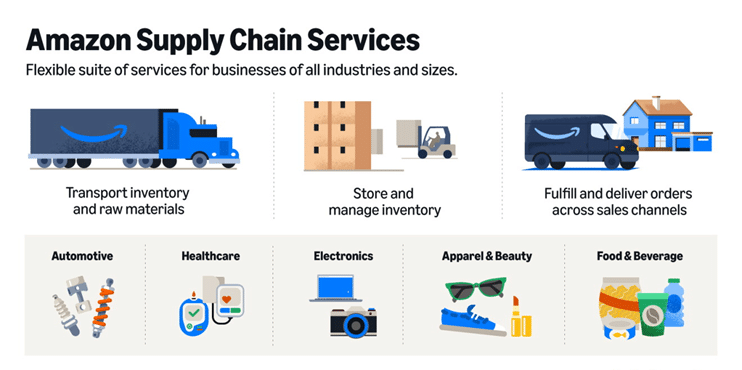
What Is the Amazon Supply Chain?
The Amazon supply chain refers to the connected processes that move products from suppliers and storage facilities to customers. It includes every major stage of product movement and order fulfillment, such as:
- Product sourcing and procurement
- Warehousing and inventory management
- Order processing and fulfillment
- Pricing and demand planning
- Shipping and final-mile delivery
- Returns and reverse logistics
A commonly cited Statista estimate indicates that third-party sellers account for approximately 61% of Amazon sales. This highlights the complexity of its supply chain, which combines Amazon’s own operations with products managed by independent businesses.
Amazon’s supply chain strategy relies heavily on two fulfillment models: Fulfillment by Amazon (FBA) and Fulfillment by Merchant (FBM). Through FBA, sellers send inventory to Amazon, which handles storage, packing, shipping, and eligible customer-service activities. With FBM, sellers manage fulfillment themselves or work with an external logistics provider.
Understanding these models helps sellers choose an approach that fits their product categories, budget, operational capabilities, and growth plans.
The Amazon Fulfillment Process
The Amazon supply chain is designed to move customer orders through a coordinated series of activities. Each stage is structured to reduce unnecessary handling, improve accuracy, and minimize the time between purchase and delivery.
Inventory and Storage
Maintaining the right inventory levels is essential to successful Amazon supply chain management. Depending on the fulfillment arrangement, products may be stored in Amazon fulfillment centers, a seller’s own warehouse, or facilities operated by a third-party logistics provider.
Amazon’s network is designed to position inventory close to areas with strong customer demand. Storing products near likely delivery destinations can shorten shipping distances and reduce the time required to complete orders.
Effective inventory placement also helps prevent stockouts, shipping delays, and other Amazon supply chain challenges. Sellers must therefore balance inventory availability with storage expenses and changing sales patterns.
According to reports referenced in this article, Amazon announced an investment of $4 billion to expand delivery services into approximately 4,000 rural communities by the end of 2026. The expansion was intended to extend faster delivery options to underserved areas and cover more than 13,000 ZIP codes. These figures should be verified against the latest company announcements before publication.
Order Placement
The Amazon supply chain process begins moving into action when a customer places an order. Product visibility, listing quality, pricing, and customer reviews can all influence whether a shopper decides to purchase an item.
Once an order is confirmed, Amazon’s systems determine how to fulfill it based on factors such as inventory availability, warehouse location, delivery promises, and transportation capacity.
The order is then directed through the relevant picking, packing, and shipping procedures. Automated systems and warehouse technologies help coordinate these activities so that products can move through the fulfillment network efficiently.
Preparation for Shipment
After an order is assigned to a fulfillment location, the warehouse team begins preparing it for dispatch. This stage includes locating the correct item, checking its condition, selecting appropriate packaging, and ensuring that the shipment is ready for transportation.
Each activity contributes to order accuracy and product protection. A well-organized preparation process can reduce mistakes, prevent avoidable damage, and keep orders moving toward their expected delivery dates.
Picking
Picking involves locating the ordered product within the warehouse, scanning it, and confirming that it matches the customer’s purchase.
Amazon uses automation and robotics in many fulfillment facilities to make this task more efficient. In some warehouses, mobile robots transport shelves or inventory containers to designated picking stations, reducing the distance employees need to walk.
This approach allows warehouse associates to concentrate on selecting and verifying products rather than spending as much time navigating storage aisles. Productivity depends on the facility, product type, technology, and workflow, but automation can significantly improve picking efficiency.
Seller insight: Keep inventory labels clear, product information accurate, and packaging compliant with Amazon’s applicable FBA preparation requirements. If you sell bundles or multipacks, package and label them so warehouse employees can identify each sellable unit correctly. These precautions can help reduce receiving problems and fulfillment errors.
Quality Checks
Product inspections help ensure that items are in acceptable condition before they reach customers. Depending on the facility and product category, quality-control processes may involve employees, automated scanning, imaging systems, or other inspection technologies.
These checks can identify visible damage, packaging problems, and certain product irregularities before an order leaves the warehouse. Detecting problems early helps reduce unnecessary returns, protect customer satisfaction, and limit waste.
Seller insight: Inspect inventory batches before sending them to an Amazon fulfillment center. Check that products are free from defects, labels are correct, and protective materials are suitable for transportation. Fragile goods should receive appropriate packaging, while restricted or sensitive products must meet the relevant handling requirements.
Packing
Once picking and verification are complete, the order moves to the packing station. The product is placed in a suitable package, secured for transportation, and prepared for its next destination.
Automated packing systems can help determine appropriate package dimensions and reduce unnecessary materials. Choosing the right packaging can lower shipping volume, protect products from damage, and support waste-reduction initiatives.
Amazon has previously reported progress in reducing packaging waste compared with its 2015 baseline. Some products may also ship in their original manufacturer packaging when they meet the applicable requirements. Sellers should review Amazon’s current packaging guidelines before sending inventory or using packaging that is intended to remain visible during delivery.
Shipping
After packing, the shipment enters the transportation network. Depending on the location, delivery service, and order requirements, Amazon may use its own logistics operations or external carriers such as UPS, FedEx, and USPS.
Its transportation network includes long-distance freight movements, regional sorting operations, and delivery stations that help move packages closer to customers.
Reliable shipping is an important part of the overall customer experience. For sellers, meeting delivery promises and maintaining strong fulfillment performance can support customer satisfaction and listing competitiveness. However, Buy Box eligibility and placement depend on multiple factors, including price, availability, fulfillment performance, and the specific marketplace requirements.
Overall, Amazon supply chain management coordinates inventory storage, order processing, transportation, and delivery to support a large volume of customer orders.
Seller Fulfillment Models in the Amazon Supply Chain
Amazon offers different fulfillment arrangements to accommodate sellers with varying budgets, product types, and operational resources. These options determine who stores inventory, prepares orders, manages delivery, and handles certain customer-service responsibilities.
Choosing an appropriate model can influence operating costs, delivery performance, customer experience, and the ability to scale.
Fulfilment by Amazon (FBA)
Fulfillment by Amazon allows sellers to outsource much of the order fulfillment process. Sellers send their inventory to Amazon’s network, where eligible products are stored until customers place orders.
Amazon then handles activities such as picking, packing, shipping, and specified customer-service and return processes under the program’s terms. This arrangement makes FBA attractive to sellers who want to concentrate on product development, marketing, sourcing, and business growth rather than daily shipping operations.
FBA can also provide eligible listings with access to Prime delivery benefits, subject to marketplace rules and program requirements. Faster delivery options may make products more appealing to customers who value convenience.
The main consideration is cost. Sellers must account for fulfillment fees, storage charges, inventory placement expenses where applicable, and other program-related costs. Long-term storage and slow-moving products can make the model less profitable.
FBA is often a strong option for businesses with sufficient margins, consistent demand, and products that are suitable for Amazon’s fulfillment network. Sellers should calculate the total cost per unit before committing substantial inventory.
FBA Onsite and Hybrid Fulfillment Arrangements
Hybrid fulfillment arrangements allow sellers to retain greater control over their own storage facilities while integrating selected aspects of Amazon’s fulfillment systems. Availability and program terms depend on the marketplace and the specific service.
For businesses with established warehouses, this type of arrangement may help simplify order processing without requiring every unit to be stored in an Amazon-operated fulfillment center.
It can be particularly useful for sellers managing fast-moving products, fluctuating demand, or large seasonal sales volumes. For example, a toy seller preparing for the holiday season may need a flexible way to handle increased order volume while maintaining control over its warehouse operations.
Before adopting a hybrid model, sellers should confirm whether the relevant program is available to them and compare its operational requirements with conventional FBA and FBM options.
Fulfillment by Merchant (FBM)
With Fulfillment by Merchant, sellers are responsible for storing inventory and shipping customer orders. They can handle these activities internally or outsource them to a third-party logistics provider.
FBM gives businesses more control over packaging, inventory handling, shipping arrangements, and certain aspects of the customer experience. It can be suitable for oversized products, customized items, slow-moving inventory, or goods that require special handling.
This model may also help sellers manage products that are difficult or expensive to store within Amazon’s fulfillment network. Businesses with established warehouses and competitive shipping arrangements can use FBM to maintain greater control over their operations.
However, sellers must manage delivery deadlines, shipping costs, customer communications, and applicable return requirements. They must also monitor fulfillment performance to remain compliant with Amazon’s policies.
FBM can be a practical choice for businesses that already have reliable logistics operations or need flexibility that a standard FBA arrangement does not provide.
Multi-Channel Fulfillment (MCF)
Multi-Channel Fulfillment enables eligible sellers to use Amazon’s fulfillment infrastructure to process orders placed outside Amazon’s marketplace. For example, a seller may fulfill purchases from its Shopify store or another sales channel using inventory held within Amazon’s network.
This can help businesses avoid operating separate fulfillment systems for every sales platform. It may also reduce the need to maintain additional warehouse space or build an independent shipping operation.
Consider a direct-to-consumer brand that sells products through its own website. By using a suitable multi-channel fulfillment service, the business may be able to access Amazon’s logistics infrastructure without establishing a completely separate network.
However, sellers should review fulfillment fees, delivery options, packaging requirements, returns procedures, and inventory availability. For products with narrow profit margins, the cost of multi-channel fulfillment may outweigh its operational advantages.
Ultimately, every model connects to Amazon’s broader supply chain differently. Sellers should evaluate profitability, control, delivery expectations, and operational capacity before making a decision.
Amazon Fulfillment Infrastructure: The Main Layers of the Supply Chain
Amazon’s logistics network extends beyond large warehouses. It includes multiple types of facilities, transportation resources, and delivery operations that work together to move products from storage locations to customer addresses.
Amazon Fulfillment Centers
Fulfillment centers are a core part of Amazon’s logistics infrastructure. These facilities receive inventory from suppliers and sellers, store products, process customer orders, and prepare shipments for dispatch.
Inside a fulfillment center, products are stored in designated locations tracked by inventory-management systems. Depending on the facility, workers may use scanning equipment, conveyor belts, automated storage systems, and robotics to retrieve products and move orders through the building.
Amazon’s storage methods do not always group similar products together in the way a traditional retail store might. Instead, inventory placement can be managed through digital records that allow workers and automated systems to locate individual items.
This system helps make use of available space while maintaining the tracking information needed for picking and replenishment.
Types of Amazon Fulfillment Facilities
Different facilities perform different roles in Amazon’s logistics network. The precise arrangement varies by location, marketplace, and service.
| Facility type | Main purpose | Key characteristics | Potential seller benefits |
| Standard fulfillment centers | Store and process general merchandise, including books, electronics, toys, and household products | Large storage areas, picking stations, conveyor systems, and automation | Supports FBA operations and scalable order processing |
| Sortation centers | Organize packages according to their destinations | Group parcels by delivery area before they move to the next stage | Can improve transportation efficiency and delivery coordination |
| Delivery stations | Prepare packages for final delivery | Local hubs that organize shipments for delivery routes | Helps move orders closer to customers |
| Specialty fulfillment facilities | Handle selected categories or products with specific requirements | May include specialized storage, garment-handling equipment, or category-specific procedures | Supports appropriate handling of eligible specialized inventory |
| Fresh and perishable facilities | Manage grocery and temperature-sensitive products | May use refrigerated storage and specialized picking procedures | Helps preserve product quality and support grocery fulfillment |
| Hybrid or seller-linked fulfillment arrangements | Connect a seller’s own storage operations with eligible Amazon services | Requirements depend on the specific program | May offer additional operational flexibility where available |
These facilities form connected stages in the fulfillment process. Inventory may pass through more than one location as it moves from storage to regional sorting and final delivery.
Amazon’s Delivery Fleet
Warehouses are only one part of Amazon’s supply chain. Transportation and delivery operations are equally important because products must move efficiently between facilities and reach customers within the promised time frame.
Amazon uses a combination of logistics resources, including:
- Amazon-branded vans and trucks: Used in various middle-mile and last-mile transportation operations.
- Air cargo operations: Help move shipments across longer distances and connect important logistics hubs.
- Amazon Flex drivers: Independent delivery partners who use eligible personal vehicles for assigned delivery routes.
This combination gives Amazon flexibility when managing different delivery distances, geographical conditions, and fluctuations in order volumes. External transportation providers can supplement these resources when necessary.
Delivery Options and Logistics Innovations
Amazon continues to develop delivery services intended to improve speed and convenience. Availability varies according to the customer’s location, product eligibility, and local infrastructure.
Same-day and one-day delivery: Eligible orders can reach customers quickly in supported locations. These services depend on inventory availability, warehouse coverage, carrier capacity, and local operating conditions.
Amazon Prime Air: Amazon’s drone delivery initiative is designed to deliver eligible small packages by air in supported areas. Its practical availability depends on regulatory approval, service coverage, and operating conditions.
Amazon Scout: Scout was an earlier autonomous delivery robot initiative intended to bring selected packages to customers’ doorsteps. It represents one of Amazon’s experiments with alternative delivery technology.
Amazon Fresh and Whole Foods delivery: Grocery fulfillment adds temperature-sensitive goods and specialized handling requirements to Amazon’s wider logistics operations.
These services demonstrate how delivery diversification can help address challenges such as seasonal demand, transportation congestion, and the need for faster order completion.
Amazon Delivery Service Partner (DSP) Program
Amazon’s Delivery Service Partner program enables entrepreneurs to establish businesses that manage delivery teams serving Amazon’s logistics network.
Depending on the applicable program terms, partners may receive access to operational support, routing technology, training, and delivery vehicles or other resources. They are responsible for managing their businesses and delivery teams according to Amazon’s requirements.
For participating entrepreneurs, the program can provide an opportunity to enter the logistics industry without independently developing an entire delivery network. Startup expenses, financing requirements, operational responsibilities, and earnings vary, so potential partners should review the complete program terms before participating.
For Amazon, working with delivery partners can increase transportation capacity and provide additional flexibility during busy periods without requiring the company to own and operate every delivery business directly.
Major Advantages of Amazon Supply Chain Management
Understanding Amazon’s supply chain can help sellers recognize how fulfillment infrastructure, delivery speed, and inventory placement influence the customer experience.
1. Strategic Warehousing and Inventory Placement
Amazon’s global logistics network includes fulfillment centers and numerous other types of facilities. Their locations help connect inventory with customers across different regions and markets.
Facilities designed for different products: Some locations focus on standard merchandise, while others are configured for oversized goods, specialized categories, sorting, or final-mile delivery. Assigning appropriate activities to different facilities can improve handling and transportation efficiency.
Space-efficient storage: Inventory may be placed according to warehouse systems and operational needs rather than being grouped exclusively by product category. Digital tracking enables the warehouse to identify each item’s location when an order needs to be fulfilled.
Predictive inventory planning: Demand forecasting helps businesses anticipate upcoming sales and position stock where it is likely to be needed. For instance, seasonal products such as winter accessories can be moved closer to expected demand areas before the busiest part of the season.
These methods help support faster fulfillment while making more efficient use of storage and transportation resources.
2. Advanced Automation and Robotics
Automation has become an important part of Amazon’s fulfillment strategy. Robotics, scanning systems, conveyor technology, and software help employees handle large volumes of inventory and customer orders.
Amazon’s robotics initiatives have included technologies such as mobile shelf-moving robots, automated storage systems, and systems designed to identify, sort, or move products.
For example, mobile robots can transport inventory to picking stations, reducing the distance warehouse employees need to travel. Other technologies support storage, product handling, and the movement of heavier items.
Automation can improve consistency, reduce unnecessary movement, and accelerate repetitive tasks. However, performance varies according to the process, facility, products involved, and the technology being used.
Automated packaging systems can also help select suitable package sizes and reduce unnecessary materials. Across a large fulfillment network, even modest improvements to individual tasks can contribute to meaningful operational gains.
3. Flexible and Fast Delivery Models
Amazon combines its logistics network with external transportation partners to serve different customer needs. Delivery options depend on marketplace coverage, inventory location, shipping capacity, and product eligibility.
Customers in supported locations may have access to standard shipping, Prime delivery, one-day delivery, or same-day services. Not every option is available for every product or destination.
Amazon’s investment in transportation, freight management, and regional delivery infrastructure helps connect suppliers, fulfillment centers, and customers. Greater coordination between these stages can reduce unnecessary delays and help control logistics costs.
For sellers, participating in eligible fulfillment services may provide access to infrastructure that would be expensive to develop independently. Options such as FBA and Multi-Channel Fulfillment can help businesses streamline operations, while Amazon’s broader supply chain services can support other logistics requirements where available.
Amazon’s global strategy also relies on regional networks and cross-border fulfillment arrangements. These systems are designed to make international selling more manageable while coordinating inventory movement and delivery across markets.
Global Expansion and Technology Powering Amazon’s Supply Chain
Amazon’s logistics strategy combines international fulfillment infrastructure with technology intended to simplify inventory storage, transportation, and cross-border selling.
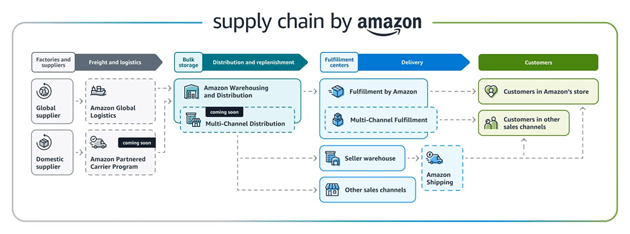
Services such as Supply Chain by Amazon and Amazon Warehousing and Distribution provide eligible sellers with additional logistics options. The precise services, cost savings, and requirements depend on the seller’s marketplace and circumstances.
An Extensive Global Network
Amazon operates fulfillment and delivery facilities across multiple international markets. Its network includes large warehouses, sorting locations, delivery stations, and other specialized logistics facilities.
These locations are strategically distributed to support inventory movement and bring products closer to customers. By connecting facilities with road, air, and other transportation services, Amazon can coordinate orders across substantial geographical areas.
The company has continued to invest in logistics infrastructure as e-commerce demand and customer delivery expectations have evolved. Growth in online shopping during the COVID-19 period also accelerated the need for additional fulfillment capacity in various markets.
Amazon has expanded its presence in countries such as Canada through investments in different types of logistics facilities. Regional expansion can help reduce delivery distances, strengthen local coverage, and improve service availability.
Supply Chain by Amazon
Supply Chain by Amazon brings together eligible logistics services intended to simplify the movement of products from suppliers to storage locations and customer orders.
Depending on the services selected, participating sellers may be able to access transportation, freight forwarding, customs support, inventory distribution, warehousing, and fulfillment options.
The goal is to reduce the complexity of coordinating several logistics providers independently. A seller sourcing products internationally may benefit from using connected services to move inventory into the appropriate storage network and prepare it for customer orders.
Amazon has promoted potential cost advantages for certain services, including cross-border transportation and storage options. Any advertised savings should be evaluated against current fees, service conditions, product characteristics, and the seller’s usual logistics costs.
Vertical Integration in Logistics
Amazon has invested in transportation and logistics capabilities to gain greater control over the movement of goods. Developing a wider network allows the company to coordinate several stages of fulfillment rather than relying exclusively on external carriers.
Trucking
Road transportation connects suppliers, ports, fulfillment centers, sorting facilities, and local delivery stations. Amazon uses trucking operations within its logistics network and also works with transportation partners.
Its delivery-related business programs have created opportunities for outside businesses to participate in different parts of the transportation process. Amazon has also explored alternative fuel technologies as part of its wider transportation and sustainability efforts.
Amazon Air
Amazon Air supports the movement of packages over longer distances. Air transportation can help connect major logistics facilities and reduce transit times on routes where ground transport would take longer.
The air network works alongside road transportation and regional fulfillment facilities rather than replacing them. Its effectiveness depends on factors such as route planning, aircraft capacity, facility connections, and shipment volume.
Ocean Freight and Containers
Ocean freight plays an important role in international supply chains, particularly for sellers transporting large quantities of goods over long distances.
Amazon has developed freight and logistics services that help eligible businesses coordinate international shipments. Shipping goods in consolidated quantities can simplify transportation planning and may improve unit economics compared with moving many small shipments separately.
After imported goods arrive, they may still need customs clearance, inland transportation, and distribution to suitable storage or fulfillment locations.
Prime Air and Drone Delivery
Prime Air is intended to use drones to transport eligible small packages over short distances in supported areas. Amazon has described drone deliveries as a potential way to improve delivery speed for particular types of orders.
The practical reach of drone delivery depends on regulatory approvals, package restrictions, local operating conditions, and service availability. It is one component of Amazon’s wider logistics innovation efforts rather than a replacement for its existing road and air transportation networks.
How Tariffs Affect the Amazon Supply Chain
International trade policies can influence product sourcing, shipping costs, inventory decisions, and profitability for Amazon sellers. Tariffs and import-rule changes can affect both businesses that import products independently and those using third-party logistics or Amazon fulfillment services.
The impact depends on the country of origin, product classification, destination market, shipment value, applicable exemptions, and importer responsibilities.
Rising Inbound Costs
Higher import duties can increase the cost of bringing products into a target marketplace. Sellers may face additional expenses when importing new products, replenishing inventory, or moving large shipments to fulfillment centers.
These increases can put pressure on profit margins, especially for products that already have high transportation or manufacturing costs.
Ordering larger quantities may reduce certain per-unit transportation expenses, but it can also create higher storage costs and increase the risk of unsold inventory. Sellers must therefore balance shipment economics with their sales forecasts, cash flow, and inventory turnover.
Demand forecasting and inventory reporting are particularly important when import costs are unpredictable. Businesses need to understand how quickly products sell and how much stock they can reasonably hold.
Changes in Supplier Locations
Tariff changes can encourage sellers to review their sourcing strategies. Depending on the applicable trade rules, businesses may explore suppliers in countries such as India, Vietnam, or Mexico, or investigate domestic manufacturing options.
However, changing supplier locations does not automatically eliminate import duties. The actual treatment of a product depends on the rules that apply to its origin, classification, and destination.
Before moving production, sellers should compare manufacturing prices, quality standards, shipping routes, lead times, customs requirements, and the total landed cost.
A sourcing decision that appears cheaper at the factory level may become less attractive after transportation, duties, storage, and other expenses are included.
Potential Risks for FBM Sellers
Under Fulfillment by Merchant, sellers are responsible for organizing their fulfillment operations and may also be responsible for arranging imports, depending on their supply chain.
If a seller imports goods directly, an unexpected tariff increase can raise the landed cost of inventory. Businesses may need to adjust pricing, negotiate with suppliers, revise order quantities, or accept lower margins.
FBA does not automatically remove a seller’s import-duty obligations. Sellers must determine who is responsible for customs clearance and duties under their shipping arrangements and the applicable terms.
Amazon’s logistics services may provide opportunities to consolidate shipments or coordinate transportation more efficiently, but they do not guarantee protection against tariff changes. Sellers should include applicable duties and customs expenses in their total cost calculations regardless of the fulfillment model they choose.
Government Measures and Import Rules
Governments may introduce temporary measures or revise customs procedures to respond to changes in international trade. These policies can affect the way low-value shipments are assessed, cleared, and taxed.
In 2025, changes to U.S. import and de minimis rules became an important issue for cross-border e-commerce businesses. The treatment of eligible shipments and the applicable duty arrangements have been subject to policy changes.
Temporary flat-duty arrangements described in earlier reports should not be assumed to remain in effect. Before shipping products into the United States, sellers should verify the current requirements through official U.S. customs and government sources.
In some circumstances, consolidated shipments may be more economical than sending many small packages. However, the best approach depends on current duty rules, freight charges, inventory needs, and the seller’s business model.
Keeping up with trade policies is essential for businesses that rely on international sourcing. A clear understanding of import costs helps sellers avoid unexpected expenses and make better decisions about pricing, inventory, and fulfillment.
Final Thoughts
Amazon’s supply chain is built around coordinated logistics operations, data-driven planning, automation, and an extensive transportation network. These elements help the company process large numbers of orders while offering a range of delivery options across supported markets.
For sellers, understanding the system is an important step toward building a more efficient and profitable Amazon business. Choosing the right fulfillment model, planning inventory carefully, monitoring sales velocity, and accounting for shipping and storage costs can make a meaningful difference to long-term performance.
Inventory analytics tools can help sellers monitor stock levels, identify slow-moving products, evaluate turnover, and anticipate replenishment needs. These insights support smarter decisions about how much inventory to order, where to store it, and when to send it to a fulfillment center.
Despite its scale and technological capabilities, Amazon’s supply chain is not immune to operational challenges. Seasonal demand, international trade disruptions, transportation delays, warehouse capacity constraints, and unexpected changes in customer demand can all affect performance.
Sellers who understand these risks and maintain flexible inventory and fulfillment strategies are better prepared to respond to changing conditions. The key is to treat supply chain management as an ongoing business priority rather than simply a process that begins after a customer places an order.