
Running Amazon PPC campaigns can be an effective way to drive sales, increase product visibility, and strengthen your organic rankings. And, managing your Amazon Break-even RoAS along is a big catch.
But one important question remains: how much can you actually spend on advertising before your campaigns stop being profitable?
This is where break-even RoAS (Return on Ad Spend) becomes valuable.
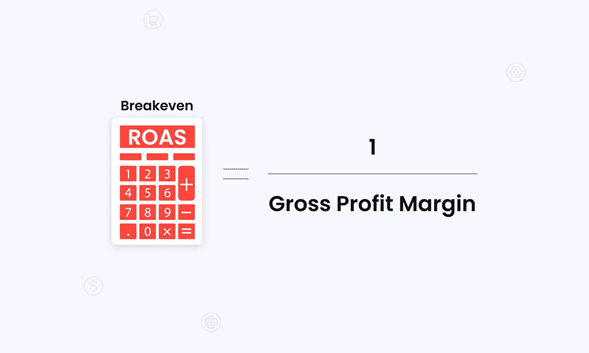
While RoAS shows how much revenue your advertising generates compared with your ad spend, break-even RoAS goes a step further by considering your profit margins. This gives you a clearer picture of whether your advertising campaigns are actually making money.
Understanding break-even RoAS can help Amazon sellers move away from guesswork and make more informed decisions about advertising budgets, bids, and campaign performance.
What Is RoAS and How Do You Calculate It?
RoAS stands for Return on Advertising Spend. It measures the amount of sales revenue generated for every dollar invested in advertising.
This metric helps sellers evaluate the performance of their PPC campaigns, estimate advertising returns, and determine when campaign adjustments may be necessary to improve profitability.
How to Calculate RoAS
The basic formula for calculating RoAS is:
RoAS = Total Ad-Attributed Sales / Total Ad Spend
For example, suppose your Amazon advertising campaigns generate $20,000 in attributed sales during February, while your total advertising spend is $5,000.
Your RoAS would be:
RoAS = $20,000 / $5,000 = 4
This means you generated $4 in sales for every $1 spent on advertising.
There is also another way to estimate RoAS using average order value, conversion rate, and cost per click.
RoAS = (Average Order Value × Conversion Rate) / CPC
For example, assume your average order value is $50, your ad conversion rate is 5%, and your average CPC is $1.
The calculation would be:
RoAS = ($50 × 5%) / $1 = 2.5
This means every $1 invested in advertising generates approximately $2.50 in revenue.
However, RoAS by itself does not tell you whether your advertising campaign is profitable. To determine that, you also need to consider your profit margin and other product-related costs.
For instance, imagine your profit margin is 25%. On a $50 sale, that means you are left with only $12.50 in profit before advertising expenses.
If you spend $100 on advertising, you would need to generate:
$100 / 25% = $400
in sales revenue just to cover the advertising cost.
At that point, you are only breaking even rather than generating an actual profit.
If your advertising produces less than $400 in sales, your campaign would operate at a loss.
That is why looking at RoAS without taking profit margins into account can provide an incomplete picture of advertising performance.
How to Calculate Break-Even RoAS for Amazon
Break-even RoAS is an important metric for Amazon sellers who want to understand the actual profitability of their advertising campaigns.
Unlike standard RoAS, which compares advertising spend with attributed revenue, break-even RoAS considers the profit available before advertising costs are deducted. This provides a more realistic threshold for determining whether a campaign is profitable.
To calculate your break-even RoAS, you first need to determine the profit you make before advertising expenses for each product.
The formula is:
Profit Before Advertising = Selling Price – COGS
Suppose your average selling price is $50 and your cost of goods sold (COGS) is $20.
Your profit before advertising would be:
$50 – $20 = $30
Now imagine you spend $10 on advertising to generate that sale.
Your remaining profit would be:
$30 – $10 = $20
On the other hand, if your advertising cost reaches $30 per sale, your profit becomes zero.
At this stage, you are neither making nor losing money. This is your break-even point.
You can then use that point to calculate your break-even RoAS.
Break-Even RoAS = Product Selling Price / Break-Even Ad Cost
Using the example above:
Break-Even RoAS = $50 / $30 = 1.67
This means your campaign needs to generate more than $1.67 in revenue for every $1 spent on advertising in order to move into profitability.
The higher your actual RoAS is above this threshold, the greater your potential advertising profitability.
What Is the Difference Between ACoS and RoAS?
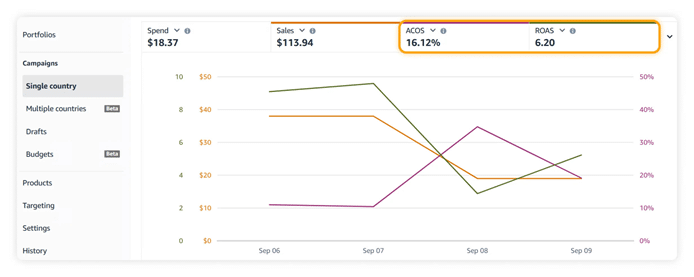
RoAS and ACoS (Advertising Cost of Sales) provide two different ways of looking at the same advertising relationship.
RoAS tells you how much revenue you generate for each dollar spent on advertising, while ACoS shows what percentage of your advertising revenue is being spent on ads.
Both metrics can be useful when evaluating PPC campaign efficiency.
For example, suppose you spend $100 on advertising and generate $500 in attributed sales.
Your ACoS would be:
ACoS = ($100 / $500) × 100 = 20%
Your RoAS would be:
RoAS = $500 / $100 = 5
Now imagine your ad revenue increases to $700 while your advertising spend remains at $100.
Your ACoS becomes:
ACoS = ($100 / $700) × 100 = 14.29%
At the same time, your RoAS increases to:
RoAS = $700 / $100 = 7
The lower ACoS indicates that advertising is consuming a smaller percentage of your sales revenue, while the higher RoAS shows that each advertising dollar is producing more revenue.
What Are the Benefits of Calculating Break-Even RoAS?
Knowing your break-even RoAS gives you a benchmark for evaluating whether an advertising campaign is financially sustainable.
Suppose your break-even RoAS is 2.
If your actual campaign RoAS is higher than 2, your advertising campaign is operating above the break-even threshold. You may then have room to increase your budget, raise bids strategically, and compete more aggressively for valuable traffic.
If your actual RoAS is exactly 2, your campaign is reaching the break-even point. In this situation, you could look for ways to improve profitability by reducing bids, lowering product costs, improving conversion rates, or optimizing your targeting.
If your RoAS falls below 2, the campaign is not generating enough revenue to cover the advertising cost based on your current margins. You may need to reduce wasted spend, pause underperforming campaigns, or shift your budget toward higher-converting keywords and targeting options.
That said, a campaign with a RoAS below the break-even threshold is not necessarily useless.
For example, you may intentionally accept a lower RoAS when the goal is to build brand awareness, increase impressions, introduce a new product, or gain visibility in a competitive category.
The same can apply when advertising helps bring in customers who are likely to make repeat purchases.
A campaign with a lower initial RoAS may still be valuable when it contributes to stronger customer lifetime value (CLV) and creates additional revenue over time.
How Does CLV Relate to Break-Even RoAS?
Customer lifetime value, or CLV, estimates the total value a customer can generate throughout their relationship with a business.
Understanding CLV can help Amazon sellers evaluate customers from a longer-term perspective instead of judging profitability based solely on their first purchase.
For example, acquiring a customer through advertising may initially seem expensive. However, if that customer returns repeatedly and makes additional purchases, the value generated from that customer can be significantly greater than the revenue from the first transaction.
This is why evaluating advertising performance without considering customer lifetime value can sometimes lead to overly conservative decisions.
When customers have the potential to generate repeat revenue, sellers may be willing to accept a lower initial RoAS because the long-term return can justify the acquisition cost.
How to Calculate CLV-Adjusted Break-Even RoAS
Consider a campaign where you spend $10 on advertising to generate a $20 sale.
At first glance, the RoAS is:
RoAS = $20 / $10 = 2
Now suppose that customer makes five additional purchases during the year, bringing their total purchases to $100 while your original advertising cost remains $10.
The effective revenue generated from that customer has now increased substantially, making the initial customer acquisition expense more attractive.
A basic CLV calculation can be represented as:
CLV = Average Order Value × Number of Orders × Retention Period
Once you determine the estimated customer lifetime value, you can compare it with your advertising investment.
A simplified CLV-adjusted RoAS calculation is:
CLV-Adjusted RoAS = CLV / Total Ad Spend
This approach can provide a broader perspective when determining how much you are willing to spend to acquire customers.
It can also help you allocate advertising budgets more strategically, especially when repeat purchases play an important role in your business model.
Final Thoughts
For Amazon sellers, understanding break-even RoAS is an important part of building more effective and sustainable PPC strategies.
It gives you a clear benchmark for evaluating advertising performance and helps you determine whether your campaigns are generating enough revenue to cover their costs.
When your actual RoAS is comfortably above your break-even level, you may have an opportunity to scale successful campaigns. When it falls below that threshold, you can investigate bids, targeting, conversion rates, pricing, and product costs to improve performance.
Break-even RoAS can also help you identify which products deserve greater advertising investment and which campaigns may need to be reduced or optimized.
At the same time, remember that profitability should not always be judged by a single metric. Factors such as brand awareness, product launches, customer acquisition, repeat purchases, and customer lifetime value can influence how you evaluate an advertising campaign.
By combining RoAS, ACoS, profit margins, and CLV, Amazon sellers can make more informed decisions about their PPC budgets and build advertising strategies designed for both short-term performance and long-term growth.