
Amazon aggregators have become an important part of the ecommerce acquisition market. These companies specialize in purchasing established Amazon brands and growing them through better operations, advertising strategies, supply chain management, and expansion into new marketplaces. Instead of developing products from the ground up, aggregators acquire businesses that already have proven demand and then look for ways to unlock additional growth.
For Amazon sellers, aggregators can provide a potential exit strategy while also showing what buyers consider valuable in an ecommerce business. Understanding how aggregators operate can help sellers improve profitability, strengthen their operations, and build a brand that becomes more attractive to potential buyers.
This guide explores how Amazon aggregators operate, how their business model works, what they look for when evaluating acquisition opportunities, and how Amazon brands may be valued in 2026.
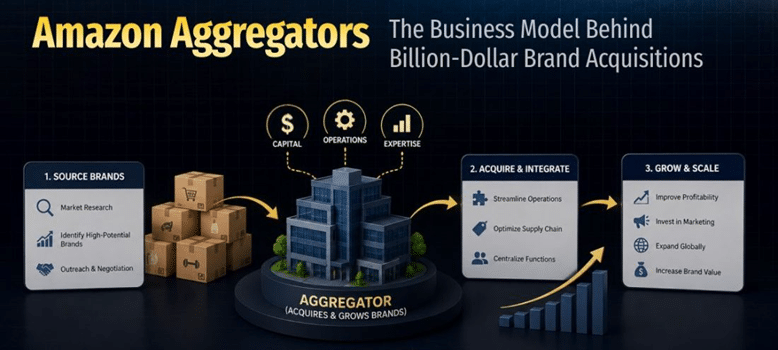
What Are Amazon Aggregators?
Amazon aggregators acquire established ecommerce brands and attempt to improve their performance after the transaction. Their post-acquisition strategies commonly include:
- Improving advertising performance
- Optimizing Amazon listings
- Reducing supply chain costs
- Improving inventory forecasting
- Expanding into international marketplaces
- Launching additional products
For many Amazon sellers, the rise of aggregators created an exit opportunity that was previously difficult to access. Instead of building a business indefinitely, sellers with established Amazon-native brands can potentially sell their businesses to specialized buyers.
How the Amazon Aggregator Business Model Works
The Amazon aggregator business model is built around a relatively straightforward cycle: acquire promising brands, improve their performance, and increase the overall value of the portfolio.
Rather than depending on one business, aggregators typically build portfolios containing multiple brands across different categories. Their process generally follows several stages.
| Step | What Happens | Revenue Driver |
| Identify | Aggregators search for promising Amazon brands | Acquisition opportunities |
| Acquire | The selected business is purchased through a negotiated transaction | Portfolio growth |
| Optimize | Advertising, listings, operations, and costs are improved | Increased profitability |
| Expand | Brands enter new markets, products, or sales channels | Revenue expansion |
| Scale | Improved brands contribute greater value to the portfolio | Long-term returns |
How Amazon Aggregators Make Money
A major part of the aggregator strategy is based on the assumption that successful operational improvements can be applied across multiple brands. In theory, centralized teams and shared systems can create efficiencies in areas such as advertising, purchasing, inventory management, and marketplace expansion.
However, scaling this approach across a large portfolio is not always simple. Every brand has its own category, customer base, competitive environment, and product mix. Two brands operating in similar categories may even compete for the same keywords, audiences, or advertising placements. Instead of creating additional revenue, this overlap can sometimes lead to sales cannibalization.
Successful aggregators therefore need to understand the differences between their brands rather than applying an identical strategy to every business. Portfolio-wide data can help identify where centralized processes create value and where brands require a more customized approach.
Acquisition Multiples and Portfolio Growth
Acquisition valuation is one of the most important elements of the Amazon aggregator business model.
Many transactions are based on a multiple of Seller Discretionary Earnings (SDE) or EBITDA. Aggregators generally prefer businesses that already generate healthy profits while still offering clear opportunities for additional growth.
For example, imagine an Amazon brand generating $500,000 in annual Seller Discretionary Earnings. If the business is purchased at a 3x multiple, its acquisition value would be approximately $1.5 million.
Following the acquisition, the aggregator improves advertising efficiency, negotiates better supply chain terms, introduces two complementary products, and expands the brand into Amazon’s European marketplaces. Over the next two years, annual SDE increases from $500,000 to $800,000.
If the business continues to receive a 3x multiple, its valuation would rise from $1.5 million to $2.4 million. If the brand also becomes less risky and demonstrates stronger growth prospects, it could potentially command an even higher multiple.
This illustrates how aggregators can create value through more than simply purchasing profitable businesses. By increasing earnings and improving the quality of the underlying business, they can potentially increase its future valuation as well.
The strategy can create value through two primary channels:
Higher Ongoing Cash Flow
Improving profitability increases the amount of cash the business generates.
Greater Long-Term Business Value
Higher earnings, stronger operations, and improved growth prospects can increase the brand’s overall valuation.
The approach shares similarities with private equity investing, but it is specifically adapted to the characteristics of ecommerce and Amazon-native businesses.
How Amazon Aggregators Improve PPC Performance After an Acquisition
Advertising performance is often one of the first areas aggregators analyze after acquiring an Amazon brand. Many sellers manage PPC accounts with small teams, limited automation, or campaign structures that have developed gradually without a broader profitability strategy.
Consider an Amazon kitchenware brand generating $2 million in annual revenue. Suppose the business spends $400,000 each year on PPC while relying heavily on broad targeting, overlapping campaigns, and limited search-term segmentation. As a result, its Advertising Cost of Sales (ACoS) sits around 35%.
After acquiring the business, the aggregator restructures the advertising account. Branded and non-branded keywords are separated, negative targeting is introduced, bids are adjusted according to profitability, and more budget is allocated to search terms that consistently generate profitable conversions.
If ACoS falls from 35% to 25% while sales remain stable or increase, the business can potentially retain significantly more profit from its existing advertising spend.
However, managing PPC across an entire portfolio requires more than copying one successful campaign structure across every brand. Each product category has different customer behavior, keyword competition, conversion rates, and advertising economics. Brands within the same portfolio can also target similar search terms, creating the possibility of internal competition.
For this reason, established aggregators often rely on centralized analytics, portfolio-level reporting, and dedicated Amazon PPC teams. Their objective is not simply to make one brand’s advertising more efficient, but to ensure advertising decisions improve the performance of the portfolio as a whole.
How Aggregators Increase Conversion Rates Through Listing Optimization
Some acquired brands already receive substantial traffic but fail to convert enough visitors into customers. In these situations, improving the listing can generate additional sales without requiring a proportional increase in advertising spend.
For example, consider a fitness accessories brand receiving 50,000 product page visits each month while converting at 8%. After improving the product images, rewriting the listing copy, strengthening A+ Content, and addressing common customer concerns, the conversion rate rises to 10%.
A two-percentage-point improvement may appear modest, but at the same traffic volume it could generate approximately 1,000 additional orders every month.
This is why listing optimization is often a major focus following an acquisition. Rather than concentrating exclusively on generating additional traffic, aggregators also examine how effectively the existing traffic is converted into sales.
Supply Chain and Inventory Optimization
Operational efficiency becomes increasingly important as an aggregator’s portfolio grows. Poor inventory forecasting can quickly affect profitability through stockouts, excess storage costs, lost sales, and delayed replenishment.
Larger aggregators commonly focus on improving:
- Supplier negotiations
- Freight planning
- Demand forecasting
- Inventory allocation
- Warehousing efficiency
Managing several brands at scale can also give aggregators greater purchasing leverage and access to operational efficiencies that may be difficult for an individual seller to achieve.
Better supply chain management can have a direct impact on margins, particularly in product categories where profit margins are already relatively tight.
International and Multi-Platform Expansion
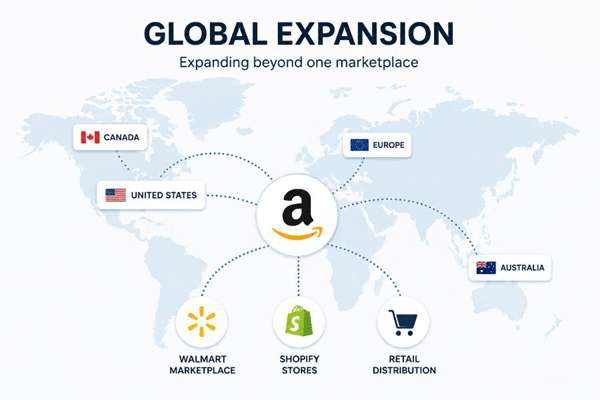
Many Amazon sellers generate the majority of their revenue from a single marketplace, particularly the United States. Aggregators often identify expansion opportunities by taking established brands into additional countries and sales channels, including:
- Canada
- Europe
- Australia
- Walmart Marketplace
- Shopify
- Retail distribution
International and multi-channel expansion can provide a significant source of additional revenue after acquisition.
For instance, a brand generating $5 million in annual U.S. sales could potentially add another $1 million to $1.5 million by entering markets such as Canada, the United Kingdom, and Germany. A broader marketplace presence can also reduce reliance on one sales channel and potentially make the business more appealing to future buyers.
What Do Amazon Aggregators Look For in a Brand?
Not every Amazon business is an attractive acquisition target. Most aggregators look for companies with stable operations, predictable earnings, and identifiable opportunities for future growth. Although revenue remains important, buyers also consider profitability, product diversification, customer sentiment, and the overall maturity of the business.
Private Label Businesses Over Wholesale Models
Private label brands often receive greater interest because they give the owner more control over pricing, branding, product development, and future expansion. Wholesale businesses can certainly be profitable, but dependence on third-party suppliers can create limitations and additional risks for an acquiring company.
Consistent Revenue and Profitability
Revenue is important, but predictable and sustainable earnings are often even more valuable. Aggregators generally prefer businesses with consistent sales patterns, healthy margins, and a demonstrated history of profitability rather than brands whose performance fluctuates significantly.
Product Diversification and SKU Mix
Product concentration can significantly influence acquisition risk. A brand that generates most of its revenue from one SKU may be vulnerable to ranking changes, policy updates, supply disruptions, or increased competition. Aggregators typically prefer brands with revenue spread across several products because a diversified catalog can provide greater stability.
Strong Customer Reviews and Brand Reputation
Strong ratings, positive customer feedback, and an established reputation can make a brand more attractive to buyers. Brands with customer trust already built into the business generally require less post-acquisition work to rebuild their market position.
Operational Stability and Supplier Relationships
Well-organized operations can make the transition to a new owner much easier. Reliable suppliers, clean processes, accurate inventory systems, and documented workflows can reduce integration challenges and operational risk following an acquisition.
Growth Potential Beyond Current Revenue
Aggregators also look beyond a brand’s current financial performance. Potential opportunities may include international expansion, new product launches, additional marketplaces, improved advertising, and other initiatives capable of increasing future earnings and valuation.
| Evaluation Area | What Aggregators Usually Prefer |
| Revenue Pattern | Consistent month-over-month performance |
| Profitability | Healthy and stable margins |
| Business Model | Private label with less supplier dependency |
| Product Portfolio | Diversified SKU structure |
| Customer Reviews | Strong ratings and positive sentiment |
| Operations | Organized systems and reliable suppliers |
| Marketplace Presence | Established demand in scalable niches |
How Amazon Aggregators Value a Brand
Amazon aggregators generally place greater emphasis on profitability than revenue alone when determining the value of a business. A common approach is to apply a valuation multiple to Seller Discretionary Earnings (SDE) or EBITDA, depending on the size, structure, and maturity of the company.
In simple terms, businesses with stronger fundamentals can often command higher multiples because buyers perceive them as lower-risk opportunities with greater potential for continued growth.
A brand with stable profits, organized operations, and predictable performance may attract a stronger offer than a business generating more revenue but struggling with inconsistent margins or operational problems.
How Much Can Sellers Potentially Make?
Many Amazon businesses are sold within the range of roughly 2x to 4x annual SDE. Larger brands with stable operations, diversified product portfolios, and strong customer reviews may potentially achieve higher multiples.
Smaller businesses or brands with inconsistent profitability generally fall toward the lower end of the valuation range.
However, the valuation multiple is only one part of the transaction. The structure of the acquisition can have a major impact on how much the seller actually receives.
Not every acquisition involves receiving the entire purchase price as an upfront cash payment. Some aggregators may structure transactions around earnouts linked to future performance, transition or consulting arrangements, or a combination of upfront consideration and performance-based payments.
As a result, the headline acquisition value and the amount a seller ultimately receives can vary considerably depending on the deal structure.
Sellers with organized operations, strong profitability, and reliable financial records are generally better positioned to negotiate competitive offers and favorable terms. Businesses requiring significant post-acquisition improvements may see those risks reflected in the final valuation.
Why Amazon FBA Aggregators Focus on FBA Brands
Many Amazon aggregators prioritize FBA businesses because they can be easier to integrate, operate, and scale following an acquisition. Amazon already manages important functions such as warehousing, fulfillment, and returns, allowing the acquiring company to focus more heavily on growth rather than rebuilding the logistics infrastructure.
This standardized operating structure is one reason FBA businesses can attract stronger acquisition interest compared with some merchant-fulfilled businesses.
Easier Operational Integration
FBA businesses already operate within Amazon’s fulfillment infrastructure, which can make post-acquisition onboarding faster and more predictable.
Standardized Fulfillment Processes
Amazon manages warehousing, shipping, returns, and much of the customer service process. This means aggregators can avoid rebuilding many of the logistics systems that would otherwise be required after an acquisition.
Greater Focus on Growth Activities
Because much of the fulfillment process is already handled, aggregators can concentrate their resources on higher-impact initiatives such as PPC optimization, listing improvements, international expansion, and new product launches.
Simplified Portfolio Management
Managing a large collection of brands becomes more manageable when those businesses follow similar fulfillment structures and operational processes. Standardization can make it easier for centralized teams to oversee multiple businesses.
Lower Operational Complexity Than FBM Brands
Merchant-fulfilled businesses may rely on different warehouse arrangements, shipping providers, and customer support systems. These differences can introduce additional complexity when an aggregator attempts to integrate several businesses into one portfolio.
FBA Doesn’t Guarantee Acquisition
Being an FBA business does not automatically make a brand attractive to an aggregator. Buyers still evaluate profitability, margins, inventory management, supplier relationships, and future growth opportunities before deciding whether to make an offer.
Top Amazon Aggregator Companies in 2026
Amazon aggregators do not all use the same acquisition strategy. Although their underlying model involves purchasing and scaling ecommerce brands, individual companies may focus on different categories, business sizes, growth opportunities, and operational strategies.
Understanding these differences can help sellers determine which type of aggregator may be the most suitable potential buyer for their business.
High-Volume Acquisition Aggregators
Some aggregators concentrate on acquiring a large number of brands across multiple categories. Their strategy is generally based on creating efficiencies through centralized advertising, supply chain management, inventory planning, and marketplace expansion.
These businesses typically place a strong emphasis on portfolio scale and diversification.
Category-Focused Aggregators
Other aggregators concentrate on specific industries, such as beauty, home products, pet supplies, fitness, or consumer electronics.
Specialization allows these companies to build deeper category expertise and potentially use established supplier relationships, market knowledge, and customer insights to improve acquired brands.
Profitability-Focused Aggregators
Following the acquisition boom of the early 2020s, many aggregators became more focused on profitability and operational efficiency.
These companies tend to be more selective and prioritize businesses with healthy margins, consistent earnings, and sustainable growth opportunities rather than evaluating brands primarily on revenue.
Multi-Channel Expansion Aggregators
Some aggregators focus on taking Amazon brands beyond Amazon itself.
Following an acquisition, they may expand the business through Walmart Marketplace, Shopify, retail partnerships, and international marketplaces. This strategy can diversify revenue and reduce dependence on a single platform.
What This Means for Sellers
The aggregator offering the highest valuation is not necessarily the best acquisition partner.
Different buyers may bring different strengths, including operational expertise, international expansion capabilities, advertising knowledge, or category-specific experience. Understanding an aggregator’s strategy can help sellers evaluate not only the financial offer but also what may happen to their brand after the acquisition.
Examples of Amazon Aggregator Companies
| Company | Focus Area | Notable Approach |
| Thrasio | Large-scale acquisitions | Pioneer of the modern aggregator model |
| Perch | Operational optimization | Focus on sustainable portfolio growth |
| Razor Group | International expansion | Strong global marketplace presence |
| Berlin Brands Group | Multi-channel commerce | Expands brands beyond Amazon |
| Heyday | Brand scaling | Emphasis on marketing and operational improvements |
Should You Sell Your Amazon Business to an Aggregator?
Selling an Amazon business to an aggregator can provide liquidity, reduce the day-to-day responsibilities associated with running the company, and allow founders to realize the value they have built over several years. However, whether selling is the right decision depends on the maturity of the business and the owner’s long-term objectives.
Several established Amazon brands have followed the acquisition route. For example, kitchenware brand Angry Orange was acquired by Thrasio after building significant traction on Amazon. Pet-focused brand Denali Pure also became part of an aggregator portfolio during the period when companies were actively pursuing leading FBA brands.
These examples demonstrate a common acquisition pattern. Aggregators generally are not looking for businesses that need to be completely rebuilt. Instead, they tend to seek brands with demonstrated demand, healthy margins, strong customer reviews, and identifiable opportunities for further growth.
For sellers, one of the most important questions is whether the business still has substantial value that can be created before an exit.
For example, an Amazon brand generating $500,000 in annual SDE at a 3x multiple could be valued at approximately $1.5 million today. If the owner expands internationally, introduces complementary products, and improves profitability over the following 12 to 18 months, both earnings and the potential valuation multiple could increase.
This is why many founders compare acquisition offers with the business’s future growth potential. If significant opportunities remain untapped, continuing to grow the company may create more value than selling immediately. On the other hand, if inventory management, advertising requirements, and operational complexity are becoming barriers to growth, an aggregator may have the resources needed to take the business to its next stage.
Ultimately, the right time to sell is when the acquisition offer reflects the financial strength of the business and aligns with the founder’s personal and professional objectives.
Pros and Cons of Amazon Aggregators
The growth of Amazon aggregators created new exit opportunities throughout the ecommerce industry, but the rapid expansion of the model also introduced operational and financial challenges.
Pros of Amazon Aggregators
1. Creates More Exit Opportunities for Sellers
One of the biggest advantages of the aggregator model is that it gives ecommerce founders more defined exit opportunities. Before aggregators became prominent, Amazon sellers had fewer specialized buyers available and often had to continue operating their businesses independently. Today, dedicated acquisition companies actively seek established Amazon brands, giving founders more options when considering their next move.
2. Provides Access to Specialized Growth Resources
Aggregators can bring dedicated teams with experience in advertising, supply chain management, inventory planning, and marketplace expansion. These specialists may identify growth opportunities and operational improvements that smaller businesses would struggle to pursue with limited internal resources.
3. Reduces Operational Burden for Founders
Managing a growing Amazon business can become increasingly demanding. Inventory forecasting, supplier relationships, PPC management, product launches, and everyday operations can require significant time and expertise. Selling to an aggregator can allow founders to step away from many of these responsibilities while still capturing the financial value created by the business.
Cons of Amazon Aggregators
1. Operational Complexity Increased Rapidly
During the early funding boom, some aggregators prioritized rapid acquisitions over long-term operational sustainability. As portfolios grew to include dozens of brands, managing inventory, suppliers, advertising, and daily operations across multiple companies became increasingly difficult.
2. Integration Became More Difficult at Scale
Purchasing a brand is only the first step. Successfully integrating that business into a larger portfolio presents its own challenges. Many aggregators found that managing several acquisitions simultaneously requires strong systems, standardized workflows, and consistent execution. Without these foundations, post-acquisition performance can decline.
3. Profitability Came Under Pressure
Increasing competition across Amazon marketplaces, combined with higher advertising costs and tighter margins, made profitability more difficult to maintain. Revenue growth alone became insufficient if an acquired business could not generate sustainable returns.
4. The Industry Shifted Toward Sustainable Growth
As a result, the aggregator industry moved beyond its initial rapid-acquisition phase. Many companies now place greater importance on profitability, operational efficiency, sustainable growth, and long-term portfolio management instead of simply increasing the number of businesses they acquire.
Final Takeaway: Where Are Amazon Aggregators Headed in 2026?
The Amazon aggregator market has matured significantly. The companies that remain competitive in 2026 are not necessarily those that acquired the most brands the fastest. They are the companies that developed the systems, processes, and operational discipline needed to successfully grow the businesses they purchased.
For Amazon sellers, this shift is important because it affects which brands attract acquisition interest and how buyers determine their value. Aggregators are no longer evaluating businesses based primarily on revenue growth. Instead, they increasingly look for strong fundamentals, including healthy margins, diversified product portfolios, positive customer reviews, efficient advertising, and systems that allow the business to operate without being completely dependent on its founder.
The brands receiving stronger acquisition interest are also increasingly those capable of expanding beyond one marketplace. A presence across channels such as Walmart, Shopify, and international Amazon marketplaces can demonstrate that a brand’s growth is not dependent entirely on one platform or algorithm.
Whether your objective is to build toward an eventual exit or continue scaling independently, these principles remain valuable. The characteristics that make an Amazon business appealing to an acquirer are often the same characteristics that make it more stable, profitable, and resilient as an independent company.