
Managing an Amazon business has become increasingly challenging for U.S. sellers. Every time you log into Seller Central, you’re greeted with new notifications, inventory updates, advertising metrics, account health warnings, and policy changes that all compete for your attention.
With so many moving parts, even experienced sellers can find it difficult to determine which issues require immediate action and which can wait. To help simplify this process, Amazon introduced Amazon Amelia.
Rather than adding another dashboard or report, Amazon Amelia serves as an AI-powered assistant designed to help sellers understand the information already available in Seller Central. Instead of simply displaying data, it explains what the data means, why changes are happening, and what actions sellers should consider taking.
The introduction of Amazon Amelia marks a significant shift in how Amazon supports businesses operating on its marketplace.
Many sellers don’t struggle because they lack information—they struggle because valuable insights are scattered across multiple reports, policy documents, and support articles. Finding the answer to a simple question often requires searching through several pages before reaching a conclusion. Amazon Amelia aims to remove that complexity.
Instead of digging through reports, sellers can simply ask questions like:
- Why has this product’s sales dropped?
- Is my inventory ready for the holiday shopping season?
- Are there any compliance issues I should address before they become serious?
Rather than leaving sellers to interpret countless reports themselves, Amazon Amelia provides straightforward explanations and actionable recommendations that make decision-making faster and more efficient.
In this guide, we’ll explain what Amazon Amelia is, how it works, its current capabilities and limitations, the latest developments, and how sellers can use it to make smarter business decisions on Amazon.

What Is Amazon Amelia AI?
Amazon Seller Central provides access to a wealth of business data, including sales performance, inventory levels, advertising reports, and operational metrics. However, while this information is valuable, it often doesn’t explain the reasons behind sudden changes or identify which issues deserve immediate attention. Many sellers spend hours moving between reports instead of focusing on growing their business.
Amazon Amelia was created to bridge that gap.
Rather than functioning as a traditional analytics platform, Amelia acts as an intelligent business assistant. It analyzes Seller Central data alongside Amazon’s internal marketplace intelligence to provide meaningful explanations instead of just displaying numbers.
Unlike many third-party tools that primarily identify patterns and correlations, Amazon Amelia is built on Amazon Bedrock. This allows it to understand potential cause-and-effect relationships within your business. Instead of merely reporting that your Best Sellers Rank has declined, Amelia can help identify possible reasons, such as inventory shortages, listing suppression, or increased competition.
This ability to identify likely causes allows sellers to resolve issues much earlier, reducing the time spent investigating problems and minimizing potential revenue loss.
Why Amazon Amelia Stands Out
Prioritizes the Most Important Tasks
Not every notification inside Seller Central carries the same level of importance. Amazon Amelia helps sellers focus on the issues that are most likely to impact revenue rather than treating every alert equally.
For example, if a high-performing ASIN suddenly experiences lower traffic, Amelia may identify that a suppressed keyword is the primary cause instead of seasonal demand changes. This helps sellers solve the real problem instead of wasting time investigating multiple possibilities.
Helps Resolve Operational Issues Faster
Amazon sellers frequently deal with operational challenges such as shipment delays, listing restrictions, Buy Box fluctuations, and fulfillment limitations.
Amazon Amelia connects information from different areas of Seller Central and recommends the most practical solution based on the available data. Instead of applying temporary fixes, sellers can address the underlying issue and improve overall account performance.
Detects Early Warning Signs
Identifying problems before they become major setbacks can make a significant difference in maintaining sales performance.
Amazon Amelia monitors subtle marketplace signals, including unusual return patterns, competitor activity, and changing performance trends. These early insights give sellers the opportunity to make small adjustments—such as updating pricing, running targeted promotions, or modifying advertising campaigns—before larger issues develop.
Delivers More Personalized Insights
As Amazon Amelia continues learning from your business activity, it becomes better at understanding your catalog, seasonal demand patterns, and category-specific behavior.
Instead of relying on generic recommendations, its suggestions gradually become more relevant to your individual business, allowing sellers to make better-informed decisions with greater confidence.
Reduces Daily Workload
One of Amazon Amelia’s greatest strengths is its ability to simplify daily operations.
Running an Amazon business often involves managing inventory, pricing, advertising, marketing campaigns, and account health simultaneously. Amelia helps organize these priorities by highlighting the tasks that deserve immediate attention while leaving strategic business decisions in the hands of the seller.
Overall, Amazon Amelia is much more than a simple AI chatbot. It functions as an intelligent operational assistant that combines marketplace insights with your business performance to help sellers identify problems faster, prioritize more effectively, and spend less time manually reviewing reports.
For businesses operating in highly competitive categories, where advertising costs, inventory challenges, and marketplace competition continue to increase, Amazon Amelia offers valuable support by transforming hours of manual analysis into actionable recommendations delivered within minutes.
What Does Amazon Amelia Mean for Different Types of Sellers?
Although Amazon Amelia offers valuable features, its benefits vary depending on the size and maturity of each seller’s business.
New Sellers
For beginners, Amazon Amelia can significantly reduce the learning curve associated with selling on Amazon.
New sellers often struggle with listing optimization, inventory planning, account policies, and understanding why listings suddenly lose visibility. Instead of searching through lengthy help documents or online forums, sellers can ask Amelia direct questions and receive practical guidance almost instantly.
Whether it’s determining how much inventory to send or understanding why a listing was suppressed, Amazon Amelia simplifies many of the challenges that new sellers commonly face.
Growing Businesses
As businesses expand, managing inventory, advertising campaigns, forecasting, and profit margins becomes increasingly complex.
For growing sellers, Amazon Amelia helps identify trends and opportunities that would otherwise require reviewing multiple reports across Seller Central. While it doesn’t replace advanced planning tools, it reduces the time spent gathering information, allowing sellers to focus more on strategy and business growth.
Large Brands and High-Volume Sellers
Large businesses typically manage hundreds or thousands of SKUs, along with ongoing compliance tasks, catalog maintenance, fulfillment issues, and advertising optimization.
For these sellers, Amazon Amelia’s value lies in its ability to automate repetitive analysis and highlight operational issues before they become expensive problems. As Amazon continues expanding Amelia’s capabilities, it could significantly reduce the amount of manual work required by larger teams.
International Sellers
Although Amazon Amelia is currently focused primarily on U.S. sellers, its future potential extends well beyond a single marketplace.
If Amazon continues expanding language support and localizes the assistant for regional marketplace rules, fulfillment requirements, and country-specific policies, Amelia could become a valuable resource for international sellers operating across multiple Amazon marketplaces.
What Amazon Amelia Can’t Do
Amazon Amelia has generated considerable interest among Amazon sellers, but it’s important to understand that the tool is still evolving. At present, access remains limited, as Amazon has only rolled it out to a selected group of U.S. third-party sellers through a controlled beta program. Many sellers are still waiting for it to become available in their Seller Central accounts.
While Amelia delivers valuable insights, it isn’t designed to replace every tool or workflow sellers currently rely on.
Although it can quickly identify issues and explain potential causes, sellers will still need spreadsheets, advertising platforms, inventory planning systems, and other analytics tools to manage complex business operations. This is especially true for businesses handling large catalogs, parent-child variations, seasonal products, or rapidly changing inventory.
One of Amelia’s biggest strengths is simplifying information that would normally require searching through multiple reports. However, it doesn’t eliminate the need for careful planning or detailed performance analysis. Instead, it helps sellers understand their data more efficiently so they can make informed decisions faster.
Businesses that depend on detailed keyword tracking, advertising metrics, conversion analysis, or long-term performance trends will still require specialized reporting tools. Amelia provides guidance, but it isn’t intended to replace advanced analytics.
Another concern many sellers have is data privacy. Naturally, business owners want to know whether Amazon Amelia learns from their confidential account information.
According to Amazon, the assistant is not trained using individual seller data. Instead, it relies on Amazon’s marketplace intelligence and foundation models to generate recommendations while keeping seller-specific information protected.
Amazon has also shared its long-term vision for Amelia, where the assistant may eventually move beyond providing recommendations and begin completing certain tasks automatically.
However, those autonomous capabilities are still under development.
For now, sellers remain responsible for reviewing recommendations, approving actions, and monitoring business performance. Amelia serves as a decision-support assistant rather than an autonomous business manager.
How Sellers Should Use Amazon Amelia
Amazon Amelia isn’t simply another AI feature added to Seller Central. It has the potential to change how sellers analyze business performance and make operational decisions.
Rather than treating Amelia as a tool that answers questions, sellers should use it to improve planning, reduce inefficiencies, and identify opportunities that might otherwise go unnoticed.
Plan Peak Seasons More Effectively
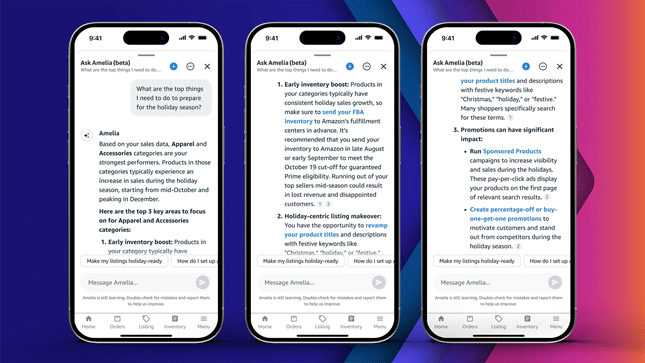
Preparing for major shopping events has always been one of the biggest challenges for Amazon sellers. Demand can shift quickly, shipping timelines may change unexpectedly, and inaccurate forecasts often result in either stock shortages or excessive inventory.
Amazon Amelia helps reduce this uncertainty by analyzing historical sales performance, current marketplace activity, category trends, and fulfillment constraints.
Instead of relying on assumptions, sellers can evaluate multiple demand scenarios and better understand how inventory levels and advertising decisions may affect future performance.
This allows businesses to prepare for peak seasons with greater confidence while reducing the risk of costly inventory mistakes.
Lower Storage Costs Without Sacrificing Sales
Long-term storage fees can gradually reduce profitability without attracting immediate attention.
Many sellers focus on individual product performance without considering how each SKU contributes to the overall health of their catalog.
Amazon Amelia provides a broader perspective by identifying products with slow inventory movement and estimating future holding costs under different demand scenarios.
Rather than recommending that sellers simply remove underperforming products, Amelia helps identify practical strategies such as promotional discounts, product bundles, or gradual inventory reductions that can lower storage costs while maintaining sales performance. By reviewing these recommendations regularly, sellers can improve inventory efficiency and protect overall profitability.
Make Better Advertising Decisions
Advertising performance depends on much more than increasing budgets.
Amazon Amelia helps sellers understand why campaigns perform the way they do by highlighting important performance patterns, identifying potential issues, and surfacing opportunities that deserve attention.
For example, Amelia may reveal that declining conversions are linked to inventory availability, listing quality, pricing changes, or increased competition rather than advertising itself.
These insights allow sellers to make more informed optimization decisions instead of relying solely on trial and error.
Although Amelia provides valuable context, successful advertising still requires strategic planning, continuous optimization, and careful performance monitoring.
Final Thoughts
Amazon Amelia represents an important step toward making Amazon Seller Central more intelligent and easier for sellers to navigate.
Its greatest strength lies in helping sellers quickly understand business performance. Identify the causes behind operational issues, and prioritize the actions that can have the biggest impact on growth.
At the same time, Amazon Amelia is not intended to replace every aspect of running an Amazon business. Advanced keyword research, competitor analysis, profitability tracking, forecasting, and detailed advertising optimization still require specialized tools, experience, and strategic decision-making.
Instead, sellers should view Amazon Amelia as an AI-powered business assistant that simplifies daily operations. And reduces the time spent interpreting reports. By combining its recommendations with sound business strategies and ongoing performance analysis, sellers can make faster decisions. Respond to problems sooner, and build a stronger, more efficient Amazon business over time.