Amazon Sponsored Display ads have consistently proven to be a strong tool for brands aiming to connect with customers throughout their buying journey by VCPM.
In the past, these campaigns mainly operated on a cost-per-click (CPC) basis. However, in 2022, Amazon introduced a new pricing model known as viewable cost-per-mille (VCPM), designed to optimize bidding based on impressions rather than clicks.
This blog will break down what VCPM means and how advertisers can use it effectively to achieve better results.
Decoding VCPM in Sponsored Display Campaigns
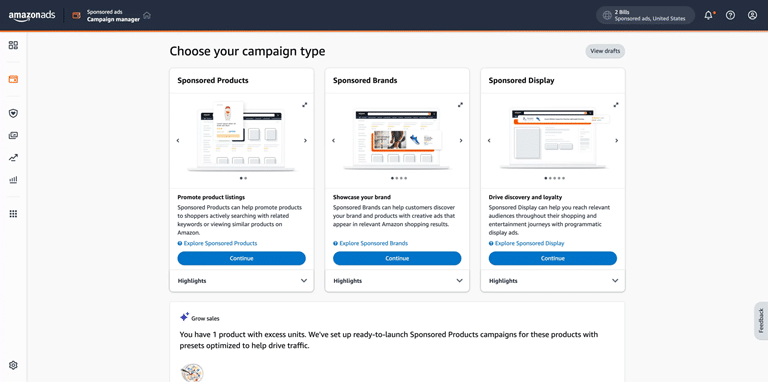
Amazon provides three bid optimization strategies for Sponsored Display campaigns:
- Optimize for reach
- Optimize for page visits
- Optimize for conversions
Each option targets customers at different stages of their shopping journey. “Reach” focuses on awareness, “page visits” targets the consideration phase, and “conversions” addresses shoppers ready to make a purchase.
When you select “optimize for reach,” Amazon uses the VCPM pricing model.
Traditionally, CPC campaigns charge advertisers only when users click on an ad. In contrast, VCPM charges based on every 1,000 viewable impressions, regardless of user interaction. In many ways, it resembles a simplified version of DSP advertising but offers fewer targeting controls.
A “viewable impression” is counted when an ad appears on a user’s screen for at least one second—even if only a portion of the ad is visible.
Who Should Use VCPM Campaigns
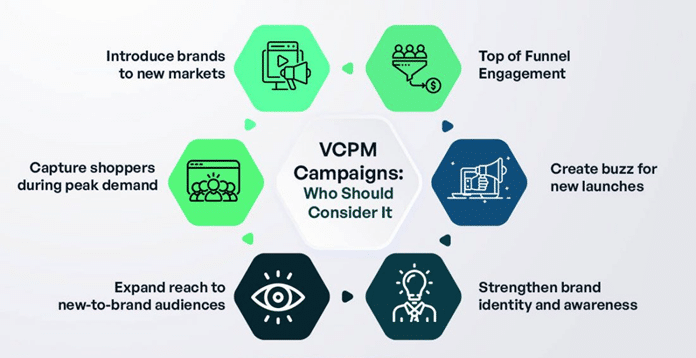
VCPM campaigns are ideal for advertisers aiming to capture attention at the top of the sales funnel. Here are some situations where they work particularly well:
- Launching a new product or brand: These campaigns help create early buzz and awareness.
- Strengthening brand identity: Consistent exposure reinforces your messaging in customers’ minds.
- Reaching new audiences: VCPM enables brands to connect with new-to-brand shoppers both on and off Amazon.
- Promoting seasonal campaigns: Ideal for highlighting limited-time deals or special promotions.
- Entering new markets: Helps introduce your brand to a fresh audience in new regions.
While VCPM campaigns are not designed to drive immediate sales, they are highly effective when combined with other campaign types to build a full-funnel strategy.
CPC vs. VCPM: Key Differences
Amazon advertising mainly relies on two pricing models: CPC and VCPM, each serving different objectives.
CPC (Cost Per Click) charges advertisers when a user clicks on an ad, making it suitable for performance-driven campaigns focused on conversions and sales.
On the other hand, VCPM (Cost Per Thousand Viewable Impressions) charges based on impressions, making it ideal for increasing brand visibility and awareness.
In short, CPC works best for bottom-funnel performance, while VCPM is better suited for top-funnel branding efforts.
How to Create a VCPM Campaign
Setting up a VCPM campaign in Amazon Seller Central is straightforward:
- Log in to your Seller Central account and navigate to Campaign Manager.
- Click on “Create Campaign” and select “Sponsored Display.”
- Fill in all required campaign and ad group details.
- Choose “Optimize for reach” as your bidding strategy.
- Review your setup and click “Launch Campaign.”
Once launched, your campaign will begin delivering impressions to your target audience.
Advantages and Drawbacks of VCPM
Like any advertising approach, VCPM comes with both benefits and limitations.
Advantages
- Wider Audience Reach: VCPM allows your brand message to reach a larger audience, even beyond Amazon.
- Exposure to New Customers: Ads shown off-platform help build awareness and familiarity with new-to-brand audiences, even without immediate clicks.
Drawbacks
- Less Precise Targeting: Since the focus is on impressions, ads may reach less relevant audiences.
- Paying Without Clicks: Advertisers pay for impressions, which makes direct performance tracking harder.
- Higher Costs: Campaigns focused on visibility can become expensive over time.
- Measurement Complexity: It can be difficult to directly link impressions to measurable outcomes.
- Cannibalization Risk: Multiple ads for the same product may compete with each other, affecting performance data.
Cannibalization and Attribution Challenges
Consider a shopper browsing for a product and nearing the final purchase stage. If your VCPM ad appears just before they click “Buy Now,” even briefly, the sale may be attributed to that ad.
This is due to Amazon’s last-touch attribution model, where the final ad interaction receives full credit for the sale.
As a result, VCPM campaigns may appear to drive conversions that actually originated from organic traffic or other ad types. Amazon refers to these as “assisted sales,” as the ad still plays a role in securing the purchase by preventing competitor interference.
To better evaluate performance:
- Focus on Total ROAS (TROAS) instead of standard ROAS.
- Place VCPM campaigns in separate portfolios for clearer tracking.
- Use CPC campaigns for mid- and bottom-funnel stages, while combining VCPM with DSP for awareness.
This structured approach can improve overall performance, including both paid and organic results.
Final Thoughts
Building brand awareness is essential for long-term growth.
VCPM campaigns are powerful for reaching audiences at the awareness stage, but they come with challenges such as broad targeting, higher costs, and attribution complexities. Without proper measurement, they can lead to misleading insights.
That said, VCPM campaigns can deliver strong results when used strategically as part of a full-funnel approach. The key is to balance them with performance-driven campaigns to maximize impact.
This is where SAECOM FBA PRO can support your business. With proven expertise in managing full-funnel Amazon advertising strategies for global brands, the team helps businesses scale effectively and sustainably.
Get in touch today and take your brand’s growth to the next level.