
Imagine a customer clicking “Buy Now,” and within hours, their order is already moving through a highly advanced delivery system designed for speed. That’s the reality of Amazon Logistics.
Over the years, Amazon has heavily invested in building one of the most efficient fulfillment systems in the world.
Today, its logistics network is massive and constantly improving. It controls everything from inventory storage to picking, packing, shipping, and real-time tracking.
For sellers using Fulfillment by Amazon (FBA), this means outsourcing nearly all operational tasks to a powerful system. For Fulfillment by Merchant (FBM) sellers, it sets a high benchmark they must match.
If you’re selling across multiple platforms, efficiency becomes essential. Customers don’t care where the order comes from—they expect speed, accuracy, and reliability every time.
What makes this system stand out is not just fast delivery through Prime, but the entire logistics process. From robotic warehouses to AI-based inventory placement and a vast transport network, Amazon has built a system comparable to global shipping giants.
This logistics engine doesn’t just deliver packages—it predicts demand, reduces costs, and builds customer trust through accurate tracking updates.
What is Amazon Logistics?
Amazon Logistics is the system working behind the scenes to move products quickly from sellers to customers. It connects every stage of the supply chain—from receiving inventory and storing it in warehouses to processing orders and delivering them to customers.
This system enables Amazon’s fast delivery promises. Inventory is strategically placed based on demand forecasts rather than stored randomly. Once an order is placed, fulfillment centers quickly pick and pack items, sortation centers organize shipments, and transportation networks move them efficiently across regions.
By the time a package reaches a local delivery station, drivers prepare it for final delivery while customers track its progress in real time. This transparency builds trust and keeps customers coming back.
Amazon combines its own infrastructure with external partnerships. While it owns warehouses, technology, and much of its transport system, it also works with independent drivers and delivery partners.
For sellers, this creates both opportunity and responsibility. FBA sellers benefit from full-service logistics, while FBM sellers must manage their own operations to match Amazon’s standards.
For those selling across multiple platforms, programs like Multi-Channel Fulfillment and Buy with Prime allow them to extend Amazon’s logistics capabilities beyond its marketplace.
Evolution of Amazon’s Logistics Network
Amazon initially introduced FBA with a simple idea: sellers send products, and Amazon handles storage, shipping, and customer service. This transformed e-commerce by removing the need for sellers to build their own logistics systems.
Over time, Amazon expanded far beyond warehouses and built a global logistics network.
Take Amazon Air as an example. What started with a few leased aircraft has grown into a large cargo fleet with dedicated hubs and long-haul capabilities, enabling faster inventory movement and fewer delays.
At the same time, robotics technology inside fulfillment centers has significantly improved processing speed.
Amazon has also introduced micro-fulfillment centers in urban areas, placing inventory closer to customers and enabling same-day deliveries. This approach reduces delivery times and raises customer expectations.
Another major development is Amazon Warehousing & Distribution (AWD), which allows sellers to store inventory upstream and distribute it not only to FBA but also to other sales channels.
These advancements show how Amazon is evolving into a full-scale logistics provider rather than just a fulfillment service.
Step-by-Step Fulfillment Process
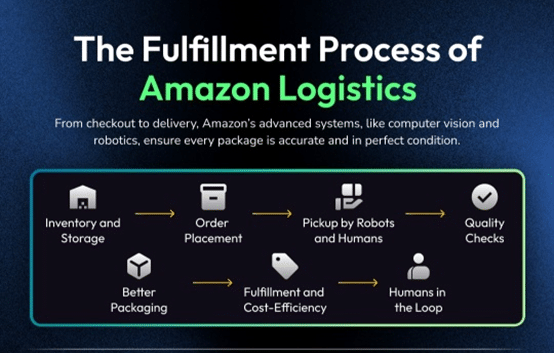
Inventory and Storage
Orders begin long before a customer clicks “buy.” Amazon strategically distributes inventory across its network based on predicted demand, reducing delivery time and cost. Sellers can choose between FBA, FBM, or third-party logistics solutions.
Order Placement
Once an order is placed, Amazon’s system instantly determines the best fulfillment location based on speed, cost, and capacity, ensuring timely delivery.
Picking (Robots and Humans)
Inside warehouses, robots handle heavy lifting and transport, while human workers ensure accuracy and manage exceptions. This collaboration balances speed with precision.
Quality Checks
Products go through automated and manual inspections to ensure correct labeling and condition before packing.
Packaging Optimization
Amazon uses advanced tools to select the most efficient packaging, reducing waste, cutting costs, and improving sustainability.
Outbound Fulfillment
Packed items move through outbound systems that are increasingly automated, improving efficiency and reducing operational costs.
Human Oversight
Despite automation, human workers play a critical role in quality control, system management, and problem-solving.
Fulfillment Models in Amazon Logistics
Fulfillment by Amazon (FBA)
Amazon handles storage, shipping, returns, and customer service. Products gain Prime eligibility, improving visibility and sales.
FBA Onsite (Hybrid)
Sellers store inventory in their own warehouses while using Amazon’s delivery network and technology.
Fulfillment by Merchant (FBM)
Sellers manage their own logistics, offering more control but requiring higher operational efficiency.
Multi-Channel Fulfillment (MCF)
Amazon fulfills orders from other platforms, allowing sellers to maintain a unified inventory system across multiple channels.
Amazon’s Fulfillment Infrastructure
Amazon’s logistics network includes multiple facility types:
- Large fulfillment centers for storage and processing
- Sortation centers for organizing shipments
- Delivery stations for last-mile delivery
- Specialized facilities for unique product categories
- Grocery fulfillment centers for perishable goods
Its delivery fleet includes vans, trucks, cargo planes, and gig drivers, ensuring efficient movement across all stages of delivery.
Delivery Innovations
Amazon continues to experiment with faster delivery methods, including same-day shipping, drones, and autonomous robots.
Its grocery services also integrate into the logistics system, enabling rapid delivery of fresh and frozen products.
Partner Programs and Customer Options
Amazon works with delivery partners through programs that allow small businesses to operate fleets under its brand.
Customers also have flexible delivery options, including lockers, pickup points, and secure in-home delivery services.
Amazon Logistics vs Competitors
Amazon now competes directly with major shipping companies by handling a significant portion of deliveries itself.
Its advantage lies in combining logistics, retail, and technology into a single ecosystem, creating a seamless experience for both sellers and customers.
Globally, it faces competition from regional carriers and logistics platforms, but its integrated approach continues to set it apart.
The Future of Amazon Logistics
Amazon is expanding further into freight services and large-scale logistics operations. Investments in air cargo, trucking, and warehousing indicate long-term growth in this sector.
There is also potential for Amazon Logistics to evolve into a standalone business, offering services beyond its marketplace.
For sellers, logistics costs remain a key factor. While efficiencies are improving, managing fees, inventory, and operations is essential to maintaining profitability.
Final Thoughts
Amazon Logistics has become a global benchmark for speed and efficiency in e-commerce.
For sellers, it provides access to a powerful infrastructure that simplifies operations and improves delivery performance.
However, relying on Amazon comes with trade-offs, including costs and reduced control. Success depends on balancing these factors while leveraging the system effectively.