
Whether you sell products on Amazon or shop on the platform, keeping track of product prices can make a significant difference. The best Amazon price trackers make this process easier by helping you monitor price changes without having to check product listings manually.
For Amazon sellers, a reliable price tracker can provide useful insights into pricing patterns, competitor behavior, and market fluctuations. These insights can help sellers identify opportunities to improve their pricing strategies, protect profit margins, and remain competitive.
Let’s take a closer look at some of the most useful Amazon price trackers and how they can help you make smarter pricing decisions.

What Are Amazon Price Trackers?
Amazon price trackers are tools or services that monitor product prices on Amazon over a period of time.
Most of these tools allow users to select products they want to follow and create alerts for specific price points. When the price of a tracked product changes or falls below a chosen amount, the tracker can notify the user through email, a browser notification, or a mobile application.
For sellers, Amazon price trackers can also be used to monitor competitor pricing, identify pricing patterns, understand seasonal changes, and adjust their own product prices based on changing market conditions.
Some advanced price tracking tools provide additional capabilities, including historical price charts, competitor comparisons, marketplace monitoring, and tracking across multiple Amazon regions.
How Do Amazon Price Trackers Work?
Amazon price trackers continuously monitor product listings to identify changes in pricing.
To begin, users generally select the products they want to track and add them to their monitoring list. Depending on the platform, this may involve entering an Amazon product URL, using an integrated search feature, or installing a browser extension.
After a product has been added, the tracker periodically checks its current price. Depending on the tool, this information may be collected directly from Amazon’s website or through available data integrations and APIs.
Some trackers can also monitor different sellers offering the same product. This allows users to compare prices and understand how sellers are positioning their products within the marketplace.
When a product reaches a price level specified by the user, the tracker can send an alert. These notifications may arrive through email, push notifications, a mobile app, or the tracker’s website.
Many price tracking platforms also maintain historical pricing records. Reviewing this information allows users to understand how a product’s price has changed over time and determine whether the current price represents a good opportunity.
Overall, Amazon price trackers simplify the process of following price movements and provide useful historical information for making better purchasing and pricing decisions.
Why Should Amazon Sellers Use Price Trackers?
Amazon sellers operate in a highly competitive marketplace, making it important to understand how competing sellers price similar products. Price trackers allow sellers to monitor competitor prices and observe pricing changes without constantly checking individual product pages.
By following competitor pricing, sellers can identify when competitors lower or increase their prices and make informed decisions about their own pricing strategy. This can help sellers remain competitive while avoiding unnecessary price reductions that could negatively affect margins.
Price trackers can also support profitability analysis by revealing pricing patterns and historical market behavior. Instead of relying only on the current product price, sellers can review previous trends to determine when demand may be stronger or weaker.
For instance, historical price information can help identify periods when customers are more willing to pay higher prices, allowing sellers to evaluate potential opportunities to improve margins. During slower periods, sellers may use similar data to determine whether a strategic price reduction could help stimulate demand and support sales.
Timing is another important part of Amazon pricing. Promotions and discounts can be more effective when they are introduced at the right time. Price tracking data can help sellers observe competitor activity and market movements before deciding when to launch an offer.
This can be particularly useful around holidays, major shopping events, seasonal demand periods, and other occasions when customer purchasing behavior may change.
Manually monitoring prices across multiple Amazon listings can also consume a considerable amount of time. Price tracking tools automate much of this work by monitoring products and providing updates automatically.
Instead of repeatedly checking Amazon pages, sellers can receive notifications and review pricing information from a centralized dashboard. This saves time and allows sellers to focus on other areas of their businesses, such as inventory management, marketing, product development, and customer service.
Factors to Consider When Choosing a Price Tracker
Before selecting an Amazon price tracking tool, consider the following factors.
1. Features and Functionality
The available features should match your specific tracking requirements. Start by evaluating how many products the tool allows you to monitor and whether it supports individual product tracking or larger groups of products.
Price history is another valuable feature because it allows you to examine previous pricing patterns and better understand market behavior.
You should also check whether the platform provides customizable alerts so you can receive notifications when a product reaches a particular price level. Other useful features may include competitor monitoring, price comparison tools, browser extensions, mobile applications, and integrations with other e-commerce platforms.
Reviewing these capabilities carefully can help you select a tracker that fits your business needs and pricing objectives.
2. User Interface and Ease of Use
A price tracking tool should be simple to understand and convenient to use. An intuitive interface can make it much easier to find product information, configure alerts, and review pricing data.
Look for a platform that offers clear navigation and straightforward controls. Customization options can also be useful when you want to organize the dashboard around your preferred workflow.
It is also worth considering whether the tool works effectively across different devices. Easy access from a desktop, tablet, or smartphone can make price monitoring more convenient, particularly for sellers who need to review market changes while away from their main workspace.
3. Pricing and Scalability
The cost of a price tracker is another important factor to evaluate. Depending on the platform, pricing may be based on a free model, subscription plan, one-time payment, or a combination of different packages.
Think about your current requirements as well as your future needs. A tool that works well for a small product catalog may become less practical if your inventory expands significantly.
Look for pricing plans that allow you to scale your usage as your business grows without creating unexpectedly high costs. A flexible pricing structure can make the tool more useful over the long term.
4. Customer Support and Training
Customer support can have a major impact on your experience with a price tracking tool, especially when you are learning how to use advanced features.
Before choosing a platform, check which support options are available. These may include email assistance, live chat, phone support, tutorials, help centers, documentation, or training resources.
It is also useful to evaluate how quickly support teams respond to questions and technical issues.
A provider with accessible support and helpful learning resources can make it easier to set up tracking, understand reports, and get the most value from the platform.
Best Five Amazon Price Trackers for Amazon
Amazon price trackers can be valuable for both shoppers and sellers who need a convenient way to monitor price movements and identify pricing trends.
Each tracking platform offers different features, making some tools more suitable for shoppers while others may provide useful information for sellers and market researchers.
Here are five popular Amazon price tracking tools worth considering.
1. CamelCamelCamel
CamelCamelCamel is one of the most established and straightforward Amazon price tracking tools.
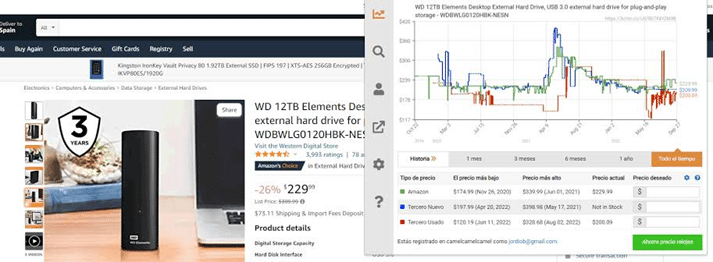
It provides historical pricing charts for a wide range of Amazon products, allowing users to see how prices have changed over time. This makes it easier to identify previous price highs, lows, and general pricing patterns.
Users can also create price drop alerts by setting a target price for products they want to monitor. When the product reaches that price, the platform can notify them.
CamelCamelCamel also offers the Camelizer browser extension, which allows users to view price history information directly while browsing Amazon product pages.
2. Honey
Honey combines price monitoring with other shopping-related savings features.
In addition to tracking prices, Honey can automatically search for applicable coupon codes during checkout. It also provides price history information that can help users determine whether a current price is competitive.
Honey can send notifications when monitored products experience price changes, making it easier to identify potential savings opportunities.
Its browser extension works across multiple browsers and platforms, making it a convenient option for shoppers who want both price tracking and automated coupon discovery in one tool.
3. Keepa
Keepa is another widely used Amazon price tracking platform that integrates closely with Amazon product pages.
Through its browser extension, Keepa displays detailed price history charts directly on product listings. Users can examine historical pricing information and review how prices have changed over different periods.
The platform also provides options for monitoring pricing across different marketplaces and product variations. Alerts can be configured to notify users about price drops and other changes.
Keepa also includes information about deals and pricing movements, while its mobile functionality makes it possible to monitor products while on the go.
4. Waatcher
Waatcher goes beyond basic price monitoring by offering an automated purchasing feature.
Instead of simply informing users when a product reaches a specific price, the service can be configured to automatically place an order once the desired price condition is met.
This can be particularly useful for products that frequently sell out or experience temporary discounts. Rather than constantly checking the listing yourself, the tool can monitor the product and act according to your predefined requirements.
Users generally need to connect their Amazon account and configure the conditions under which an order should be placed.
5. Earny
Earny takes a slightly different approach by concentrating on price changes after a purchase has already been made.
The platform monitors products users have previously purchased and looks for subsequent price reductions. When eligible price protection or adjustment opportunities are identified, Earny can assist users in seeking the price difference.
It can connect with email accounts to identify purchase receipts and may work with retailer policies or eligible credit card price protection programs.
For shoppers, this can be useful when they want additional protection against paying more for an item that becomes cheaper shortly after purchase.
Each of these Amazon price tracking tools serves a different purpose. Some focus primarily on historical price data, while others emphasize alerts, discounts, or post-purchase price protection.
Tips to Effectively Use Amazon Price Trackers
Amazon price tracking tools can become much more valuable when used strategically. Rather than relying only on basic notifications, sellers and shoppers can use their features to identify meaningful pricing opportunities.
1. Set Alerts for Price Drops
One of the simplest ways to benefit from an Amazon price tracker is to create alerts for important price thresholds.
Once an alert is configured, you can receive a notification when the price reaches your desired level. This reduces the need to repeatedly visit product pages and helps you react quickly when a suitable price appears.
For sellers, alerts can also be useful for observing competitor price reductions and keeping track of important market changes.
2. Compare Prices Across Different Channels
Use price tracking tools to compare prices across different sellers, marketplaces, and shopping channels where the feature is available.
This can provide a broader view of how the same product is being priced and help you determine whether a particular offer is competitive.
For sellers, comparing prices across channels can also provide additional market context when evaluating their own pricing strategy.
3. Create Custom Filters for Targeted Results
Custom filters can make large amounts of pricing information easier to manage.
Depending on the tracker, you may be able to narrow results based on factors such as product price, brand, seller, category, or ratings.
Using targeted filters allows you to focus on products that are most relevant to your needs instead of sorting through unnecessary results. This can make price research faster and more efficient.
By using alerts, comparisons, and filtering features effectively, you can get more practical value from Amazon price tracking tools while spending less time monitoring product pages manually.
Final Thoughts
Amazon price trackers can be useful tools for sellers and shoppers who want greater visibility into product pricing and market movements.
Platforms such as CamelCamelCamel, Honey, Keepa, Waatcher, and Earny provide different approaches to monitoring prices, from historical price charts and automated alerts to purchasing automation and post-purchase price tracking.
For Amazon sellers, these tools can provide valuable competitive insights, support pricing decisions, and help identify changes in the marketplace. Shoppers can make it easier to recognize discounts and determine when a product may be available at a more favorable price.
For a broader view of your Amazon business performance, combining price tracking with profit and fee calculations can help you understand your actual earnings per unit and make more informed pricing decisions.